

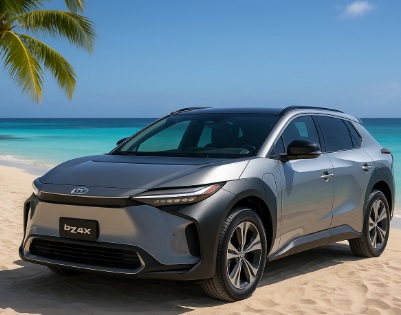
Toyota bZ4X (MY 2025)

Toyota’s first purpose-built battery-electric model is a mid-size SUV on the e-TNGA platform. It measures 4.69 m in length and 1.86 m in width, rides on a generous 2.85 m wheelbase and offers about 452 litres of luggage space behind the second row. A 71.4 kWh battery powers either a 204 hp single-motor front-drive layout or a 218 hp dual-motor AWD-i version with X-Mode. The official WLTP range is up to 516 km (FWD) or around 470 km (AWD), and a 10–80 % fast-charge takes roughly 30 minutes at a peak of 150 kW.
Strengths
What works well | Why it matters |
|---|
Extensive battery warranty | Capacity is guaranteed above 70 % for ten years or one million kilometres when the annual EV health check is carried out. |
Improved winter efficiency | A heat-pump conditioning system introduced for the current model year raises cold-weather range and sustains higher charging speeds. |
Full Safety Sense 3.0 package | Standard equipment includes adaptive cruise with stop-and-go, lane-trace assist and automatic emergency braking with cyclist and pedestrian detection. |
Capable AWD-i system | The dedicated rear motor and selectable X-Mode provide secure traction on snow, gravel and steep descents without the weight of a driveshaft. |
Spacious, flat-floor cabin | The long wheelbase delivers generous rear-seat leg-room, and cargo space rivals many combustion-engine crossovers. |
Low routine maintenance | Three years of scheduled servicing are included, and wear items are limited largely to tyres, brake fluid and cabin filters. |
Weaknesses
Possible drawback | Details |
|---|
Range lags on motorways | Real-world testing shows 330–370 km at motorway speeds and average consumption close to 19 kWh/100 km. |
Fast-charging plateau | Although the peak is 150 kW, charge power tapers quickly after about 40 % state of charge; a 10–80 % stop often takes 35–40 minutes. |
Auxiliary-battery drain | Some owners have experienced 12-volt battery discharge when connected-services apps keep the vehicle awake; software patches help, but a replacement battery is sometimes required. |
Early wheel-bolt recall | Initial production needed new hub collars and bolts after reports of wheel loosening; confirm that the fix is recorded. |
Smaller boot and no frunk | At 452 litres the luggage area trails key rivals such as the Ioniq 5 and Model Y, and there is no front storage compartment. |
6.6 kW AC charger on older FWD cars | Versions built before the 2024 update need more than ten hours for a full home charge; the latest models gain an 11 kW onboard unit on higher trims. |
Typical maintenance and repair costs
Item | Parts | Labour | Indicative total |
|---|
12 V battery replacement | €180 – 220 | €30 | €210 – 250 |
Brake pads (axle) | €90 – 120 | €60 – 100 | €150 – 220 |
Discs + pads (axle) | €240 – 300 | €90 – 135 | €330 – 435 |
High-voltage battery (out of warranty) | €8 000 – 10 000 | €600 | €8 600 – 10 600 |
Annual EV health check | – | ~€120 | €120 |
Price guide (Italy, on-the-road)
Version | List price | Typical promotion |
|---|
bZ4X 2WD Pure | €41 400 | ~€32 400 with current incentives |
bZ4X 2WD Lounge | €46 500 | ~€38 500 |
bZ4X AWD-i Lounge | €58 000 | ~€50 000 |
Nearly-new (MY 24-25) | – | from ~€35 000 |
Verdict
The bZ4X blends Toyota build quality, a decade-long battery guarantee and a complete ADAS suite in a family-friendly package. Recent software and heat-pump upgrades improve cold-weather performance, yet motorway range and rapid-charge speeds still trail the class leaders, and owners should ensure early recall work and auxiliary-battery updates have been completed. If most journeys stay within 300 km and home charging is available, the bZ4X offers a calm, low-maintenance introduction to electric driving; frequent long-distance travellers or rapid-charging regulars may prefer an EV with a flatter charging curve.