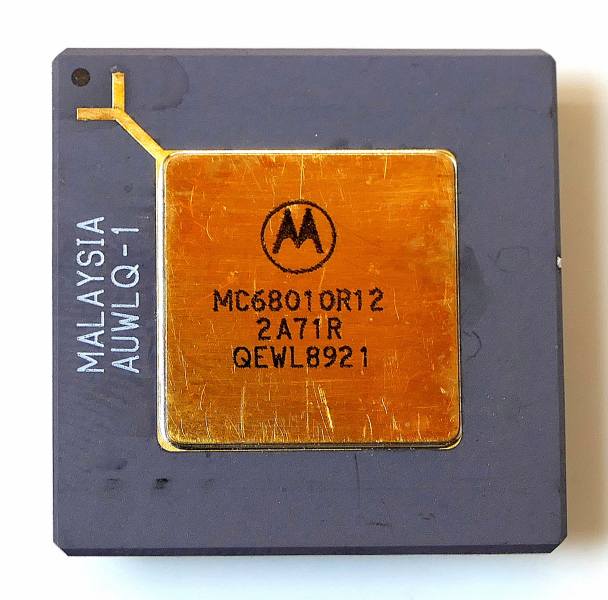
Motorola MC68010 – 16-bit microprocessor with 32-bit registers in the 68000 family, with system and virtual-memory support
Definition
The MC68010 is a microprocessor in the 68000 family from Motorola, built using VLSI technology. It is a CPU with a 16-bit class data bus and 32-bit internal registers, intended for systems that require a linear memory model, a rich instruction set, and more “machine-level” features (operating system support and memory-management support) than the original 68000.
In practice, the 68010 preserves family compatibility while introducing improvements aimed at making execution more robust in environments with traps, exceptions, and more structured memory handling.

Architecture and registers: 17 × 32-bit data and address registers
The MC68010 exposes a programming model based on 32-bit registers:
Practically, wide registers and a clear separation between “data” and “address” registers reduce memory traffic and improve efficiency for pointers, stack handling, and data structures.
Addressing: up to a 16 MB direct range
The CPU supports a direct addressing range up to 16 MB. This enables:
Larger memory maps for RAM, ROM, peripherals, and framebuffers.
Natural use of memory-mapped I/O, simplifying the software model (devices appear as memory addresses).
Virtual memory and “machine support”
Among the distinguishing points of the 68010 is support for more advanced systems:
Practically, the CPU provides behavior better suited to handling exceptions, traps, and execution contexts systematically, reducing workarounds and the “fragility” common in simpler systems.
Instruction set: 57 instruction types, 14 addressing modes, 5 main data types
The 68010 is characterized by a rich and versatile ISA:
57 instruction types (broad coverage of arithmetic, logic, control-flow, and memory operations).
14 addressing modes (immediate, direct, indirect, indexed, relative, etc.), useful for compilers and optimized assembly.
Operations on five main data types, providing consistent handling of byte/word/long and commonly used 68k formats.
The practical result is strong flexibility: often fewer instructions are needed to express an operation, benefiting both performance and code size.
High-performance looping: a dedicated instruction
A cited feature is a high-performance looping instruction, designed to reduce overhead in tight loops:
Fewer branches and software-managed counter updates.
Better execution-flow predictability in repetitive routines (copy, fill, buffer processing).
Sketch of the most important connections
                 system bus (address/data/control)
        ┌──────────────────────────────────────────────────────────┐
        │             memory and memory-mapped I/O                 │
        │   RAM, ROM, peripherals, timers, serial, video, etc.     │
        └───────────────────────────────┬──────────────────────────┘
                                        │
                                        ▼
                           ┌─────────────────────────────┐
                           │        Motorola MC68010      │
                           │  16-bit CPU, 32-bit registers│
                           │  up to 16 MB addressing      │
                           │  “machine/VM” support        │
                           └─────────────┬───────────────┘
                                         │
                                         ├────────► RAM/ROM (code and data)
                                         └────────► memory-mapped I/O (peripherals)
Table 1 – Identification data and specifications (English)
| Characteristic | Indicative value |
|---|
| Device | Motorola MC68010 |
| Family | 68000 |
| Technology | VLSI |
| Class | 16-bit microprocessor with 32-bit registers |
| Registers | 17 × 32-bit data/address registers (architectural context) |
| Addressing | Up to 16 MB (direct addressing range) |
| I/O | Memory-mapped I/O |
| Instructions | 57 instruction types |
| Addressing modes | 14 modes |
| Data types | Operations on five main data types |
| System support | Virtual memory / machine support |
| Looping | High-performance looping instruction |
Table 2 – Operational and design considerations (English)
| Aspect | Practical meaning |
|---|
| 32-bit registers | More natural pointers and long operations; fewer memory accesses than “narrower” models |
| 16 MB direct space | Larger maps for RAM/ROM/peripherals; suitable for complex systems |
| VM/machine support | Better suited to OS and exception/context handling; typically paired with system logic/MMU |
| 57 instruction types | Rich ISA: often fewer instructions for the same result, improving performance and code density |
| 14 addressing modes | High flexibility for compilers and assembly; optimized data movement |
| Memory-mapped I/O | Uniform model: devices appear as memory, simplifying drivers and the system map |
| Dedicated looping | Reduces overhead in tight loops (buffer routines, copy, initialization) |



 Motorola MC6810R12