

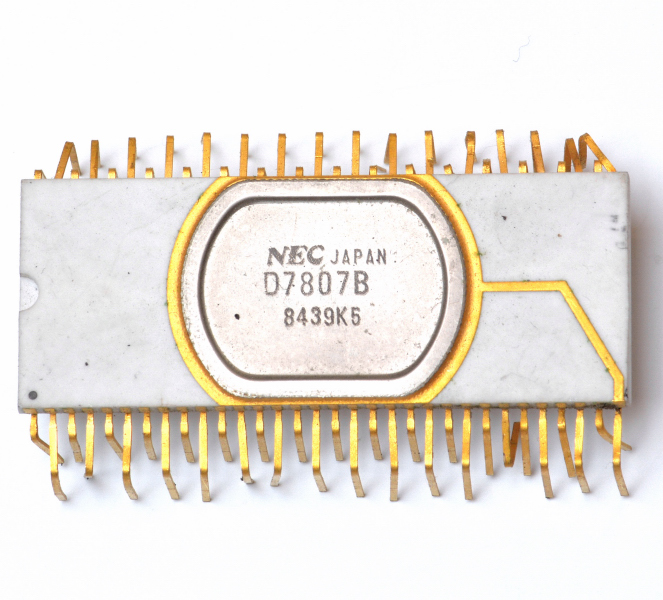
NEC D7807 (µPD7807 / D7807B)
Definition
The NEC D7807 (often also referred to as µPD7807 or D7807B, depending on the commercial variant) is an 8-BIT single-chip microcomputer/microcontroller in the µCOM-87 / µPD7800 family, designed to integrate in one device the CPU, a certain amount of on-chip ROM/RAM (variant-dependent), and a set of basic peripherals ( I/O ports, timers, interrupt logic).
In practice, it is intended for late-1970s/1980s embedded control designs, minimizing external logic: you connect power, clock, reset, and a small number of I/O lines, and the device handles firmware execution and timing.

Historical and family positioning
The D7807 belongs to a generation of NEC devices which, by the end of the 1970s, introduced an 8-bit “system-oriented” architecture (µCOM-87) featuring a relatively rich instruction set and a classic microcomputer-style memory organization—useful for applications with structured firmware (control logic, simple protocols, keypad/display handling, small real-time loops).
Functional architecture (what is inside and what it does)
Conceptually, a D7807 can be seen as a minimal integrated system:
8-BIT CPU: executes firmware and manages registers, ALU operations, branches, and interrupts.
On-chip memories: many configurations include ROM (program) and RAM (data); the exact amount depends on the sub-model (mask ROM, development variants, etc.).
I/O ports: digital lines to read inputs (keys, ON/OFF sensors) and drive outputs (relays, LEDs, control signals).
Timers/counters: provide delays, a system time-base, periodic events, and basic synchronizations.
Interrupt controller: enables reacting to external or internal events (timers, dedicated pins), improving responsiveness versus pure polling.
The practical benefit is fewer components: in many typical designs you only need the chip, a crystal/oscillator, a few passives, and the interface to the external world.
Memory and address map (system view)
In architectures of this class, firmware resides in ROM and uses RAM for variables, stack, and buffers. Depending on the variant and board design:
you can stay fully on-chip (small firmware, limited I/O),
or allow expansion (external memory/peripherals) for larger applications, using the D7807 as the central controller and sequencer.
Operationally, the designer scales the system by choosing the appropriate chip variant and deciding how much functionality to delegate to external devices.
Typical uses (practical)
The D7807 fits scenarios where logic and timing are needed, but high compute power is not:
Consumer appliances and equipment control (sequences, keypads, indicators).
Small industrial controls (interlocks, digital sensors, simple actuators).
Basic human–machine interfaces (keys, segment displays, beep, LEDs).
Programmable “glue logic” where hardwired logic would be too rigid.
Sketch of the most important connections
┌──────────────────────────────┐
│ POWER │
│ VDD / VSS + filtering │
└──────────────┬───────────────┘
│
▼
┌──────────────────┐
│ NEC D7807 │
│ (µPD7807 / 8-BIT)│
│ CPU + ROM/RAM │
│ I/O + TIMER + INT│
└───────┬──────────┘
│
├────────► I/O ports → sensors / keys / relays / LEDs
│
├────────► Clock (crystal/oscillator) + RESET
│
└────────► (opt.) expansions → external memory / peripherals
Table 1 – Identification data and specifications (English)
| Characteristic | Typical value |
|---|
| Device | NEC D7807 (variants: µPD7807, D7807B) |
| Class | 8-BIT single-chip microcomputer/microcontroller |
| Family | µCOM-87 / µPD7800 |
| Integration | CPU + (typically) ROM/RAM + I/O ports + timers + interrupts |
| Memories | On-chip sizes vary by version; expansion may be possible depending on design |
| Use | Embedded control, sequencing, timing, digital I/O |
| Package | Variant-dependent (depends on sub-model and market) |
Table 2 – Operational and design aspects (English)
| Aspect | Practical meaning |
|---|
| Firmware in ROM | Product behavior is defined by software stored in the device |
| Time-base via TIMER | Delays, periodic events, and synchronization without dedicated external logic |
| Interrupts | Improves responsiveness to events versus polling-only designs |
| Integrated I/O | Direct connection to simple sensors/actuators with few external parts |
| Scalability | From “all on-chip” solutions to designs with external expansions (if supported) |
| Main advantage | Reduced BOM and simpler board versus CPU + separate peripheral chips |