

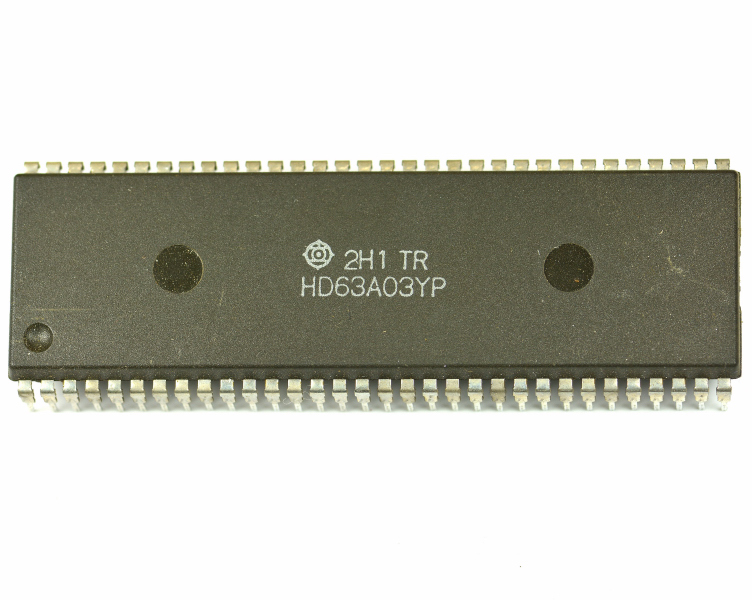
Hitachi HD63A03YP
Definition
The Hitachi HD63A03YP is an 8-BIT microcontroller/microprocessor built in CMOS technology, belonging to the HD63A03 line (a derivative of the HD6301/HD6303 family). It is designed to provide a compact architecture suited to embedded and control systems, with an important feature: it is instruction set compatible with HD6301V1.
In system-level terms, the device is commonly described as suitable for systems with an address space up to 64K (typically a 64 KB memory map on a 16-bit address bus), with 256 BYTE of on-chip RAM and a set of peripherals useful for I/O and timing.

CMOS technology and practical motivations
The CMOS implementation is relevant because, in general, it provides tangible benefits compared with older process technologies:
Lower power consumption for the same workload.
Easier thermal management and better robustness in compact equipment.
Better alignment with reliability requirements in continuous-control systems.
Instruction set compatibility with HD6301V1 (what it really means)
Saying the HD63A03YP is instruction set compatible with HD6301V1 means software (object/assembly) written for the HD6301V1 family can be migrated with reduced impact, because:
The core instructions and the programming model remain consistent.
Control sequences, I/O handling, and timing logic built around the family’s typical instruction patterns can be reused.
In practice, this compatibility was very useful for firmware reuse, maintenance of installed bases, and project migration across variants of the same family.
Memory: up to 64K address space and 256 BYTE internal RAM
From a system point of view, the HD63A03YP fits a classic 16-bit memory map (up to 64K), where you can combine:
Firmware and data residing in external memories (ROM/EPROM/system ROM, external RAM), depending on the board architecture.
Temporary data and variables in 256 BYTE of internal RAM, useful for stack, small buffers, and latency-critical variables.
This scheme supports both minimal configurations (little external logic) and broader configurations with external memory/peripherals memory-mapped into the address space.
Integrated I/O and peripherals (typical functional profile)
Commonly associated features include:
24 PARALLEL I/O pins.
A port with PARALLEL HANDSHAKE capability (often described as Port 6).
Programmable TIMER blocks (some descriptions mention a 16-BIT TIMER and an 8-BIT reloadable timer).
A SERIAL COMMUNICATION INTERFACE (SCI) for serial communications.
MEMORY READY signals, useful to interface slower memories/peripherals without violating bus timing.
Overall, the combination of parallel I/O, handshake, timers, and serial makes it suitable for control, simple acquisition, protocol handling, and interfacing external devices.
Sketch of the most important connections
┌──────────────────────────────┐
│ SYSTEM / BOARD │
│ EXTERNAL MEMORY + PERIPHERALS │
└──────────────┬───────────────┘
│ BUS (up to 64K) + READY signals
▼
┌──────────────────┐
│ HITACHI HD63A03YP│
│ 8-BIT CPU (CMOS) │
│ 256 BYTE RAM │
│ 24 I/O + TIMER │
│ SCI + HANDSHAKE │
└───────┬──────────┘
│
├────────► Parallel I/O → sensors / latches / drivers / logic
│
├────────► HANDSHAKE → synchronous peripherals / dedicated interfaces
│
└────────► SCI → serial (peripherals / debug / communication)
Table 1 – Identification data and specifications (English)
| Characteristic | Typical value |
|---|
| Device | Hitachi HD63A03YP |
| Class | 8-BIT microcontroller/microprocessor |
| Technology | CMOS |
| Compatibility | Instruction set compatible with HD6301V1 |
| Memory space | Up to 64K (typical 16-bit address map) |
| Internal RAM | 256 BYTE |
| Parallel I/O | 24 pins |
| Integrated interfaces | SCI, HANDSHAKE port, TIMER, MEMORY READY signals |
Table 2 – Operational and design aspects (English)
| Aspect | Practical meaning |
|---|
| Firmware compatibility | Reuse of code and control flows developed for HD6301V1 |
| Internal RAM | Latency-critical variables, stack, and small buffers |
| MEMORY READY | Improves interfacing with slower memories/peripherals |
| I/O + handshake | Direct connection to external logic and synchronous peripherals |
| Timers | Time-base, sequencing, measurements/delays without dedicated external logic |
| Typical use | Embedded control, I/O, simple protocols, parallel/serial interfaces |
RAM 256 bytes
24 Parallel I/O Pins
Parallel Handshake Interface Port 6
Darligton transistor Drive
16 bit Programmable Timer
8 bit Reloadable Timer
Serial Communication Interface SCSI
Memory Ready