

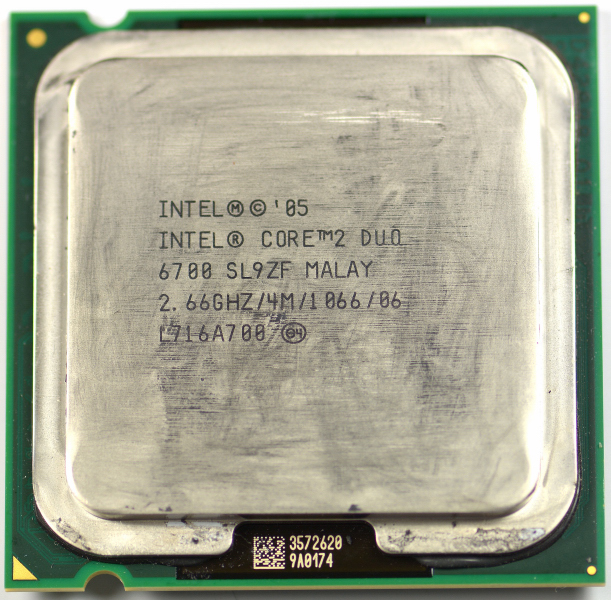
Intel Core 2 Duo E6700
The Core 2 Duo E6700 (name: E6700) is a dual-core CPU by Intel designed for desktop systems, aiming to balance strong single-thread performance, good energy efficiency, and compatibility with Front Side Bus platforms. The processor runs at 2.66 GHZ, integrates 4 MB of L2 cache, and uses a 1066 MHZ FSB, with 64-bit instruction support.
From a design standpoint, the combination of clock speed, large L2 cache, and a 1066 MHZ bus is intended to reduce perceived latency in common applications and sustain multitasking workloads, while keeping a manageable thermal profile (TDP 65 W) for standard desktop systems.

Name and positioning: E6700
The E6700 designation identifies a specific model in the Core 2 Duo family, typically targeted at:
general-purpose desktops and entry-level workstations
workloads where responsiveness and stable performance matter
FSB-based chipsets/memory configurations, where cache and bus bandwidth strongly influence real behavior
Frequency: 2.66 GHZ and practical behavior
The 2.66 GHZ frequency defines the baseline performance profile. In practice:
on light and interactive workloads, responsiveness is strongly tied to frequency and cache latency
on moderate multi-thread workloads, the dual-core design helps distribute processes and keep multitasking fluid
overall results also depend on the chipset, RAM, and power settings (VID)
L2 cache: 4 MB and performance impact
The 4 MB L2 cache reduces dependence on system RAM for medium working sets and repetitive access patterns. In practice:
it improves performance consistency in real applications (browsing, office, productivity tools)
it reduces penalties from main-memory accesses when datasets are not too large
it also helps on branch-heavy code, where instruction/data reuse is frequent
FSB: 1066 MHZ and platform dependency
The 1066 MHZ Front Side Bus is the channel between the CPU and the chipset/memory. Operationally:
it determines how much bandwidth is available to RAM and I/O through the northbridge
it can become a constraint if the platform is unbalanced (slow RAM, limited chipset)
a large L2 cache mitigates some pressure on the FSB, but does not eliminate it
Instruction set: 64-bit
64-bit support enables:
running 64-bit operating systems and applications
addressing a larger memory space (useful with more RAM and modern workloads)
in practice, longer platform longevity versus 32-bit-only solutions
Technology and electrical parameters: 65 NM, VID, 65 W TDP
Process: 65 NM
The 65 NM process aligns with a generation targeting strong clocks with relatively controlled desktop power.
VID voltage range: 0.8500 V – 1.5 V
The VID range indicates the nominal voltage window managed by the platform for this model. In practice:
TDP: 65 W
A 65 W TDP places the CPU in a class compatible with standard desktop cooling solutions, with a balanced performance/thermal profile.
Package and die: size and density
Package size: 37.5 mm × 37.5 mm
A package of this size is typical for socketed desktop processors of the era, with implications for mechanical retention and thermal contact to the heatsink.
Processing die size: 143 mm3
The provided die value (143 mm3) represents the physical size of the processing silicon. In practice, size and density influence localized heat flux and thermal distribution.
Transistors: 291 million
A count of 291 million transistors indicates an integration level appropriate for two cores and a substantial shared L2 cache.
Sketch of the most important connections
1066 MHZ FSB + chipset (memory and I/O)
┌──────────────────────────────────────────────────────────┐
│ northbridge / chipset + RAM + I/O controllers │
│ RAM, storage, peripherals, system buses │
└───────────────────────────────┬──────────────────────────┘
│
▼
┌─────────────────────────────┐
│ Intel Core 2 Duo E6700 │
│ 2.66 GHZ, 64-bit │
│ 4 MB L2, 65 W TDP │
└─────────────┬───────────────┘
│
├────────► RAM (via chipset over FSB)
└────────► I/O (storage/network/graphics via platform)
Table 1 – Identification data and specifications
| Characteristic | Indicative value |
|---|
| Name | E6700 |
| Family | Core 2 Duo |
| Frequency | 2.66 GHZ |
| L2 cache | 4 MB |
| FSB speed | 1066 MHZ |
| Instruction set | 64-bit |
| Process | 65 NM |
| VID voltage range | 0.8500 V – 1.5 V |
| TDP | 65 W |
| Package size | 37.5 mm × 37.5 mm |
| Processing die size | 143 mm3 |
| Transistors | 291 million |
Table 2 – Operational and design considerations
| Aspect | Practical meaning |
|---|
| 2.66 GHZ | Strong responsiveness and single-thread performance for desktop use |
| Dual-core | Better multitasking and handling of moderate parallel workloads |
| 4 MB L2 | Reduces RAM accesses, improves consistency on medium working sets |
| 1066 MHZ FSB | Bandwidth/latency depend on chipset; can bottleneck memory-bound workloads |
| 64-bit | 64-bit OS/app support and longer platform lifespan |
| 65 NM | Generation-typical performance/power trade-off |
| VID 0.8500–1.5 V | Impacts power/thermals; tied to motherboard power management |
| 65 W TDP | Standard desktop cooling, manageable thermal profile |
| 37.5×37.5 mm package | Socketed integration and heatsink thermal interface |
| 291 million transistors | Integration appropriate for two cores and a large shared L2 cache |