

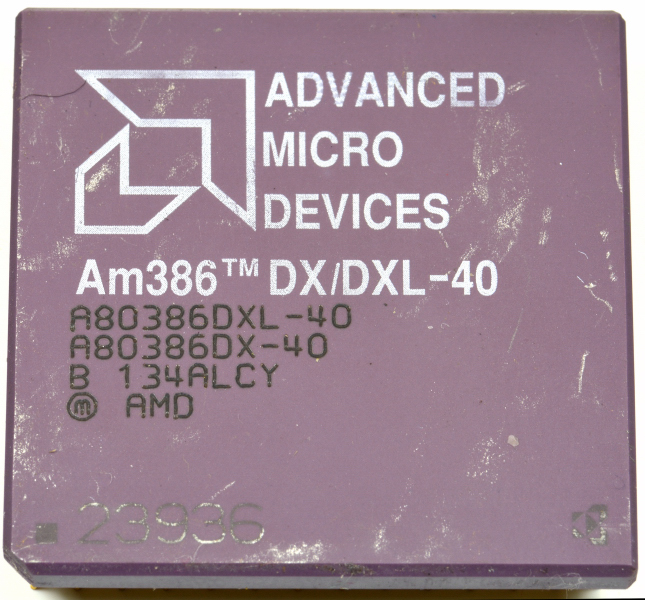
AMD Am386 DX/DXL-40
The AMD Am386 DX/DXL-40 is an AMD 32-bit x86 CPU fully compatible with the 386DX class, offered as a high-performance alternative (40 MHZ) in the PC market and also as an attractive solution for embedded systems. The DX label identifies the “desktop/standard” variant, while DXL identifies the low-power version based on a true static implementation, designed for battery-powered platforms and for applications where it is useful to drastically reduce the clock without losing internal state.
In practice, the Am386 DX/DXL-40 combines 386DX-class 32-bit logic (including protected mode and paging) with an aggressive market positioning on cost and availability, and with a DXL variant that emphasizes power efficiency.

Architecture: true 32-bit and “full” 386DX platforms
The Am386 DX/DXL is a 386DX-class CPU: a 32-bit core, typically paired with a “386DX-style” platform, capable of running software designed for the IA-32 era (DOS environments with extenders, OS/2, UNIX-like systems, Windows in advanced modes). The practical difference versus “SX” variants is better bandwidth to memory and I/O when the motherboard is built around a 32-bit subsystem.
DX vs DXL: what really changes
DX
The DX version is the standard desktop/general-purpose implementation, where the priority is throughput at a given clock rate and broad compatibility with 386DX motherboards and chipsets.
DXL (low power, true static)
The DXL version is the low-power true static variant: it can operate with very aggressive clock-reduction policies, conceptually down to static operation (extremely low clock) while retaining the state of registers and internal logic. This makes it suitable for transitional-era laptops and for embedded systems where you want to modulate power and performance.
Clock: 40 MHZ and performance profile
The 40 MHZ speed grade is one of the most relevant within the Am386 family: in many real configurations, a 386DX at 40 MHZ reaches “high-end” perceived performance for the 386 class, especially when the memory platform is well designed (external cache, fast RAM, efficient chipset). In real-world use, the memory subsystem is often the bottleneck, but a 32-bit bus and higher clock help materially on transfers and cache refills.
Power and energy management: why the DXL was interesting
On battery platforms, or in systems that alternate compute phases with idle/wait phases, the “true static” feature has a practical impact: instead of keeping the CPU constantly at full clock, you can lower or gate the clock and resume when needed. This reduces average power and heat dissipation and simplifies thermal design in compact chassis.
System integration: package and typical platforms
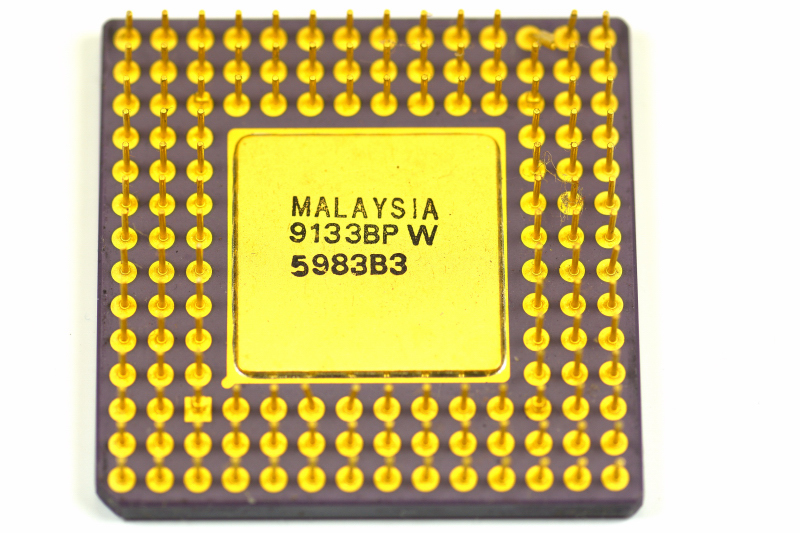
The Am386DX/DXL-40 was offered in packages suitable for both socketed systems and soldered solutions (depending on the board). Operationally, it was common on ISA/VLB motherboards for PC compatibles and on embedded x86 designs where software compatibility and long-term availability mattered.
Sketch of the most important connections
386 chipset + RAM + I/O (motherboard)
┌──────────────────────────────────────────────────────────┐
│ memory controller, ISA/VLB, BIOS/ROM, storage, peripherals │
│ (external cache often decisive for performance) │
└───────────────────────────────┬──────────────────────────┘
│
▼
┌─────────────────────────────┐
│ AMD Am386 DX/DXL-40 │
│ 32-bit core, 40 MHZ │
│ DXL: true static low power │
└─────────────┬───────────────┘
│
├────────► RAM/ROM (via chipset)
└────────► I/O (peripheral bus)
Table 1 – Identification data and specifications
| Characteristic | Indicative value |
|---|
| Device | AMD Am386 DX/DXL-40 |
| Manufacturer | AMD |
| Class | 32-bit x86 CPU (386DX-class) |
| Frequency | 40 MHZ |
| Low-power variant | DXL (true static) |
| Physical addressing | Up to 4 GB (386DX-class) |
| Typical platforms | 386DX-compatible PCs, embedded x86 |
| Transistors | About 275,000 (386DX class) |
| Common packages | 132-pin PGA / 132-pin PQFP (depending on version/platform) |
Table 2 – Operational and design considerations
| Aspect | Practical meaning |
|---|
| 40 MHZ | Strong performance level for 386 systems, especially with well-configured memory/cache |
| DX vs DXL | DX for general-purpose platforms; DXL for reduced power and battery/embedded designs |
| True static (DXL) | Ability to lower the clock significantly while retaining internal state, improving average power |
| Platform dependency | External cache, chipset, and RAM often matter more than clock alone |
| Software compatibility | Runs 386DX-class x86 environments and applications without porting |
| Industrial integration | Attractive for embedded due to availability and clock-based power management strategies |