

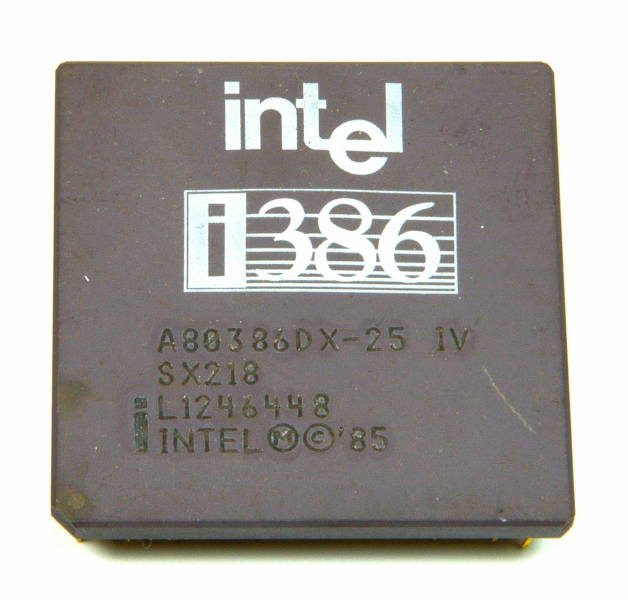
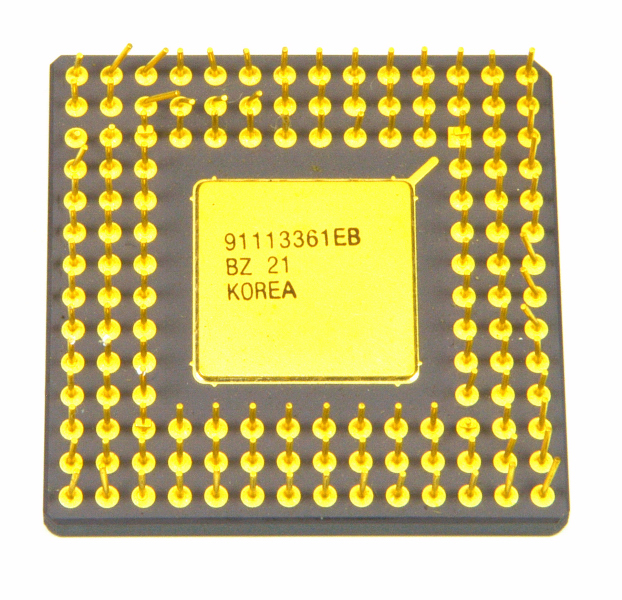
Intel 386 DX-25: the generation that brought PCs to 32-bit computing
Definition
“386 CPU” refers to the generation of 32-bit x86 microprocessors introduced by Intel with the 80386 and later offered also by AMD with the Am386 family. This generation made protected memory, multitasking, and large address spaces truly practical on PCs, setting the stage for more advanced operating systems and more complex software than in the 8086/286 era.
In terms of impact, the 386 was a watershed: not merely a frequency increase, but a model shift (protection, paging, memory management) that defined the modern PC.

What made the 386 “different”
32-bit architecture
The biggest leap is full adoption of 32-bit registers and data paths (emerging IA-32), with direct benefits for integer computing, pointer handling, and overall performance.
Addressing up to 4 GB
With a theoretical address space up to 4 GB, the 386 changes the rules compared to earlier practical limits. Even if real machines of the time did not ship with such large RAM amounts, the architecture becomes scalable.
Protected mode and protection rings
Multi-level protection (rings) and enhanced segmentation make it possible to separate applications from the kernel, reducing cascading crashes and enabling more robust operating systems.
Paging (virtual memory)
Paging provides the hardware basis for virtual memory, useful for multitasking and for handling working sets larger than physical RAM.
386 family characteristics (integrated data)
16-bit data bus
For some variants of the family (typically those aimed at lower-cost platforms or embedded integration), a 16-bit data bus is specified. In practice, this reduces motherboard complexity and cost, but can limit memory bandwidth compared to wider-bus solutions.
24-bit address bus and 16-Mbyte address range
A 24-bit address bus and a 16 MB addressable range are also reported. Operationally, this aligns with implementations/variants that reduce effective addressing width for cost and platform-integration reasons, especially in embedded contexts or resource-constrained boards.
40, 33 and 25 MHZ operating speeds
Typical operating speeds of 40 MHZ, 33 MHZ, and 25 MHZ are indicated, representing the most common speed grades in PC-class 386 platforms and some industrial implementations.
Embedded applications
The 386 family was also used in embedded applications, thanks to variants and configurations oriented toward power and reliability, in addition to x86 software compatibility.
True static design for low-power applications
“True static design” indicates logic that can retain state even at very low frequencies, enabling power-saving strategies: in practice, you can lower the clock without losing internal context.
3–5 V operation at 25 MHZ
Operation between 3 and 5 V at 25 MHZ is specified, typical of low-power or embedded versions: in practice, this simplifies power design and allows integration with logic at different supply levels.
True DC (0 MHZ) operation
“True DC operation” down to 0 MHZ implies the CPU can remain static with no clock and resume execution when the clock returns, useful for extreme power-saving modes and clock-gated systems.
Main variants: 386DX and 386SX
386DX
This is the “full” version in terms of external bus: generally associated with a 32-bit external data bus and better performance at the same clock, because it reduces the memory bottleneck.
386SX
This version targets lower-cost platforms: typically with a 16-bit external data bus and a simpler motherboard subsystem. In practice, it enables cheaper 386 PCs, but penalizes memory bandwidth and therefore real-world performance.
Intel 386: strengths and limits
Strengths
Platform reliability and broad adoption: many motherboards, chipsets, BIOSes, and software stacks were developed and tuned with Intel CPUs as the reference, improving compatibility and predictability.
Limits
Over time, Intel’s 386 became the baseline reference, while the market increasingly valued alternatives with higher clocks or better cost positioning.
AMD Am386: why it mattered
The Am386 family (especially DX- and SX-compatible versions) played a key role because it:
increased competition on 386 PC pricing
often offered higher speed grades or stronger availability in certain market phases
enabled many manufacturers to ship competitive 386 systems, especially in cost-sensitive segments
Practically, AMD helped “democratize” the 386 by making 32-bit machines more accessible when total platform cost mattered more than branding.
Platform components that change the real experience
387 math coprocessor
Many 386 systems could add an optional FPU coprocessor (typically “387”). Practically, CAD, scientific workloads, and some graphics/computation routines benefit strongly; without an FPU, many floating-point operations are software-emulated with significant penalties.
Chipset and RAM
On 386 systems, the difference between a well-configured board (RAM and cache) and a “budget” platform is often more noticeable than the raw CPU clock suggests. The CPU may be capable, but memory is frequently the bottleneck.
Software and usage context
The 386 made several scenarios credible:
MS-DOS as a base, with more room for extenders and 32-bit software
OS/2 and more structured multitasking environments
Windows 3.1 in advanced modes
UNIX-like systems on PC hardware, benefiting from protected mode and paging
Practically, the 386 is the CPU that made the PC more of an “operating-system platform”, not only a single-application machine.
Sketch of the most important connections
chipset + RAM + I/O (386 motherboard)
┌──────────────────────────────────────────────────────────┐
│ memory controller, ISA/VLB (depending on system), I/O │
│ BIOS/ROM, storage, peripherals, (optional external cache) │
└───────────────────────────────┬──────────────────────────┘
│
▼
┌─────────────────────────────┐
│ 386 CPU │
│ 32-bit core, paging, PM │
│ DX: wider external bus │
│ SX: narrower external bus │
└─────────────┬───────────────┘
│
├────────► RAM/ROM (via chipset)
├────────► I/O (peripheral bus)
└────────► 387 FPU (optional)
Table 1 – Identification data and specifications
| Characteristic | Indicative value |
|---|
| Family | 386 / 80386 / Am386 |
| Main manufacturers | Intel, AMD |
| Class | 32-bit x86 CPU |
| Addressing | Theoretical space up to 4 GB; 24-bit/16 MB variants in specific contexts |
| Data bus | 32-bit (DX); 16-bit (SX and some variants) |
| Typical speeds | 25, 33, 40 MHZ |
| Memory management | Protected mode + paging (virtual memory) |
| Low-power modes | True static design; true DC (0 MHZ) operation |
| Supply (some variants) | 3–5 V at 25 MHZ |
| FPU | Optional 387 coprocessor |
| Market focus | Desktop PCs, embedded/industrial (depending on versions) |
Table 2 – Operational aspects and evaluation (Intel vs AMD)
| Aspect | Practical meaning |
|---|
| 32-bit jump | Better memory handling and more complex software vs 286 and earlier |
| Protected mode + paging | Hardware base for multitasking and improved stability |
| 386DX vs 386SX | Cost and memory bandwidth strongly affect real performance |
| Intel | Platform standard, broad compatibility, historical adoption |
| AMD | Competitive alternatives, often strong price/performance |
| Role of the 387 | In floating-point workloads, the “with vs without FPU” gap is often larger than clock alone |
| Embedded and low power | True static/DC and 3–5 V range enable low-power designs and clock gating |
| Memory bottleneck | Chipset and RAM can limit more than the CPU, especially on SX/budget systems |