



Country of Manufacture
The Toyota C-HR Plug-in Hybrid is assembled in Sakarya, Turkey, on the TNGA-C platform shared with the Corolla Cross.
Quick Overview
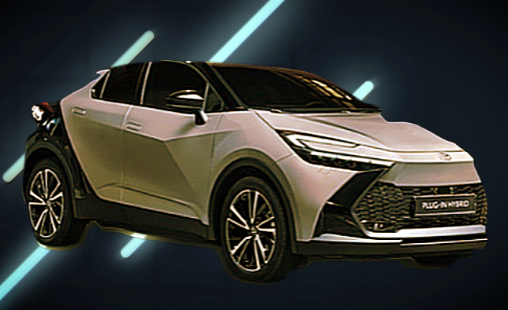
The C-HR Plug-in Hybrid blends the coupe-style crossover design of the standard C-HR with a larger, rechargeable battery pack. It features pronounced wheel arches, a sloping roofline, and a modern interior with a 10.5″ central touchscreen and digital instrument cluster. You can drive up to 66 km on pure electric power (WLTP) before the gasoline engine seamlessly takes over.
Powertrain & Performance
| Powertrain Component | Specification |
|---|---|
| Gasoline Engine | 2.0 L 4-cylinder, 150 hp / 190 Nm |
| Electric Motor | 120 kW (163 hp) / 208 Nm (front) |
| Combined System Power | 223 hp (164 kW) |
| Battery | 13.6 kWh Li-ion |
| Electric Range (WLTP) | 66 km |
| 0–100 km/h | 7.4 s |
| Top Speed | 180 km/h |
Efficiency & Charging
| Characteristic | Value |
|---|---|
| Combined Fuel Consumption | 0.8–0.9 L/100 km |
| CO₂ Emissions | 17–19 g/km |
| AC Charging | 3.3 kW onboard |
| DC Fast Charging | Not supported |
Dimensions & Capacity
| Specification | Measurement |
|---|---|
| Length | 4 362 mm |
| Width | 1 832 mm (excl. mirrors) |
| Height | 1 564 mm |
| Wheelbase | 2 640 mm |
| Curb Weight | 1 645–1 695 kg |
| Cargo Volume | 310 L |
| Ground Clearance | 137 mm |
| Turning Circle | 5.5 m |
Trim Levels & Pricing
| Version | Price (€) |
|---|---|
| Trend | 39.900 |
| Lounge | 42.900 |
| Lounge Hero | 44.400 |
| GR SPORT | 43.900 |
| GR SPORT Hero | 45.400 |
(On-the-road price; VAT included, incentives and delivery fees excluded.)
Maintenance & First Services (Indicative Costs)
| Service | Average Cost (€) |
|---|---|
| 1st Service (1 year or 15 000 km) | 365 |
| 2nd Service (2 years or 30 000 km) | 200–240 |
| Front Brake Pads Replacement | 200–240 |
| Front Discs + Pads Replacement | 500–600 |
| Cabin & Engine Air Filter Replacement | 100–130 |
| 12 V Auxiliary Battery Replacement | 120–150 |
| Tire Replacement (each) | 140–180 |
Pros
Electric-only range of 66 km ideal for daily urban commutes
Strong performance with 0–100 km/h in 7.4 s despite the added battery weight
Outstanding efficiency at just 0.8–0.9 L/100 km combined
Distinctive styling and hi-tech interior with dual displays
Tax and ZTL benefits thanks to ultra-low emissions
Cons
No DC fast-charging, making recharge times long on 3.3 kW AC
Reduced cargo volume (310 L) due to the large battery pack
Lower ground clearance limits light off-road use
Higher entry price compared to the standard full-hybrid C-HR
- Automatic parking: a real problem. While with the previous C-HR you just had to move closer to the parking lot and press a button, in this new C-HR you have to stop, press the automatic parking button, look at the display and press the icon that refers to the chosen seat. Unworkable option in city traffic conditions. Additionally, the "Insufficient parking space" error often appears even when this is not the case.
In Summary
The Toyota C-HR Plug-in Hybrid 220 marries the everyday zero-emission capability of an EV—up to 66 km—with the reassurance of a gasoline engine for longer journeys. It delivers class-leading efficiency and striking design, making it an ideal urban crossover for style- and eco-conscious drivers, while asking you to accept trade-offs in cargo space, charging speed, and purchase price.
Verdict — Toyota C-HR Plug-in Hybrid (Model Year 2025)
Compact PHEV Crossover · 2.0 L 4-cyl (184 hp) + Dual Electric Motors (combined 225 hp, 270 Nm) · FWD · E-CVT · 0–100 km/h in 7.8 s · 18.1 kWh Battery · WLTP Electric Range ~70 km · AC Charging up to 6.6 kW · 160 mm Ground Clearance
The 2025 Toyota C-HR Plug-in Hybrid adds substantial electric-only range to the stylish, coupe-inspired crossover segment. Its sharply sculpted body features a closed front grille, “Plug-in” badging, and aerodynamic 18″ wheels. At 4.40 m long on a 2.64 m wheelbase, it balances compact urban agility with surprisingly generous cabin space.
Inside, the “Smart & Bold” cockpit centers on a 12.3″ touchscreen for infotainment and climate—complete with wireless Apple CarPlay and Android Auto—and a 7″ digital instrument display with hybrid-system readouts. Upscale cloth and vegan-leather upholstery, heated front seats, and ambient lighting create a refined atmosphere. The 360 L cargo area (1,155 L with seats folded) offers a dual-level floor and “Simply Clever” storage bins for maximum versatility.
Key Technical Highlights:
Powertrain: 2.0 L naturally aspirated 4-cyl (184 hp) paired with dual electric motors for a combined 225 hp and 270 Nm; 0–100 km/h in 7.8 s.
Battery & Range: 18.1 kWh (usable ~17 kWh); WLTP electric range ~70 km; selectable EV, Hybrid, and Power driving modes.
Charging: AC up to 6.6 kW (0–100 % in ~2.5 h); regenerative braking captures energy on deceleration.
Drivetrain & Chassis: E-CVT; MacPherson front and torsion-beam rear suspension; 160 mm ride height.
ADAS Level 2: Toyota Safety Sense with adaptive cruise control, lane-keep assist, Pre-Collision Braking, blind-spot monitoring, and pedestrian detection.
| Category | Strengths | Performs Well | Limitations |
|---|---|---|---|
| Design & Styling | Coupe-inspired silhouette; PHEV-specific grille and badging | Sharp, modern lines | Polarizing styling not for conservative buyers |
| Comfort & Space | Upscale materials; heated front seats; ambient lighting | Roomy front and decent rear passenger space | Rear headroom and center-seat comfort somewhat tight |
| Efficiency & Range | ~70 km pure-electric range; minimal fuel use in daily city use | Smooth EV-Hybrid transitions | Real-world electric range dips in cold weather or high loads |
| Driving Dynamics | Instant torque in EV mode; responsive power delivery | Balanced comfort and handling | No dedicated “Sporty” drive feel |
| Practicality | 360 L cargo (+1,155 L folded); dual-level floor | Clever storage bins and ambient lighting | High loading sill for heavy items |
| Infotainment & Connectivity | 12.3″ touchscreen with wireless CarPlay/Android Auto | Intuitive UI and over-the-air updates | Built-in navigation requires higher trim |
| Safety & ADAS | Comprehensive Safety Sense; effective Pre-Collision Braking | Blind-spot monitoring and adaptive cruise work well | No hands-free highway driving |
| Running Costs | Potential for zero-cost daily electric driving; PHEV incentives | Low scheduled maintenance | PHEV servicing less widespread in rural areas |
| Depreciation | Strong residuals thanks to Toyota reliability and PHEV demand | Steady used-car market interest | Intense competition from other compact PHEVs and EVs |
Who It’s For
Urban drivers wanting a distinctive, electrified crossover with substantial electric-only range, upscale cabin feel, and Toyota’s renowned reliability.
Who Should Look Elsewhere
If you need more pure-EV capability or all-wheel drive, consider the Kia Niro PHEV, Ford Kuga PHEV, or Hyundai Tucson Plug-in.
Recommended Configuration
Executive trim with 18″ wheels, panoramic roof, Smart Connect navigation, and bidirectional V2L charging—for the best blend of electric range, comfort, and technology.

