



Toyota Land Cruiser 250 Series (2025)
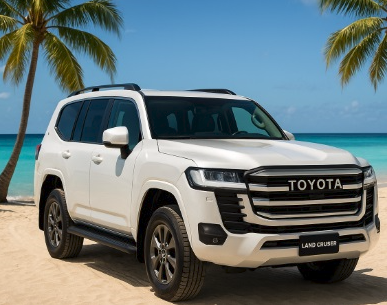
1. Vehicle Overview
The new 250 Series replaces the outgoing 150 Prado while positioning itself beneath the larger 300 Series. It retains a body-on-frame GA-F chassis but benefits from a 50 % increase in torsional rigidity and a 30 % stiffer suspension mounting structure. Dimensions land it in the mid-size SUV class:
| Spec | Value |
|---|---|
| Length / Width / Height | 4 690 × 1 865 × 1 875 mm |
| Wheelbase | 2 850 mm |
| Track (F/R) | 1 575 / 1 575 mm |
| Kerb Mass | 2 330–2 480 kg (trim-dependent) |
| Luggage Volume | 452 l (5-seat), 310 l (7-seat, third row stowed) |
A steel ladder frame, aluminium roof and composite tailgate shave roughly 200 kg versus the 150.
2. Powertrain Line-up
| Market | Engine | Output | Transmission | Driveline |
|---|---|---|---|---|
| EU / MEA | 2.8 L 1GD-FTV I-4 | 204 hp – 500 Nm | 8-sp Aisin torque-converter | Full-time 4WD |
| Aus / LatAm | 2.4 L T24A-FTS turbo-petrol | 278 hp – 430 Nm | 8-sp auto | Full-time 4WD |
| Global (late 2025) | 2.8 L + 48 V MHEV | 221 hp – 550 Nm (est.) | 8-sp auto | Full-time 4WD |
The diesel achieves 0–100 km/h in ~9,9 s and returns 8,8–9,3 l/100 km combined. The 48-V belt-starter generator adds 12 kW of launch boost, idle-stop smoothing and an extra 0,4 l/100 km saving.
3. Driveline & Suspension Technology
Transfer Case: 1:1 high / 2.566:1 low range, electronically selected.
Differentials: Torsen centre diff with manual lock; rear e-locker standard; front e-locker optional on Adventure & First Edition.
e-KDSS (electronic Kinetic Dynamic Suspension System) disconnects the front anti-roll bar at < 30 km/h to increase axle articulation by up to 30 %.
Multi-Terrain Select integrates throttle mapping, ABS logic and locker control for Mud, Sand, Rock & Dirt, Auto and Deep Snow.
Crawl Control offers five low-speed “off-road cruise-control” settings from 1,5 to 7 km/h.
Approach / Break-over / Departure: 32° / 24° / 26° (with Adventure bumpers), plus a 31° ramp-over angle and 700 mm wading depth without snorkel.
Towing: 3 500 kg braked with 350 kg tongue load; trailer-sway integrated into VSC.
4. On-Road Manners
Steering: electric rack with variable gear ratio (VGRS) quickens off-centre response at low speed.
NVH: a triple-layer dash panel, hydraulic body mounts and acoustic glass for the front side windows reduce cabin noise by ~3 dB versus the 150.
Ride: coil-spring multilink rear keeps the tail better planted over corrugations; the new electric front sway-bar adds roll control without affecting articulation off-road.
Braking: 340 mm ventilated discs on all corners, twin-piston front calipers, with by-wire brake booster that supports the full ADAS suite.
5. Interior, Infotainment & Safety
Cabin Layout: flat floor, 60/40 sliding second row, optional two-seat third row, synthetic leather on GX/Adventure, semi-aniline on Lounge/First Edition.
Infotainment: 12.3″ touchscreen runs Toyota’s latest Linux-based OS; wireless Apple CarPlay & Android Auto, 14-speaker JBL on upper trims, dual 11.6″ rear displays optional.
Driver Information: 12.3″ configurable cluster plus colour head-up display.
ADAS (Safety Sense 3.0): ACC with stop-&-go, lane-trace, emergency steering assist, blind-spot with rear cross-traffic auto-brake, front cross-traffic alert and 360° multi-terrain monitor with under-floor transparent view.
6. Operating Costs & Reliability Outlook
| Item | Interval / Lifespan | Typical Parts (€) | Labour (€) |
|---|---|---|---|
| Oil + filters (7.9 l 0W-30) | 15 000 km / 12 mo | 220 | 200 |
| Fuel filter + air filter | 30 000 km | 90 | 60 |
| ATF + transfer/l-box oils | 90 000 km | 260 | 250 |
| Brake pads / discs (axle) | 45 000 / 90 000 km | 110-130 / 280-320 | 90-120 / 120-150 |
| Coolant & DPF service | 150 000 km | 240 | 140 |
| 48 V Li-ion pack (MHEV) | 8-10 yr | 1 600–2 500 | 200 |
Diesel owners who log frequent short hops should schedule a preventive DPF regen every quarter to avoid ash loading.
Relax Plus warranty can be renewed annually up to 250 000 km or 15 years with dealership servicing.
7. Market Position & Pricing
| Trim | Key Kit | List € | Typical promo € |
|---|---|---|---|
| Adventure | front locker, fabric, 18″ AT tyres | 84 000 | ~79 000 |
| Lounge | semi-aniline, JBL, HUD, 20″, sunroof | 90 500 | ~85 500 |
| First Edition | both lockers, matte paint, roof rack, heritage grille | 96 500 | ~91 500 |
Outgoing 150-series stock is clearing at €60-65 k; early 250-series “First Batch” units are already trading second-hand at a €4-5 k premium due to tight allocation.
8. Known Early-Production Issues
48 V battery DTCs (MHEV) — sporadic “Hybrid System Malfunction” messages; resolved with revised BMS firmware and, where necessary, pack replacement.
Low-speed judder on AT models — a batch of torque-converter lock-up clutches showed harsh engagement; Toyota released a friction-coefficient update to the TCM.
Roof-rail torque spec error — delivery checklist updated; retorque to 40 N·m prevents clunk over washboards.
9. Verdict
The 250 Land Cruiser is no lifestyle crossover in disguise: it remains a ladder-frame workhorse, yet chassis stiffness, a quieter cabin and an expansive ADAS suite finally make it civilised for long motorway slogs. Running costs are undeniably high—fuel, tyres, insurance and super-tax weigh heavier than on monocoque rivals—but residual values remain among the strongest in the segment, and the mechanical package is engineered for decades, not product cycles.
If you tow heavy, live far from tarmac or simply prize mechanical redundancy, few alternatives match its blend of robustness and factory warranty. Shoppers focused on city manoeuvrability, plush ride or CO₂ taxation will find more sensible choices elsewhere; for everyone else, the Land Cruiser’s “go-anywhere, last-forever” brief survives intact and, in several areas, leaps forward.

