

Rear-wheel drive (RWD): pros, cons, problems
Rear-wheel drive (RWD) is a drivetrain layout in which driving torque is delivered to the rear wheels, while the front wheels are primarily responsible for steering. It is a typical configuration for many premium sedans, sports cars, and vehicles that prioritize robustness or towing capability.
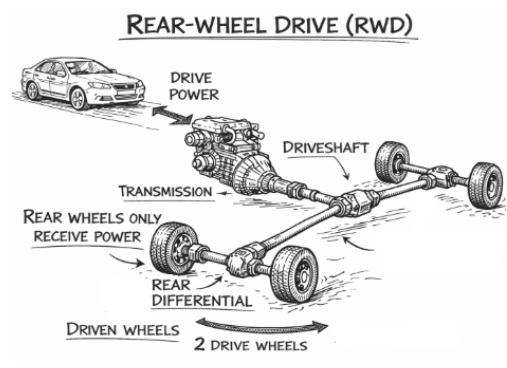
From an architectural standpoint, the engine can be longitudinal (common) or transverse in some special cases, but the classic layout uses a transmission connected to a driveshaft that carries torque to a rear differential. From there, two half-shafts deliver torque to the wheels. This separation between the steering axle and the driven axle simplifies how forces are managed through a corner.
The best-known dynamic advantage is task separation: the front axle can focus on directional control, while the rear axle provides traction. Under acceleration, weight transfer toward the rear increases vertical load on the driven wheels, improving the ability to put torque down compared with a front-drive layout—especially on higher-power vehicles.

In driving terms, RWD can provide a “cleaner” steering response because the front tires are not also transmitting drive torque. This reduces phenomena such as torque steer and can improve precision and feedback—qualities valued in sporty driving.
The trade-off is that, in low-grip conditions, RWD can be more demanding: if torque exceeds available traction, the rear axle can break traction and induce oversteer. Modern TCS and ESP mitigate the risk by reducing torque and applying selective braking, but the underlying physics remains decisive.
An important element is the type of differential: with an open differential, under acceleration on uneven-grip surfaces the wheel with less traction can spin. To improve traction and control, many RWD cars use a mechanical or electronic limited-slip differential (LSD), which distributes torque more effectively between the rear wheels.
From a practical standpoint, RWD often involves more mass and packaging complexity than FWD (driveshaft, differential, additional components), with potential impacts on fuel consumption and cost. In return, it enables better weight distribution (even close to 50:50 on some models) and supports higher power levels without saturating the front axle.
In terms of comfort and durability, the layout can be robust for towing and demanding use, but it requires attention to maintenance of differential oil, joints, and driveshaft supports. On slippery surfaces, appropriate tires (including winter tires) and correct torque management are essential to leverage the benefits without compromising safety.
In summary, rear-wheel drive prioritizes dynamic qualities and the ability to handle higher torque thanks to the separation of steering and traction and favorable acceleration weight transfer. However, it demands more care on low-grip surfaces and entails greater mechanical complexity than FWD layouts, which is why it is typically chosen when performance, balance, and driving enjoyment are priorities.