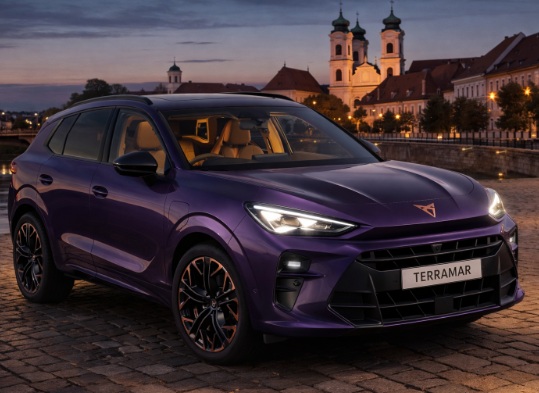
Cupra Terramar
Country of production
The Cupra Terramar is produced in Hungary, at Győr plant, one of the Volkswagen Group’s most advanced industrial hubs for building high-technology models. It is Cupra’s first higher-segment SUV developed as a strategic global model.
Model market launch
September 2023: official presentation of the Cupra Terramar.
Late 2023: start of production in Hungary.
Early 2024: order books opened in major European markets.
Spring 2024: start of deliveries.
2024–2025: full commercialization with the gradual expansion of the engine lineup.

Facelift and main updates
No facelift at launch: this is a first-generation model and it debuts already featuring Cupra’s latest design language.
“Next generation” design: aggressive front end with triangular light signature, sculpted surfaces, and a more muscular stance than the Formentor.
On-board technology: latest-generation infotainment, advanced digital instrument cluster, and high-level ADAS.
Electrified powertrain range: strong focus on mild-hybrid and new-generation e-HYBRID plug-in hybrids.
The Cupra Terramar is a D-segment sporty SUV, positioned above the Formentor in both size and content. It combines a bold, sporty design with increased cabin space and a chassis setup oriented toward dynamic driving, while maintaining a more family-friendly and versatile character. It is conceived as a sporty alternative to traditional premium SUVs, with electrified engines and high-performance VZ versions.
Powertrains and performance
| Feature | 1.5 eTSI 150 | 2.0 TSI 204 | 1.5 e-HYBRID 204 | 1.5 e-HYBRID VZ 272 | 2.0 TSI 265 VZ 4Drive |
|---|
| Engine / layout | 1.5 turbo MHEV, FWD | 2.0 turbo gasoline, FWD | PHEV, FWD | PHEV, FWD | 2.0 turbo gasoline, AWD |
| Power | 150 hp | 204 hp | 204 hp | 272 hp | 265 hp |
| Max torque | 250 Nm | 320 Nm | 350 Nm (system) | 400 Nm (system) | 400 Nm |
| 0–100 km/h | ~9.3 s | ~7.4 s | ~8.3 s | ~7.3 s | ~5.9 s |
| Top speed | ~205 km/h | ~220 km/h | ~205 km/h | ~220 km/h | 243 km/h |
| Battery / electric range | — | — | ~19.7 kWh / over 100 km WLTP* | ~19.7 kWh / over 100 km WLTP* | — |
| Charging (PHEV) | — | — | AC + DC up to 50 kW (where available) | AC + DC up to 50 kW (where available) | — |
* Indicative values, subject to change depending on version, homologation, and real-world conditions.
Dimensions and capacity
| Specification | Value |
|---|
| Length | 4,519 mm |
| Width (excluding mirrors) | 1,869 mm |
| Height | 1,586 mm |
| Wheelbase | 2,681 mm |
| Trunk | ~540 L (varies depending on e-HYBRID version) |
Main trims and prices
(Indicative list prices; they may vary due to promotions, options, and registration costs.)
| Version | From (€) |
|---|
| Terramar 1.5 eTSI 150 | ~43,000 |
| Terramar 2.0 TSI 204 | ~48,000 |
| Terramar e-HYBRID 204 | ~51,000 |
| Terramar e-HYBRID VZ 272 | ~56,000 |
| Terramar VZ 2.0 TSI 265 4Drive | ~59,000 |
Practical note: e-HYBRID versions may benefit from local incentives and often feature range structures that change over time.
Maintenance and early servicing (indicative costs)
(Estimates for D-segment sporty SUVs; wide variability depending on dealer network and usage.)
| Service item | Average cost (€) |
|---|
| Annual service / 15–30,000 km (gasoline/MHEV) | 320–600 |
| Annual service (e-HYBRID) | 380–700 |
| Brake fluid | 100–190 |
| Cabin filter | 70–150 |
| Front brake pads | 280–560 |
| Front discs + pads | 850–1,550 |
| Tire (each, 18"–21") | 190–420 |
| 12 V battery | 150–280 |
Pros
Highly distinctive Cupra design, more mature and muscular than the Formentor.
Better interior space and comfort, suitable for family use as well.
Modern electrified range, with e-HYBRID versions offering high electric-only range.
Strong performance in VZ versions, with all-wheel drive availability.
Cons
High entry price compared to mainstream SUVs of similar size.
Significant weight on PHEV versions, affecting dynamics and consumption.
Reduced trunk space on e-HYBRID versions compared with ICE variants.
Options and packages can quickly increase the final price.
In summary
The Cupra Terramar represents a key step in the brand’s evolution, bringing Cupra’s sporty identity into the midsize SUV segment. It is aimed at buyers seeking image, performance, and technology in a roomier, more versatile format than the Formentor. The e-HYBRID versions are particularly compelling for everyday use, while the VZ variants cater to those who want an SUV with strong character and higher-end performance.
Verdict — Cupra Terramar (Model Year 2026)
The Cupra Terramar is the C-segment SUV through which the brand completes its sporty line-up between compact crossovers, the electric coupé-SUV, and (here) a ICE/electrified SUV. The formula is straightforward: more aggressive design than mainstream siblings, chassis and steering tuned to feel more “driver oriented”, and an engine line-up that covers the two most sensible choices in this class today: petrol 4Drive for those who do not want charging constraints, and plug-in hybrid for those who can charge and genuinely benefit from EV running.
Its main strength is project coherence: true-SUV dimensions (but not oversized), a modern cabin with a large infotainment screen, and a technical set-up that supports both a VZ performance flagship (2.0 TSI 265 and 1.5 e-Hybrid 272) and more rational variants (150 mild-hybrid and 204 e-Hybrid). The purchase decision is simple: choose PHEV if you have regular charging and want to lower day-to-day running costs, or choose TSI 4Drive if you want maximum day-to-day simplicity and AWD without charging compromises.
Key technical points
Engine range (5-door SUV)
Indicative performance (claimed)
1.5 Hybrid DSG 150 hp: 0–100 km/h 9.3 s, top speed 205 km/h
1.5 e-Hybrid DSG 204 hp: 0–100 km/h 8.3 s, top speed 205 km/h
VZ 1.5 e-Hybrid DSG 272 hp: 0–100 km/h 7.3 s, top speed 215 km/h
2.0 TSI DSG 4Drive 204 hp: 0–100 km/h 7.1 s, top speed 225 km/h
VZ 2.0 TSI DSG 4Drive 265 hp: 0–100 km/h 5.9 s, top speed 243 km/h
Plug-in hybrid: where it makes the difference
Battery: 19.7 kWh (net, claimed).
WLTP electric range: approximately 109–118 km (depending on version and homologation).
Charging
Practical impact: e-Hybrid boot volume is more affected by component packaging and load-area layout (see below), but it remains workable as a “one-car solution” unless you regularly need maximum cargo capacity.
Dimensions and space
SUV-compact but substantial footprint: 4,519 mm long, 1,863 mm wide, 1,584 mm high; wheelbase 2,681 mm.
Comfortable for four adults; the fifth seat is best considered occasional-use, typical for the class.
Boot (claimed)
Technology and daily usability
Infotainment: 12.9" central touch display (tablet-style layout) plus digital cockpit.
ADAS: extensive, configurable equipment (adaptive cruise, lane support, AEB, etc.); the top feature set is often package-dependent.
Chassis: availability of dynamics-oriented solutions (e.g., adaptive chassis control DCC, depending on version/packages), aligned with Cupra’s positioning.
Market: launch and mid-cycle update
Market introduction: world premiere on 3 September 2024; order opening followed the launch phase, with first deliveries communicated for November 2024 (depending on market and allocation).
Mid-cycle facelift/update: currently no mid-cycle facelift is indicated; the model is still in its early lifecycle stage.
Indicative prices (Model Year 2026 price list)
1.5 Hybrid DSG 150 hp: €43,650
2.0 TSI DSG 4Drive 204 hp: €47,550
1.5 e-Hybrid DSG 204 hp: €48,700
Impulse 2.0 TSI DSG 4Drive 204 hp: €49,950
Impulse 1.5 e-Hybrid DSG 204 hp: €51,000
VZ 2.0 TSI DSG 4Drive 265 hp: €54,700
VZ 1.5 e-Hybrid DSG 272 hp: €56,250
| Category | Where it shines | Where it holds up | Where it falls short |
|---|
| Design & image | Strong Cupra styling, distinctive light signature and road presence | Modern interior and sporty ambience | Polarising look: not “neutral” |
| Comfort & space | Good driving position and convincing seats | Solid for four adults | Big wheels/sportier set-ups can feel firmer on rough roads |
| Efficiency & consumption | e-Hybrid’s potential is very high if you charge often | Mild-hybrid is sensible for mixed use without constraints | TSI and VZ: consumption and tyres rise quickly if you use the power often |
| Driving dynamics | Steering/chassis are more engaging than the average C-SUV | Well-balanced in mixed driving | SUV mass and higher centre of gravity remain: not a “hot hatch on stilts” |
| Practicality | Modular, usable boot space | Cabin packaging is logical for the class | PHEV: lower boot volume than non-PHEV versions |
| Infotainment & connectivity | Large screen and up-to-date system | Full smartphone integration | Few physical buttons: all-screen ergonomics are not for everyone |
| Safety & ADAS | Broad, updated equipment | Strong assistance on long trips | Advanced functions often tied to packages |
| Running costs | Non-VZ versions: more straightforward taxation | e-Hybrid can reduce day-to-day running costs | Versions above 185 kW may trigger super tax; tyres/insurance cost more |
| Depreciation | Strong brand appeal and demand | Holds up well with the right spec | Prices and incentives heavily influence residuals |
Who it is for
For drivers who want a compact SUV with a sporty set-up and distinctive image, yet still usable as a “one-car solution”. It makes particular sense as an e-Hybrid if you can charge at home or at work and want to turn many daily trips into EV driving; or as a 2.0 TSI 4Drive if you prioritise AWD and simplicity without relying on charging infrastructure.
Who should look elsewhere
If your absolute priority is a soft ride on broken roads (especially if you want large wheels), or if you consistently need maximum cargo volume without compromise. In those cases, more family-oriented alternatives or comfort-focused SUVs will be more coherent. Also, without regular charging access, the e-Hybrid loses much of its advantage.
Recommended configuration
1.5 e-Hybrid DSG 204 hp: the best-balanced option if you can charge often and want lower running costs without going for the top output.
2.0 TSI DSG 4Drive 204 hp: for those who want AWD, strong performance, and no charging constraints.
VZ 1.5 e-Hybrid DSG 272 hp: for those who want the fullest PHEV (performance and equipment), leveraging DC charging and a long EV range.
VZ 2.0 TSI DSG 4Drive 265 hp: for those who want the best straight-line performance, accepting that taxation, tyres and insurance may rise quickly.



 Cupra Terramar