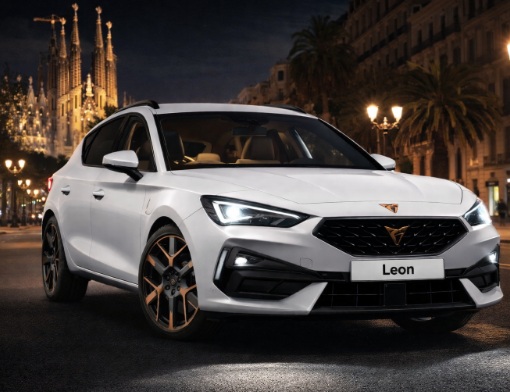
Cupra Leon
Country of production
The Cupra Leon is produced in Spain, mainly at the Martorell plant (Catalonia), within the Volkswagen Group’s industrial footprint in Iberia.
Market launch
The first Cupra Leon (as a model under the Cupra brand, separate from Seat) reached the market in 2020. The latest mid-cycle update was presented in 2024 and introduced commercially between late 2024 and 2025, depending on market.

Facelift and mid-cycle updates
The main facelift is the 2024 mid-cycle refresh, featuring:
New “shark nose” front end and updated lighting signature.
Updates to infotainment and driver assistance systems (depending on trim/market).
A major upgrade for plug-in (e-HYBRID) versions: a larger battery and the introduction of DC charging (fast charge) in addition to AC charging.
The Leon is Cupra’s sporty compact (C-segment), configured as a five-door hatchback with a more aggressive, driver-oriented identity than the group’s mainstream equivalents. The tuning prioritizes steering precision, a more planted chassis, and a driving experience that can shift from comfortable to more reactive when sport modes are selected. The cabin focuses on a modern layout with a large central display, digital instrumentation, and a full ADAS package, with the option of more performance-focused suspension and brakes on VZ trims.
Powertrain and performance
| Specification | 1.5 TSI 150 | 1.5 Hybrid DSG 150 | 2.0 TDI DSG 150 |
|---|
| Engine / layout | 4-cyl 1.5 turbo | 4-cyl 1.5 turbo mild-hybrid | 4-cyl 2.0 turbo diesel |
| Power | 150 hp (110 kW) | 150 hp (110 kW) | 150 hp (110 kW) |
| Max torque | ~250 Nm | ~250 Nm | ~360 Nm |
| 0–100 km/h | ~8.7 s | ~8.7 s | ~8.5 s |
| Top speed | ~215 km/h | ~215 km/h | ~213 km/h |
| Average consumption | varies by homologation/trim | varies by homologation/trim | varies by homologation/trim |
| Battery / range (e-HYBRID) | — | — | — |
| Charging (e-HYBRID) | — | — | — |
| Specification | 1.5 e-HYBRID DSG 204 | Leon VZ 1.5 e-HYBRID DSG 272 | Leon VZ 2.0 TSI DSG 300 |
|---|
| Engine / layout | PHEV: 1.5 turbo + e-motor | PHEV: 1.5 turbo + e-motor | 4-cyl 2.0 turbo |
| Power | 204 hp (150 kW) | 272 hp (200 kW) | 300 hp (221 kW) |
| Max torque | ~350 Nm (system) | ~400 Nm (system) | ~400 Nm |
| 0–100 km/h | ~7.7 s | ~7.1 s | ~5.7 s |
| Top speed | ~220 km/h | ~229 km/h | ~250 km/h |
| Average consumption | varies (depends on electric use) | varies (depends on electric use) | varies by homologation/trim |
| Battery / range (e-HYBRID) | ~20 kWh net / EV range up to ~130 km (markets/homologation) | ~20 kWh net / EV range up to ~120–125 km (markets/homologation) | — |
| Charging (e-HYBRID) | AC 11 kW + DC 50 kW | AC 11 kW + DC 50 kW | — |
(Indicative values: they may change depending on model year, tyres, trim, and homologation.)
Dimensions and capacity
| Specification | Value |
|---|
| Length | ~4,398–4,399 mm |
| Width | ~1,799 mm |
| Height | ~1,444–1,467 mm (depending on version) |
| Wheelbase | ~2,686 mm |
| Trunk (min) | ~380 L (ICE/mild-hybrid) |
| Trunk (min, e-HYBRID) | ~270 L (plug-in) |
| Seats | 5 |
Main trims and prices (Italy)
| Version | From (€) |
|---|
| Leon 1.5 TSI 150 | 33,450 |
| Leon 1.5 Hybrid DSG 150 (mild-hybrid) | 37,200 |
| Leon 2.0 TDI DSG 150 | 38,150 |
| Leon 1.5 e-HYBRID DSG 204 (plug-in) | 43,500 |
| Leon VZ 1.5 e-HYBRID DSG 272 | 48,950 |
| Leon VZ 2.0 TSI DSG 300 | 48,350 |
| Leon VZ Extreme 1.5 e-HYBRID DSG 272 | 55,250 |
| Leon VZ Extreme 2.0 TSI DSG 300 | 55,850 |
(“On-the-road” list prices; they may vary due to promotions, options, and dealer/on-road fees.)
Maintenance and early service (indicative costs)
(Estimates for premium/sporty compacts in Italy: they can vary significantly by official network, location, and service packages.)
| Service item | Typical cost (€) |
|---|
| Annual service / 15–20,000 km (petrol/mild-hybrid) | 300–550 |
| Annual service (diesel) | 330–600 |
| Annual service (e-HYBRID) | 280–520 |
| Front brake pads | 250–500 |
| Front discs + pads | 650–1,200 |
| Tyre (each, 18–19") | 180–380 |
| e-HYBRID: HV system check (official network) | 0–200 (if included in plans) |
Pros
Strong balance between sportiness and everyday usability, especially with mild-hybrid powertrains and non-extreme chassis setups.
VZ versions: solid performance and a more genuine “hot hatch” character.
e-HYBRID: useful for city driving and commuting, with advanced AC charging and (on updated ranges) also DC capability.
Comprehensive technology package and access to premium content (sport seats, upgraded brakes, ADAS packs).
Cons
With certain packs/options, pricing can rise quickly: “expensive configurator” effect.
Trunk capacity is reduced on plug-in versions.
Sportier suspensions and larger wheels: firmer ride on poor surfaces, especially on more performance-focused trims.
For those looking for a highly “analogue” experience, the digital layer/ADAS presence can feel significant.
In summary
The Cupra Leon is a modern sporty compact, credible both as a daily driver and as a more aggressive proposition in VZ trim. Mild-hybrid versions remain the simplest, most straightforward compromise; e-HYBRID variants make sense for those who can charge frequently and want to reduce real-world consumption in town; the VZ 300 is the choice for those seeking a clearer performance step without moving to a more extreme car. The 2024 facelift strengthened the package with a styling update and a meaningful technical evolution, especially on the plug-in side.
Verdict — Cupra Leon (Model year 2025)
The Cupra Leon is a 5-door compact that tries to do better than traditional hot hatches on two fronts: a more curated image and a lineup that now genuinely covers almost every need (petrol, diesel, mild-hybrid, and plug-in hybrid). With the recent facelift, the package has become more mature: more recognizable styling, more up-to-date tech (larger, faster infotainment), and a PHEV offer that is finally credible even for drivers who want to use EV mode often.
The key strength is dynamic coherence: steering and chassis tuning feel more “driver oriented” than the segment average, without turning the car into something uncomfortable day-to-day (provided you choose wheels and suspension carefully). The real fork in the road at purchase time is just one: a rational version (150 hp mild-hybrid or diesel) or a performance/electrified version (VZ 300 petrol or e-Hybrid 204/272).
Key technical points:
Engine range (5-door hatchback)
Petrol: 1.5 TSI 150 hp (entry), VZ 2.0 TSI DSG 300 hp
Diesel: 2.0 TDI DSG 150 hp
Mild-hybrid: 1.5 Hybrid DSG 150 hp
Plug-in hybrid (e-Hybrid): 1.5 e-Hybrid DSG 204 hp and 272 hp (VZ)
Indicative performance figures (claimed)
1.5 TSI 150 hp: 0–100 km/h in 8.9 s, top speed 215 km/h
2.0 TDI DSG 150 hp: 0–100 km/h in 8.5 s, top speed 213 km/h
1.5 Hybrid DSG 150 hp: 0–100 km/h in 8.7 s, top speed 215 km/h
1.5 e-Hybrid DSG 204 hp: 0–100 km/h in 7.7 s, top speed 220 km/h
VZ 2.0 TSI DSG 300 hp: 0–100 km/h in 5.7 s, top speed 250 km/h
VZ 1.5 e-Hybrid DSG 272 hp: 0–100 km/h in 7.1 s, top speed 229 km/h
Plug-in hybrid: where it makes the difference
19.7 kWh battery (new generation) and claimed EV range up to 125 km (depending on version and homologation).
Charging: AC up to 11 kW and, for the first time on this family, DC up to 50 kW (claimed 10–80% in about 26 minutes in favorable conditions).
Practical impact: the hatchback boot goes from about 380 L (ICE) to about 270 L (PHEV), because the battery affects packaging.
Dimensions and interior space
Compact-but-wide footprint: about 4.40 m in length and about 1.80 m in width.
Cabin works well for 4 adults; the fifth seat remains “occasional” on long trips (typical of the segment).
If you need truly more space, the Leon Sportstourer is the logical choice (boot up to 620 L on ICE versions), with an engine range that can also reach more powerful variants than the 5-door.
Technology and cabin experience
Facelift: infotainment with a 12.9" screen, updated interface, and more complete connectivity.
ADAS: generally comprehensive packages available (configure carefully, because some advanced functions can depend on trim).
| Category | Where it shines | Where it holds steady | Where it falls short |
|---|
| Design & image | Distinct Cupra styling vs mainstream siblings | Convincing sporty ambience and finishes | Polarizing look: not “neutral” |
| Comfort & space | Good seats and a driver-centered position | Works well for 4 adults | Big wheels can make it firm on rough roads |
| Efficiency & consumption | PHEV with DC charging and strong EV range (if you plug in often) | Mild-hybrid is good in town | Petrol VZ: consumption and tires rise quickly when driven hard |
| Driving dynamics | Chassis/steering more engaging than segment average | Strong balance in mixed use | Not a “pure” sports car: mass and compromises remain |
| Practicality | ICE hatchback boot near 380 L | Well-packaged cabin | PHEV reduces capacity to about 270 L |
| Infotainment & connectivity | 12.9" screen and a more modern system | Full smartphone functions | Fewer physical buttons: not everyone likes it |
| Safety & ADAS | Broad, configurable equipment | Helpful aids on long trips | Top functions depend on packs/trims |
| Ownership costs | 150 hp versions: more manageable | Diesel: excellent for high mileage | Higher-power versions may trigger superbollo; insurance/tires cost more on VZ |
| Depreciation | Brand appeal supports used demand | Good retention when well specified | Very competitive segment: price and incentives matter |
Who it is for
Drivers who want a compact with a sporty set-up and a distinctive image, without giving up true “single-car” usability. It is especially sensible for those who can charge often and truly exploit the e-Hybrid’s EV side, or for those who want a VZ 300 as a more characterful alternative to classic GTIs.
Who should consider alternatives
If your absolute priority is soft comfort (broken roads, cobblestones, heavy daily commuting) or if you always need a big boot: in those cases, it makes sense to look at more family-oriented alternatives or move straight to the Sportstourer.
Recommended configuration
1.5 Hybrid DSG 150 hp: the most balanced choice for mixed urban/extra-urban use, with controlled costs and no charging constraints.
2.0 TDI DSG 150 hp: for high-mileage drivers (motorway and main roads) who want real-world long-distance efficiency.
1.5 e-Hybrid DSG 204 hp: for those who charge often and want to maximize EV running, accepting the smaller boot.
VZ 1.5 e-Hybrid DSG 272 hp: for those who want the most “complete” PHEV (performance and equipment), with DC charging and a sportier calibration.
VZ 2.0 TSI DSG 300 hp: for those who want outright performance and driving feel, aware that ownership costs, tires, and taxation can become more demanding.



 Cupra Leon