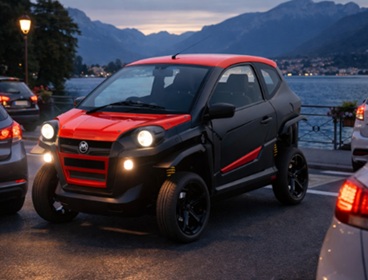
Aixam Mega (e-Scouty)
Country of production
The Aixam Mega (Aixam’s MEGA line, marketed in Europe mainly as the e-Scouty) is produced in France, within Aixam’s industrial hubs in the Auvergne-Rhône-Alpes region (group supply chain and assembly).

Market launch date
2023: start of commercialization of the MEGA e-Scouty (model introduction on the European market).
2024: range and positioning updates ahead of the next commercial season (strengthening of the group’s electric line-up).
2025: introduction/adoption of the Evo (MY25) trim in some price lists and catalogues, with updated equipment.
Facelifts and key updates
No classic structural facelift (bodywork/architecture) for the e-Scouty is evident across 2023–2025; evolution has been mainly through trims and equipment.
MY25 update / Evo trim (2025): increased “tech” and comfort content (display, infotainment/tablet solutions, finishes and styling details), while keeping the underlying quadricycle layout unchanged.
The Aixam Mega e-Scouty is an L6e electric minicar (top speed 45 km/h) with a more “crossover” attitude than typical segment citycars: mini-SUV look, higher seating, and a more distinctive design. It is intended for urban and light peri-urban use: easy parking, simple driving (automatic/variator-type transmission), and equipment aimed at delivering a “car-like” experience (infotainment, rear camera, connectivity) while staying within the technical and legal limits of a 45 km/h vehicle.
Powertrain and performance
| Caratteristica | Mega e-Scouty (L6e, 45 km/h) |
|---|
| Motor / layout | 1 electric motor, FWD |
| Power | 6 kW (8 hp) (typical declared value) |
| Max torque | 40 Nm (typical declared value) |
| Top speed | 45 km/h |
| Battery (lithium-ion) | ~5.5–7.5 kWh (depending on year/trim and technical source) |
| Declared range | ~75–113 km (depending on battery size and declared cycle) |
| Charging | household socket (typical times of a few hours, depending on battery capacity and available power) |
Note: for the e-Scouty, different battery/range figures appear depending on model year, trim, and the homologation metric referenced (indicative values to be verified against the price list for the specific year).
Dimensions and capacity
| Specifica | Misura |
|---|
| Length | ~2,650–2,720 mm (depending on trim/technical sheet) |
| Width | ~1,500 mm |
| Height | ~1,390 mm |
| Wheelbase | ~1,740 mm |
| Seats | 2 |
| Kerb weight (indicative) | ~380–500 kg (depends on trim and declared criteria) |
| Trunk (indicative) | some sheets declare up to ~700 dm³ (metric not always consistent across sources) |
Main trims and prices
(Indicative prices; they may vary with promotions, dealer network, and list updates.)
| Version | Da (€) |
|---|
| Mega e-Scouty | ~13,600–14,000 |
| Mega e-Scouty Evo (MY25) | ~14,000 (indicative, depending on catalogues/price lists) |
Practical note: real-market variability is high due to packs, campaigns, and dealer availability.
Maintenance and early service (indicative costs)
(Estimates for electric minicars/quadricycles: high variability by network, geography, and tires.)
| Intervention | Typical cost (€) |
|---|
| Periodic check/service | 150–300 |
| Brake fluid (periodic) | 70–150 |
| Front brake pads | 120–260 |
| Front discs + pads | 320–650 |
| Tire (each, small sizes) | 80–170 |
| 12 V battery (if needed) | 120–240 |
| Roadworthiness inspection (legal deadlines) | 45–80 |
Pros
Distinctive “crossover” style: a more personal image than more neutral minicars.
Simple driving and urban usability: compact footprint and a top speed consistent with city/suburban use.
Often well-equipped for the category (infotainment, rear camera/sensors depending on trim).
Electric drivetrain: quieter and typically more comfortable than equivalent diesel L6e models.
Cons
Structural category limits: 45 km/h and a city focus, not suited to real extra-urban use.
Real range is sensitive to temperature, route, and driving style; declared figures vary widely by version.
Purchase price can feel “high” compared with scooters or conventional used cars (different use logic).
Some technical sheets show non-uniform data (battery, trunk, weight): verification on the year-specific price list is recommended.
In summary
The Aixam Mega (e-Scouty) is an electric minicar for those who want a 45 km/h vehicle with a more “crossover” stance and everyday equipment. No recent structural facelift is evident, but the product has evolved through trims (notably Evo/MY25) and technology content. It makes sense as a distinctive, “protected” urban vehicle, provided you verify the exact battery/range specification of the version you are buying.
Verdict — Aixam Mega e-Scouty Evo (model year 2025)
Electric minicar (light quadricycle L6e) · 2 seats · Front-wheel drive · Automatic CVT · 6 kW (8 hp) electric motor, 40 Nm · 5.54 kWh battery · Standard cycle range 75 km · Top speed 45 km/h · Boot (load volume) 422 L · Dimensions: 2,650 mm (L) × 1,500 mm (W), wheelbase 1,795 mm · Curb weight 380 kg · Price “from” €13,999 · Relevant option: auxiliary heater · Market launch: e-Scouty project introduced in 2023; e-Scouty Evo listed in the 2025 catalog (range update)
Aixam Mega (in e-Scouty Evo form) is an electric minicar with a very clear positioning: maximum urban agility, a “mini-cross” look, and equipment targeted at simple everyday use. In 2025 the formula aligns with the city context: compact dimensions, easy turning and parking, immediate driving thanks to the CVT, and potentially low running costs as long as use stays within an urban and near-urban perimeter.
The main limitation is not technical but “mission-driven”: being L6e, the 45 km/h top speed and the typical circulation rules of the category define a predominantly city-focused use case. Also, the claimed cycle range (75 km) requires disciplined charging: if you do not have a convenient socket where you live or work, the experience can become more complicated than the “minicar” format suggests.
Key technical points:
Category and usage rules (L6e context)
Motor and transmission
6 kW (8 hp) electric motor, 40 Nm.
Front-wheel drive; automatic transmission with CVT (forward/neutral/reverse selection via reducer/inverter).
Battery, range and charging
5.54 kWh battery.
Standard cycle range 75 km (real-world range can vary significantly with temperature, route, and driving style).
Charging: household/nearby solution (time and power depend on infrastructure and configuration).
Structure, dimensions and load capacity
Claimed load volume 422 L; 2 seats.
Dimensions: 2,650 mm (L) × 1,500 mm (W); wheelbase 1,795 mm.
Curb weight 380 kg; maximum authorized mass 635 kg.
Mid-cycle updates
| Category | Where it shines | Where it holds steady | Where it falls short |
|---|
| Design & image | Distinctive “mini off-road” look, easy to spot | Good road presence for the category | Less personalization than more lifestyle-oriented minicars |
| Urban mobility | Compact footprint and easy parking | Simple driving (CVT) | 45 km/h: not suitable for fast traffic flows |
| Practicality | Claimed 422 L boot volume: useful for the class | 2 seats work well for urban commuting | Less versatile than an M1 passenger car |
| Range | 75 km cycle range fits short trips | Adequate for a city routine | Real range is sensitive to climate/route; requires disciplined charging |
| Comfort | “Car-like” cabin layout for the segment | Good baseline ergonomics | Heating not always standard: an option to assess |
| Ownership costs | EV: potentially low energy and routine maintenance | Simplified mechanicals | Insurance/residual value depend on the local market |
| Rules & perceived safety | Clear L6e regulatory framework | Equipment coherent with the category | Not an M1 car: city-car expectations are not appropriate |
Who it is for
City (or immediate-suburban) users with short, repetitive trips, prioritizing parking, simplicity, and predictable costs. It makes sense as a family second vehicle, a youth vehicle (where permitted), or a dedicated urban runabout.
Who should consider alternatives
If you often need faster extra-urban routes, want car-like comfort (air conditioning, insulation, performance), or need a full replacement for a city car (4 seats and M1-level safety/versatility), a conventional passenger car—or an L7e microcar (with different requirements)—is more coherent.
Recommended configuration
e-Scouty Evo in an “essential” configuration if your use is pure urban and you have convenient charging (garage/authorized socket).
If you live in colder areas or use the vehicle year-round, the auxiliary heater is an option to prioritize.
Before buying, always verify: where you will charge, which routes are permitted in your area, and local circulation rules for L6e.



 Aixam MEGA e-Scouty