

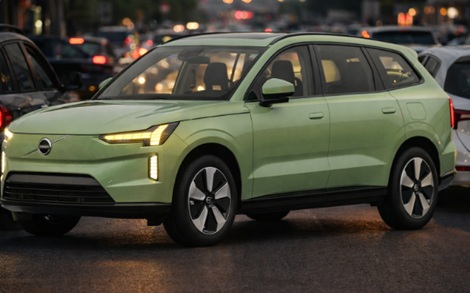
Volvo EX90
Country of production
The Volvo EX90 is produced in the United States, at Volvo’s Ridgeville (Charleston area), South Carolina plant.
Market launch date
9 November 2022: global model debut.
Second half of 2024: start of first customer deliveries (USA and Europe), with ramp-up between Q4 2024 and Q1 2025.
June 2024: start of production at the Charleston plant.
Short description
The EX90 is Volvo’s flagship fully electric SUV in a large 7-seat format, designed around comfort, quietness, and safety. The cabin follows a very clean Scandinavian minimalism, paired with top-tier technology (software platform and Google-based infotainment/services, OTA updates, and an advanced ADAS suite). On the road it aims for a soft, stable “long-distance cruiser” feel, with consistently strong performance thanks to instant torque; the latest 800 V electrical architecture (newer model year) also emphasizes fast charging.

Powertrain and performance
| Spec | Single motor (RWD) | Twin motor (AWD) | Twin motor performance (AWD) |
|---|
| Motor / layout | 1 motor, RWD | 2 motors, AWD | 2 motors, AWD |
| Max power | 245 kW / 333 hp | 335 kW / 456 hp | 500 kW / 680 hp |
| Max torque | 480 Nm | 670 Nm | 870 Nm |
| 0–100 km/h | 6.8 s | 5.5 s | 4.2 s |
| Top speed | 180 km/h | 180 km/h | 180 km/h |
| Consumption (WLTP weighted) | 18.5 kWh/100 km | 19.3 kWh/100 km | 19.3 kWh/100 km |
| Battery (nominal) | 92.0 kWh | 106.0 kWh | 106.0 kWh |
| Range (WLTP weighted) | up to 566 km | up to 620 km | up to 620 km |
| Electrical architecture | 800 V | 800 V | 800 V |
| AC charging 0–100% (3-phase 16A) | 10 h | 11 h | 11 h |
| DC charging 10–80% (up to 350 kW) | 22 min | 22 min | 22 min |
Dimensions and capacity
| Specification | Value |
|---|
| Length | 5,037 mm |
| Width (without mirrors) | 1,964 mm |
| Width (with mirrors) | 2,113 mm |
| Height | 1,744 mm |
| Wheelbase | 2,985 mm |
| Turning circle | 12 m |
| Trunk (behind 3rd row) | 377 L |
| Trunk (behind 2nd row) | 1,045 L |
| Trunk (rows folded) | 2,082 L |
| Frunk (front) | 46 L |
Main trims and prices
| Version | From (€) |
|---|
| Single motor RWD Plus | 88,200 |
| Twin motor AWD Plus | 94,100 |
| Twin motor performance AWD Plus | 99,150 |
| Twin motor AWD Ultra | 103,400 |
| Twin motor performance AWD Ultra | 108,450 |
(Indicative “on-the-road” prices: they may vary due to promotions, options, and dealer/on-the-road fees; some local tax items may be included/excluded depending on the price list. Ultra versions include a specific package indicated in the pricing document.)
Maintenance and early service (indicative costs)
(Estimates for a premium electric SUV: they can vary by official network, city, 21–22" tires, and service packages.)
| Intervention | Typical cost (€) |
|---|
| Annual check/service | 250–500 |
| Brake fluid (periodic) | 90–180 |
| Cabin filter | 80–160 |
| Front brake pads | 300–600 |
| Front discs + pads | 800–1,400 |
| Tire (each, 21–22") | 280–520 |
| Alignment/suspension setup (if needed) | 80–160 |
Pros
Very competitive WLTP range for a large SUV (up to 620 km declared on AWD versions).
800 V architecture and claimed fast charging 10–80% in ~22 min (favorable conditions).
True 7-seat usability, with real cargo capacity and a useful frunk.
Flagship-level comfort and sound insulation: coherent setup for long journeys.
Cons
High mass: inevitable on a large electric SUV, affecting real-world consumption and dynamics when pushing.
Price and options: reaching the “ideal” specification can increase the total quickly, especially in Ultra.
“Software-first” experience: many functions run through the screen; those who prefer physical controls may find it less immediate.
In summary
The Volvo EX90 is a high-end electric SUV designed as a family flagship: lots of technology, lots of comfort, and (in the newest configuration) a technical base that also emphasizes charging thanks to the 800 V architecture. The Single motor is the most rational choice if you want 7 seats and strong range while keeping price and complexity lower; the Twin motor versions add traction and towing capability; the Twin motor performance is for those seeking sports-car-like acceleration in a large SUV body, accepting higher costs and tire management.
Verdict — Volvo EX90 (Model year 2025)
Full-size premium electric 7-seat SUV · Main trims: Twin motor AWD and Twin motor performance AWD · Battery 111 kWh (nominal) / 107 kWh (usable) · Estimated range 566–620 km (depending on powertrain) · DC charging up to 250 kW (10–80% ~30 min) · Top speed 180 km/h · 0–100 km/h from 5.9 s (Twin motor) to 4.9 s (Twin motor performance) · Price “from” €94,100 (depending on trim and equipment) · Market launch: first customer deliveries September 2024 (distribution and deliveries ramp-up)
The Volvo EX90 is Volvo’s flagship-style take on the reference electric SUV: large, 7-seat, strongly comfort- and safety-oriented, with a software-defined approach (Google built-in infotainment, OTA updates, and an advanced electronic architecture). In 2025 the EX90 is conceived as a premium family long-distance EV rather than a sporty SUV: throttle response is immediate, but calibration prioritizes ease, stability, and relaxed touring.
Its value comes through in real use: space and modularity, advanced driver assistance (depending on packs/market), and a battery/charging package designed to make medium-to-long trips credible—provided you have regular access to HPC infrastructure.
Key technical points:
Powertrains and drivetrain:
Twin motor AWD: 300 kW (408 hp), 770 Nm, 0–100 km/h 5.9 s.
Twin motor performance AWD: 380 kW (517 hp), 910 Nm, 0–100 km/h 4.9 s.
Battery and range: 111 kWh (nominal) / 107 kWh (usable); estimated range 566–620 km (depending on powertrain and configuration).
Charging: DC up to 250 kW, 10–80% ~30 minutes (favorable conditions); AC typically 11 kW (market/config-dependent).
Project performance stance: top speed 180 km/h (limited), consistent with an efficiency-and-safety focus.
Dimensions and space: length ~5,037 mm, wheelbase ~2,985 mm; 6- or 7-seat layouts depending on market/trim.
Boot (7-seat): up to 377 L with all rear seatbacks up (claimed figure for 7-seat layout; varies by configuration).
| Category | Where it shines | Where it holds steady | Where it falls short |
|---|
| Comfort & space | True 7-seat capability, credible long-distance comfort | Strong balance for family and touring | Large footprint in cities and tight parking |
| Efficiency & range | High claimed range for the class (up to ~620 km estimated) | Good coherence for mixed use | Real range is sensitive to speed, climate, and tires |
| Charging & touring | 250 kW DC and 10–80% ~30 min | Easier trip planning with HPC | Experience depends heavily on charger network quality and congestion |
| Performance | Instant, linear thrust; Performance trim is very quick | Twin motor is already more than sufficient | Not a “driver’s SUV”: comfort and stability take priority |
| Safety & ADAS | Safety-first concept with advanced assistance | Strong motorway and traffic logic | Features and availability can vary by market/spec |
| Technology & connectivity | Modern, updateable digital ecosystem | Comprehensive infotainment and connected services | Software/updates matter: long-term maturity depends on release cadence |
| Ownership costs | EV: potential benefits on energy and routine maintenance | Predictable if you charge at home/work | Tires/insurance typical of a large SUV; high purchase price |
Who it is for
Families and buyers who want a truly spacious premium electric SUV, with a long-distance touring focus and strong attention to safety, comfort, and technology. It is particularly coherent if you use the 7 seats and have a charging routine (home/work + HPC for travel).
Who should consider alternatives
If your priorities are maximum urban agility, lower entry cost, or a more overtly sporty chassis/steering character, the EX90 may feel oversized. Also, if you cannot charge regularly, you may not exploit the economic and practical benefits of an EV in this size class.
Recommended configuration
Twin motor AWD for the best balance of performance, comfort, and overall cost: it is already very strong in real-world terms and tends to be the more rational choice.
Twin motor performance AWD only if you explicitly want the strongest acceleration and thrust, accepting a more performance-leaning profile (and potentially higher energy use for the same usage pattern).
In both cases, to maximize the experience: prioritize a home charging solution, ADAS packs aligned with your touring needs, and avoid overly extreme wheel/tire choices if comfort and range are the goals.