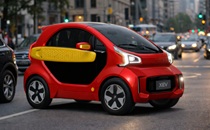
XEV YoYo
Country of production
The XEV YoYo is produced in China (production start referenced at an XEV facility in the Shanghai area), with brand setup and development that have had a strong link to Italy (concept and early presentations around the Turin area).
Short description
The YoYo is an L7e electric quadricycle designed for the city: two seats side by side, ultra-compact dimensions (2.53 m), and a “microcar” layout closer to a car than to a scooter, with a closed body and useful equipment (air conditioning and infotainment, depending on version). Its key trait is an “easy-ready” urban mobility approach: performance suited to the context (declared top speed up to 90 km/h) and a battery of about 10.4 kWh with a declared range up to 150 km. In some contexts, the concept of battery swap (quick replacement) is also highlighted as a solution/service, where available locally or within fleets.
Powertrain and performance
| Spec | YoYo / YoYo Pro (L7e) |
|---|
| Motor / layout | 1 rear electric motor, RWD |
| Rated power | 7.5 kW |
| Peak power | 15 kW |
| Battery | LiFePO4, 10.4 kWh |
| Range (declared) | up to 150 km |
| Top speed (declared) | up to 90 km/h |
| Charging (AC) | household outlet / AC |
| Charging time (indicative) | ~4 h (typical references 30–100% at low power; variable) |
Dimensions and capacity
| Specification | Value |
|---|
| Length | 2,530 mm |
| Width | 1,500 mm |
| Height | 1,560 mm |
| Wheelbase | 1,680 mm |
| Weight (running order, indicative) | ~450 kg |
| Trunk (min) | 180 L |
| Seats | 2 |
Main trims and indicative pricing
| Version | From (€) |
|---|
| YoYo | ~16,900–16,990 |
| YoYo Pro | ~17,990 |
(Indicative pricing: it can vary significantly with promos, km0, local incentives, on-the-road fees, and the actual equipment. Some “promo” offers may fall well below list price.)
Maintenance and early service (indicative costs)
(Estimates for an L7e electric microcar: they depend on the network, geographic area, and tires. On BEVs, mechanical interventions are reduced, but checks, brakes, and tires remain.)
| Intervention | Typical cost (€) |
|---|
| Annual check/service | 150–350 |
| Brake fluid (periodic) | 80–150 |
| Cabin filter (if fitted) | 50–120 |
| Front brake pads | 120–250 |
| Tire (each) | 80–160 |
| 12 V auxiliary battery (if needed) | 120–220 |
Pros
Ideal dimensions and maneuverability for city driving and parking.
Context-appropriate performance: declared up to 90 km/h for L7e.
LiFePO4 battery of ~10.4 kWh with a declared range up to 150 km, suitable for daily trips.
180 L trunk: usable for the category.
Cons
Comfort and finishes: they remain those of a microcar, with inevitable compromises versus a conventional car.
Safety and extra-urban behavior: it is not a “small car” but a quadricycle; the intended use should be evaluated carefully.
AC charging typically at modest power: for shorter times you need planning (or dedicated services where present).
Price: with higher trims or without incentives it can approach more “car-like” BEVs in higher segments (albeit with larger footprints).
In summary
The XEV YoYo is an L7e electric microcar built for urban mobility: compact, simple, and with a declared range that can cover most city travel. It makes sense if the goal is maximum ease of movement and parking, accepting the structural limits of the quadricycle format; the choice between YoYo and YoYo Pro should be made mainly on equipment and comfort rather than pure performance.
Verdict — XEV YoYo (Model year 2025, L7e “heavy quadricycle”)
Premium electric microcar · Homologation: L7e (heavy quadricycle) · Seats: 2 · Doors: 3 · Drivetrain: rear-wheel drive · Rated power 7.5 kW, peak power 15 kW · LiFePO4 battery 10.4 kWh · Claimed range up to 150 km · Top speed up to 90 km/h · AC charging (Type 2, typical power up to 2.3 kW in some specifications) · Battery swapping function (quick battery-module replacement) · Drivable from age 16 with B1 licence (or B)
The XEV YoYo is an electric microcar that sits outside the traditional quadricycle playbook: ultra-compact dimensions, an urban/peri-urban focus, but with a higher top speed (up to 90 km/h) that makes it more flexible than many L6e 45 km/h microcars. Its key differentiator is the “manageable battery” philosophy: beyond conventional charging, it also promotes battery swapping, i.e., the ability to quickly replace battery modules where the service is available.
In 2025 it should be understood for what it is: a light-mobility solution with some “car-like” features (depending on trim—e.g., up to a 10" touchscreen display, panoramic roof, comfort equipment), designed for potentially lower operating costs and effortless parking. In return, you accept the segment’s inherent limits (2 seats, less protection/comfort than a conventional city car, and AC charging that is not “fast” like a higher-segment BEV).
Key technical points:
Homologation and usage: L7e, drivable from age 16 with B1 (or B), suited to city and inner suburbs; it is not a full city car for sustained motorway use.
Performance: top speed up to 90 km/h; 7.5 kW rated and 15 kW peak power (coherent with the microcar role).
Battery and range: LiFePO4 chemistry, 10.4 kWh capacity; claimed range up to 150 km (typically highly dependent on test cycle, temperature, and driving style).
Charging and energy management: AC charging via Type 2 (power cited up to 2.3 kW in some spec sheets) plus battery swapping availability (where the service exists).
Dimensions and maneuverability: about 2.53 m long and 1.50 m wide; turning radius around 4.0 m (a real advantage in traffic and parking).
Cabin and equipment (trim-dependent): infotainment up to 10" (not on all versions), panoramic roof; equipment and packs vary widely by market and dealer network.
| Category | Where it shines | Where it holds steady | Where it falls short |
|---|
| Urban mobility | Tiny footprint, extremely easy parking | Agile and light-feeling in the city | Not a 1:1 replacement for a conventional city car |
| Usage flexibility | 90 km/h: more versatile than many microcars | Suitable for ring roads and flowing routes | Not designed for motorways and long high-speed trips |
| Running costs | EV: potential savings on energy and routine maintenance | Simple ownership if you can charge at home | AC charging is typically slow (limited power) |
| Range | Claimed up to 150 km | Adequate for urban/peri-urban commuting | Sensitive to climate, speed, and driving style |
| Smart tech angle | Battery swapping as a differentiator | Interesting infotainment/equipment (trim-dependent) | Swapping service and features can depend on area/trim |
| Practicality | True two-seat layout, excellent as a second vehicle | Strong for repeatable daily trips | Always two seats: no “family” flexibility |
Who it is for
Drivers who want a compact electric microcar that is more usable than 45 km/h L6e options, with very practical urban manners and the ability to build a simple charging routine (home/office), while also checking whether battery swapping is actually available in their area.
Who should consider alternatives
If you need 4 seats, comfort closer to a real supermini, or frequent extra-urban driving at higher speeds, a conventional city car (even used) or a higher-segment compact EV is often more coherent. Also, if you do not have a convenient and predictable charging solution, the ownership experience can be less “plug & go” than it appears.
Recommended configuration
Choose the trim with the features that materially affect daily use: climate control, full infotainment where offered, and comfort items that improve livability and resale.
Before buying, verify two practical factors that can change the entire experience: access to convenient charging (socket/wallbox) and the real availability of battery swapping in your area (if it is a key value driver for you).



 YoYo pros, cons, costs and common fixes