

Maserati GT2 pros, cons, costs and common fixes
Rating : 10
| Evaluation | N. Experts | Evaluation | N. Experts |
|---|---|---|---|
| 1 | 6 | ||
| 2 | 7 | ||
| 3 | 8 | ||
| 4 | 9 | ||
| 5 | 10 |
0 pts from Al222
| Sign up to vote this object, vote his reviews and to contribute to Tiiips.Evaluate | Where is this found? |
| "Descrizione" about Maserati GT2 pros, cons, costs and common fixes by Al222 (24052 pt) | 2025-Dec-28 16:23 |
| Read the full Tiiip | (Send your comment) |
Maserati GT2
Country of production
The Maserati GT2 is developed and built within Maserati Corse, with a supply chain and key technical content that are Made in Italy, including engineering and core components linked to the Modena hub (viale Ciro Menotti) for the Nettuno powertrain and motorsport activities.
Short description
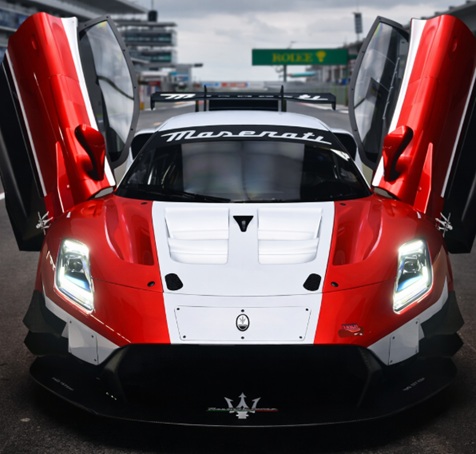
The GT2 is a competition car not road-homologated, homologated for the FIA GT2 category and derived (as a homologation base) from the MC20. It is a customer racing machine engineered to maximize aerodynamic efficiency, rigidity, and operational usability in a race environment: central carbon-fiber monocoque, FIA safety equipment (roll cage and dedicated systems), racing braking system, and “endurance-ready” solutions such as pneumatic jacks (air jacks) for rapid pit-lane operations. Output is subject to BoP (balance of performance), so final performance figures depend on regulations and the specific series/championship setup.

Powertrain and performance
| Spec | GT2 |
|---|---|
| Engine / layout | 3.0 V6 twin-turbo “Nettuno” 90°, rear-mounted, MC20-based |
| Power | 621 hp (463 kW) in base configuration, variable depending on BoP |
| Max torque | 730 Nm (reference figure; application subject to regulations) |
| Lubrication | dry sump |
| ECU | Bosch MS 6.4 EVO |
| Drivetrain / differential | rear-wheel drive, mechanical limited-slip differential |
| Gearbox | racing 6-speed sequential with paddle shift |
| Controls | adjustable racing ABS, Maserati Corse traction control |
| 0–100 km/h | n.a. (not meaningful for a race car; depends on BoP/gearing/tires) |
| Top speed | n.a. (depends on BoP, gearing, and aero configuration) |
| Consumption / emissions | n.a. (WLTP-style figures do not apply to a race car) |
Note: BoP = balance of performance, a regulatory system that harmonizes performance among different models through technical parameters (weight, power, etc.).
Dimensions and capacity
| Specification | Value |
|---|---|
| Length | 4,838 mm |
| Width (without mirrors) | 2,030 mm |
| Wheelbase | 2,700 mm |
| Dry weight | depends on BoP |
| Fuel tank | FIA FT3 120 L |
| Seats | 1 (passenger seat kit available as an option, depending on regulations) |
Main trims and pricing
| Version | From (€) |
|---|---|
| GT2 (customer racing) | on request (Maserati Corse program) |
Note: the car is sold through motorsport/customer racing channels; price and package depend on equipment, support, and championship requirements.
Maintenance and typical interventions (indicative costs)
(Estimates for a GT race car: they vary widely depending on series, race mileage, driving style, setup, and the level of technical support.)
| Intervention | Typical cost (€) |
|---|---|
| Engine service/checks between events (fluids, inspections, consumables) | 800–1,800 |
| Front brake pads (racing) | 900–1,800 |
| Front brake discs (pair, steel racing) | 1,800–3,500 |
| Slick/rain tires (set, depending on series supplier) | 1,600–3,200 |
| Sequential gearbox service (intervals depend on use) | 1,500–4,000 |
| Suspension component overhaul/servicing (per race hours) | 800–2,500 |
| Composite bodywork damage/small parts (variable) | 500–10,000+ |

Pros
GT2-homologated project with an MC20 base and technical content consistent with a true customer race car.
Carbon-fiber monocoque and comprehensive FIA safety package.
Brakes, suspension, and electronics designed for consistency and manageability in racing.
FT3 120 L fuel tank and air jacks: a practical setup for competitive operations.
Adaptability across different championships thanks to the BoP framework.
Cons
“Brochure-style” figures (0–100, top speed) are not very meaningful: everything depends on BoP and championship configuration.
High and variable operating costs (tires, brakes, composite spares, technical support).
Not a “plug-and-play” product: it requires logistics, expertise, and maintenance discipline typical of motorsport.
Potential regulatory limits on certain options (e.g., passenger seat kit).
In summary
The Maserati GT2 is a customer racing car built around the MC20 platform and the Nettuno V6, homologated for the FIA GT2 category. It is designed to deliver professional-grade rigidity, safety, and drivability, with practical paddock solutions (FT3 tank and air jacks) and performance governed by BoP. It is the right choice for teams and drivers seeking a modern GT with a Maserati identity and Corse support, accepting the costs and complexity inherent to competition.
Verdict — Maserati GT2 (Program 2024–2025)
Single-seat race car not road-homologated · Homologated for the GT2 class · Homologation basis: MC20 · 90° 3.0L twin-turbo V6 “Nettuno” with output subject to BoP (declared base 463 kW / 630 hp) · Rear-wheel drive · Racing 6-speed sequential gearbox with paddles · Ultra-light central carbon-fiber monocoque · Dry weight subject to BoP · FIA FT3 120-liter fuel tank · Brakes: ventilated steel discs 390 mm (front) / 355 mm (rear) with adjustable racing ABS · Adjustable rear wing and fully closed carbon underfloor
The Maserati GT2 marks the Trident’s return to covered-wheel GT competition with a product designed for private teams and gentleman drivers: a car developed from the MC20’s technical DNA, but optimized for modern motorsport requirements (reliability, approachable drivability, broad adjustability, and robust thermal management). At its core is the Nettuno V6 with MTC (Maserati Twin Combustion) technology, paired with a sequential transmission and an electronic package built to make performance repeatable session after session.
The philosophy is intentionally minimalist and functional: FIA-homologated roll cage, full-composite quick-release bodywork to speed up pit work, integrated pneumatic air jacks, and chassis hardware geared toward adjustability (anti-roll bars and dampers). On track, the car aims for a pragmatic balance between pace and drivability, with tunable controls (ABS and traction) and race-management tools (engine maps, pit limiter, safety-car procedures) designed for real championship scenarios.
Key technical points:
Engine and power: 3.0L twin-turbo V6 “Nettuno” with BoP-dependent power (declared base 463 kW / 630 hp), dry-sump lubrication, Bosch MS 6.4 EVO ECU, racing exhaust with twin central outlets and catalyst.
Transmission and drivetrain: 6-speed racing sequential gearbox with paddles, racing clutch, and mechanical limited-slip differential (LSD), rear-wheel drive.
Chassis and safety: central carbon monocoque, FIA roll cage (Art. 277), 120-liter FT3 fuel tank, roof safety hatch, and polycarbonate windows.
Brakes and controls: monobloc calipers (6-piston front, 4-piston rear), ventilated steel discs 390/355 mm, remote brake-bias adjustment, optimized cooling, and adjustable racing ABS.
Suspension and set-up: double wishbones front and rear, adjustable anti-roll bars, motorsport dampers adjustable in 2 ways, electric power steering (selectable settings), single-center-lock hubs.
Aerodynamics and bodywork: lightweight full-composite body, adjustable rear wing, fully closed carbon underfloor, and cooling solutions/air exits engineered for intensive use.
| Category | Where it shines | Where it holds steady | Where it falls short |
|---|---|---|---|
| Racing design & reliability | Layout and components built for severe use (cooling, accessibility, air jacks) | Solid technical base derived from the MC20 | Highly dependent on team operations and planned maintenance |
| Drivability & control | Adjustable racing ABS, traction control, broad set-up range | Designed to be approachable for gentleman drivers | Still requires experience: it is a true racing GT, not a “training car” |
| Championship performance | Competitive potential demonstrated in the GT2 European Series | Good balance of pace and consistency | BoP can materially influence results |
| Set-up & track adaptability | Bars, dampers, and brake-bias can be managed quickly | Adjustments are coherent with race-weekend workflows | Set-up is sensitive: method and telemetry matter |
| Pit operations | Quick-release bodywork, air jacks, pit-focused component design | Race functions (maps, pit limiter) integrated | Operating costs and consumables remain pure racing-grade |
| Economics (costs & value) | Attractive program for private teams and GT2 categories | Maserati brand and rarity support interest | Tires/brakes/transport budget and labour hours are significant |
Who it is for
Private teams, gentleman drivers, and organizations that want a “real” race GT, homologated for the GT2 class, suitable for championships and events where the category is eligible (with particular reference to the Fanatec GT2 European Series Powered by Pirelli). It is a coherent choice for those targeting repeatable performance, clear adjustment logic, and a technical package built for full race weekends.
Who should look elsewhere
If you need a car that can be driven on public roads, the GT2 is not the right tool by definition (it is not road-homologated). Likewise, anyone without adequate technical and logistics infrastructure is unlikely to exploit its potential.
Recommended configuration
In GT2 racing, “configuration” is fundamentally about set-up and operational discipline: start from a conservative baseline (bars/dampers and ride heights) to maximize consistency, then refine brake bias and ABS/traction calibrations to suit track, temperature, and tire degradation. For a gentleman-driver program, the priority is reducing variability (stable balance, calibrated controls, temperatures under control) before chasing a single-lap peak. In longer events/endurance-style use, it makes sense to prioritize brakes and cooling, alongside a tire strategy that protects the performance window.
| Sign up to vote this object, vote his reviews and to contribute to Tiiips.EvaluateClose | (0 comments) |
Read other Tiiips about this object in __Italiano (1)
Last update:   2025-12-28 12:46:53 |

