

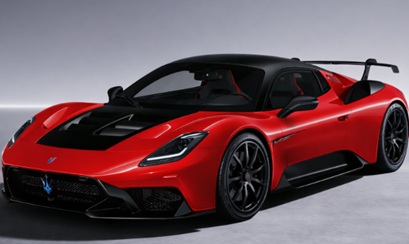
Maserati GT2 stradale
Country of production
The Maserati GT2 Stradale is produced in Italy, at the Maserati plant in Modena (viale Ciro Menotti), the brand’s historic hub for supercar production.
Short description
The GT2 Stradale is the road-homologated version derived from the GT2 race car, based on the MC20 technical package but with an even more focused setup. It is a two-seat, mid-engine car with a carbon-fiber monocoque, rear-wheel drive, and an aero and chassis configuration designed to maximize precision and stability under load, without making road use impractical. The Nettuno V6 is uprated to a higher output level (640 hp), and the car adopts typical track-car solutions: performance-oriented electronic management, high-downforce aerodynamics, and lightweight components. In the city, the front lifter (front-axle lift) helps clear speed bumps and ramps, while on fast roads the GT2 Stradale behaves like a sharpened supercar, with quick reactions and very high grip.

Powertrain and performance
| Spec | GT2 Stradale |
|---|
| Engine / layout | 3.0 V6 twin-turbo “Nettuno”, mid-engine |
| Power | 640 hp (471 kW) |
| Max torque | 720 Nm |
| Drivetrain | rear-wheel drive |
| Transmission | 8-speed dual-clutch automatic |
| 0–100 km/h | 2.8 s |
| Top speed | 324 km/h |
| Combined consumption (WLTP) | 11.6 L/100 km |
| CO₂ (WLTP) | 265 g/km |
Key technical notes (practical use)
Front lifter: +50 mm, operable up to around 40 km/h, useful over speed bumps and ramps.
Track-focused chassis and aerodynamics, with a very high declared downforce (specific configuration).
Dimensions and capacity
| Specification | Value |
|---|
| Length | 4,669 mm |
| Width (without mirrors) | ~1,965 mm |
| Width (with mirrors) | 2,178 mm |
| Height | 1,222 mm |
| Wheelbase | 2,700 mm |
| Dry weight | 1,365 kg |
| Rear trunk | 100 L |
| Fuel tank | 60 L |
Main trims and pricing
| Version | From (€) |
|---|
| GT2 Stradale | ~312,000 |
(Indicative price; it may vary with options, performance packages, personalization, and on-the-road fees. The car is offered as a limited series.)
Maintenance and early service (indicative costs)
(Estimates for a supercar / track-oriented car: they can vary widely by official network, track use, city, and service packages.)
| Intervention | Typical cost (€) |
|---|
| Annual service / 10–15,000 km | 900–1,700 |
| Brake fluid replacement (road use) | 150–350 |
| Front brake pads | 800–1,600 |
| Front discs + pads | 2,200–4,500 |
| Tire (each, performance sizes) | 400–800 |
| Alignment / geometry (if needed) | 180–400 |
| 12 V auxiliary battery (if needed) | 250–550 |
Pros
Benchmark performance for an RWD car: 0–100 km/h in 2.8 s and 324 km/h top speed.
Carbon-fiber chassis and more extreme setup: high precision and very fast responses.
High-downforce aerodynamics and a track-centric brief, while retaining full road homologation.
Front lifter improves real-world usability on public roads and in urban environments.
Exclusivity: niche positioning and limited production.
Cons
Inevitably limited practicality: it is a two-seater with a 100 L trunk.
High operating costs (tires, brakes, insurance) and potentially much higher with track use.
Performance-focused suspension and tires: on rough surfaces it demands attention and comfort compromises.
Options and packages can substantially increase the final price.
In summary
The Maserati GT2 Stradale is a road supercar with a competition-derived DNA: lighter, more powerful, and sharper than the MC20 baseline, with a balance clearly oriented toward spirited driving. It is the choice for those who want a Maserati that can be used on the road, but with clear priorities on precision, aerodynamics, and track-car sensations—accepting the typical compromises of a limited-run, high-performance machine.
Verdict — Maserati GT2 Stradale (Model year 2025)
Road-legal supercar with racing derivation · Limited series of 914 units · 3.0L twin-turbo V6 “Nettuno” 640 hp and 720 Nm · Rear-wheel drive · 8-speed dual-clutch automatic · 0–100 km/h 2.8 s · Top speed 324 km/h · Aerodynamic downforce up to 500 kg at 280 km/h (with “high-drag” wing setting) · Claimed dry weight 1,365 kg
The Maserati GT2 Stradale is the “road-and-track” interpretation of the MC20 project, developed in parallel with the GT2 race car and designed to bring circuit-grade components and logic onto the road: more effective aerodynamics, a stiffer set-up, and an electronic control package calibrated for semi-slick tyres and intensive use. The result is a supercar that remains road-usable, but makes full sense when driven in high-grip, high-speed environments, where aero and brakes genuinely change the outcome.
The cabin retains the essential, driver-centered layout typical of the MC20 family, with seats and controls oriented toward control and repeatability. The track intent is clear in the content: racing seats as standard, the option of 4-point harnesses and a rear bar (linked to performance packages), plus dedicated pages for telemetry and vehicle parameters. This is a car for those who prioritize feedback, precision, and dynamic coherence over GT-style comfort.
Key technical points:
Engine and performance: 3.0L twin-turbo V6 Nettuno delivering 640 hp and 720 Nm, with a claimed 0–100 km/h in 2.8 s and a top speed of 324 km/h.
Functional aerodynamics: multi-position adjustable rear wing, optimized splitter and underbody; downforce up to 500 kg at 280 km/h (the “high-drag” configuration), with revised balance versus the MC20.
Transmission and drivetrain: rear-wheel drive and an 8-speed DCT (wet clutch), with reduced shift times to emphasize sporting response.
Chassis and steering: geometry and calibrations derived from the track version, with targeted stiffening and dedicated tuning for severe use; the “suspension” button helps make the set-up more manageable on uneven surfaces even in sportier modes.
Brakes and cooling: a Brembo-developed system, with revised discs and thermal management (including dedicated ducting) to improve repeatability in track use.
Performance packages:
Performance pack: Michelin semi-slicks, e-LSD, carbon-ceramic brakes, fender vents, and specific ESC/MSP/ABS calibrations.
Performance plus: adds further racing-oriented content (e.g., 4-point harness provisions and track-focused equipment).
Corsa evo: a dedicated mode available only with the performance packages, featuring progressive electronic intervention levels (from more control to less control).
| Category | Where it shines | Where it holds steady | Where it falls short |
|---|
| Design & image | A credible, functional aero kit; race-derived look | Strong, recognizable Maserati identity | Less “elegant” than a GT; more technical and aggressive |
| Performance | Benchmark acceleration and high-speed capability for the RWD segment | Power that remains usable without “hypercar-only” numbers | On public roads you can exploit only a fraction of the potential |
| Driving dynamics | Aero and set-up deliver stability and precision | Strong coherence among steering, brakes, and controls | Needs good tarmac and space; city use is penalizing |
| Braking & consistency | System and cooling engineered for severe use | Repeatable stopping performance in hard driving | High consumable costs with frequent track-days |
| Comfort & usability | Modes and settings help on uneven surfaces | Infotainment and performance pages are genuinely useful | NVH/stiffness and supercar visibility are not daily-friendly |
| Exclusivity | Limited to 914 units with dedicated badging | High desirability for enthusiasts | Used market value is highly sensitive to spec and track-use history |
Who it is for
For drivers who want a genuinely track-capable supercar that is still road-legal: owners who attend circuits, events, and driving experiences, and who need aerodynamics and brakes designed to withstand thermal loads and high speeds in a repeatable manner.
Who should look elsewhere
If your goal is worry-free daily use, high comfort on broken surfaces, or a supercar more oriented to fast touring than lap times, a grand tourer or a less specialized sports car is often the more coherent choice. Likewise, if you never intend to go on track, you will struggle to extract the technical advantage over an MC20.
Recommended configuration
A GT2 Stradale with the Performance pack if effectiveness is the priority: semi-slicks, e-LSD, carbon-ceramic brakes, and dedicated calibrations make it the most “on-target” package for those who actually drive on track. The Performance plus makes sense only if you plan very frequent circuit use and want further racing-oriented content. For mixed road/event use, it is advisable to balance wheel/tyre choices and avoid pushing stiffness and noise beyond what is necessary.