

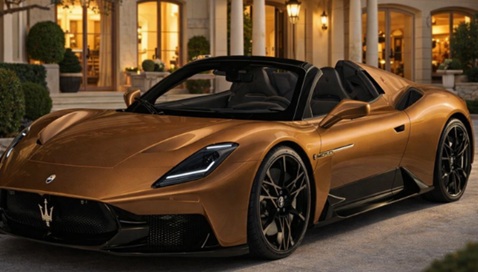
Maserati MCPura
Country of production
The Maserati MCPura is produced in Italy, at Maserati’s historic Viale Ciro Menotti plant in Modena, where key elements of the Nettuno powertrain are also built and assembled.
Short description
The MCPura is the evolution of the MC20 concept: a two-seat, mid-engine supercar built around a carbon-fiber monocoque, designed for low mass, structural rigidity, and a highly direct driver interface. The technical brief prioritizes steering precision, chassis balance, and high-speed stability, while keeping road usability at a level consistent with a modern high-end supercar. The range is typically presented in two interpretations: Coupé (maximum rigidity and focus) and Cielo (open-air experience with an electrochromic glass roof solution), sharing the same core mechanical architecture and performance envelope.

MCPura Coupé MCPura Cielo
Powertrain and performance
| Spec | MCPura Coupé | MCPura Cielo |
|---|
| Engine / layout | 3.0 V6 twin-turbo “Nettuno”, mid-engine | 3.0 V6 twin-turbo “Nettuno”, mid-engine |
| Power | 630 CV (470 kW) | 630 CV (470 kW) |
| Max torque | 720 Nm | 720 Nm |
| Drivetrain | RWD | RWD |
| Transmission | 8-speed dual-clutch automatic | 8-speed dual-clutch automatic |
| 0–100 km/h | 2.9 s | 2.9 s |
| Top speed | >325 km/h | >320 km/h |
| Combined fuel consumption | ~11.5 L/100 km (WLTP) | ~11.7 L/100 km (WLTP) |
| CO₂ (combined) | ~261 g/km (WLTP) | ~265 g/km (WLTP) |
Dimensions and capacity
| Specification | MCPura Coupé | MCPura Cielo |
|---|
| Length | 4,667 mm | 4,667 mm |
| Width (without mirrors) | ~1,965 mm | ~1,965–1,970 mm |
| Width (with mirrors) | ~2,178 mm | ~2,178 mm |
| Height | ~1,226 mm | ~1,214 mm |
| Wheelbase | ~2,700 mm | ~2,700 mm |
| Kerb mass (indicative) | ~1,475 kg | ~1,560 kg |
| Rear trunk | ~100 L | ~100 L |
| Front trunk (frunk) | ~60 L | ~60 L |
| Fuel tank | 60 L | 60 L |
Main trims and indicative pricing
| Version | From (€) |
|---|
| MCPura Coupé | 232,200 |
| MCPura Cielo | 259,250 |
(Indicative pricing: it can vary materially with options, bespoke programs, dealer policies, and model-year updates.)
Maintenance and early service (indicative costs)
(Estimates for a supercar; the spread is wide depending on dealer network, track use, and service packages.)
| Intervention | Typical range (€) |
|---|
| Annual service / 10–15,000 km | 900–1,600 |
| Brake fluid service (road use) | 150–300 |
| Front brake pads | 700–1,400 |
| Front discs + pads | 2,000–4,000 |
| Tire (each, performance sizes) | 350–700 |
| Alignment / geometry (if needed) | 150–350 |
| 12 V auxiliary battery (if needed) | 250–500 |
Pros
Top-tier performance: very rapid acceleration and a high maximum speed envelope.
Carbon monocoque delivers supercar-grade rigidity and steering accuracy.
Nettuno V6 provides strong character and sustained performance without hybrid complexity.
Clear positioning between Coupé focus and Cielo open-air usability, with minimal compromise in headline performance.
Extensive personalization potential (materials, colors, and bespoke programs).
Cons
Limited practicality: two seats and restricted luggage volume (segment-typical).
High running costs (tires and brakes in particular), amplified by aggressive driving or track time.
Supercar ride height and chassis setup demand attention on poor surfaces and urban obstacles.
Options and customization can raise the final price substantially.
In summary
The Maserati MCPura is a technically “pure” supercar: mid-engine, rear-wheel drive, carbon monocoque, and a 630 CV Nettuno V6 delivering genuinely elite performance. The Coupé is the most coherent choice for maximum precision and structural focus, while the Cielo adds a strong open-air dimension without abandoning the MCPura’s core dynamic brief. It is a niche luxury product with supercar-level costs and compromises, but it offers a distinctive Maserati identity and a highly engaging mechanical package.
Verdict — Maserati MCPura (presented 10 July 2025)
Two-seat supercar · Versions: MCPura coupé and MCPura Cielo convertible · 3.0L twin-turbo V6 “Nettuno” 630 hp and 720 Nm · Rear-wheel drive · 8-speed automatic (dual-clutch) · 0–100 km/h in 2.9 s · Top speed over 325 km/h · Carbon-fiber monocoque, butterfly doors · Claimed weight under 1,500 kg (power-to-weight 2.33 kg/hp)
The Maserati MCPura is the direct evolution of the MC20: a supercar that focuses on project purity (lightness, rigidity, and powertrain response) and on an involving, “mechanical” driving experience, rather than an overreliance on electronics or a track-only mindset. The main changes concern design and content (revised front end and bumpers, details inspired by the GT2 Stradale, interior updates with more Alcantara and a new steering wheel), while the technical foundation remains the same one that made the MC20 competitive in the segment: a carbon monocoque and the high power-density Nettuno V6, featuring pre-chamber combustion derived from racing.
Inside, the approach is essential and driver-oriented: few controls, true supercar ergonomics, and a premium feel built around Alcantara and composites (with Fuoriserie customization). Entry remains dramatic thanks to the vertically opening doors; seating is low and the sensation is of a car built around the driver, with a calibration aimed at being usable on the road (not only on track).
Key technical points:
Engine and performance: 3.0L twin-turbo V6 Nettuno delivering 630 hp at 7,500 rpm and 720 Nm from 3,000 rpm, with a claimed 0–100 km/h in 2.9 s and a top speed over 325 km/h.
Chassis architecture: carbon-fiber monocoque, developed in collaboration with Dallara, with the goal of maximizing rigidity while keeping mass under control (claimed overall weight <1,500 kg).
Aerodynamics and functional styling: CFD and wind-tunnel development focused on efficiency and downforce without intrusive aero add-ons; a larger rear spoiler is available as an option.
Transmission and driving: rear-wheel drive and an 8-speed automatic transmission (sport-oriented logic with column-mounted paddles); set-up designed to combine precision with modern GT-style usability (fast, stable, usable).
Cielo version: retractable PDLC glass roof (switches opaque/transparent in about 1 second), operable up to 50 km/h, enabling open-air driving without compromising the clean silhouette.
| Category | Where it shines | Where it holds steady | Where it falls short |
|---|
| Design & image | Clean lines, true supercar proportions, more mature details than MC20 | Strong road presence and recognizable Maserati signature | Less theatrical than some louder rivals |
| Performance | Very competitive power-to-weight; strong, usable torque delivery | Performance that can be exploited on real roads | Without track time it is difficult to fully realize its potential |
| Driving dynamics | Carbon monocoque: rigidity and precision | Balance designed for real-world use as well | Low seating and supercar visibility require acclimation |
| On-board experience | Essential, driver-centered cockpit | High perceived quality (Alcantara/composites) | Practicality and storage are inevitably limited |
| Cielo version | Distinctive tech roof (PDLC) and open-air usability | Roof operation possible at moderate speed | Aero comfort and luggage remain supercar-limited |
| Personalization | Very broad Fuoriserie program | Scope for bespoke configurations | Used values depend heavily on configuration quality |
Who it is for
For drivers seeking a modern supercar that is light and technically “clean”, with a characterful combustion engine and precise handling, more focused on effectiveness and driver-vehicle connection than on “hypercar numbers” for their own sake. The Cielo is for those who want the same technical base with an added sensory layer (open air) without typical “traditional convertible” compromises.
Who should look elsewhere
If your priority is uncompromised daily usability, maximum cargo capacity, or a more city-friendly sports car, a 2+2 GT or a less low/rigid sports car is often the more coherent choice. If, on the other hand, you want a radical track weapon, some track-focused alternatives can deliver a more extreme experience (at the expense of usability).
Recommended configuration
MCPura coupé if your objective is maximum dynamic coherence (perceived mass and rigidity) and the purest silhouette.
MCPura Cielo if you value the open-air experience: the PDLC roof is a distinctive feature and adds real versatility.
In both cases, the most sensible approach is to keep a balance between aesthetics and drivability: avoid overly extreme wheel/suspension choices for real-world roads, and select options that improve ergonomics and control (rather than turning the car into a showcase of packages).