

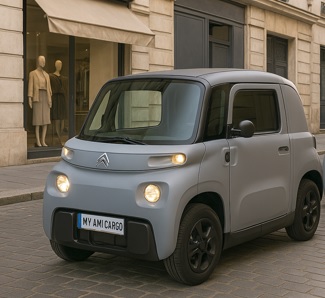
Citroën Ami – Model Year 2025

Citroën Ami
Country of production
The Citroën Ami is produced at the Stellantis plant in Kenitra (Morocco), the same industrial hub that also assembles some technical “siblings” within the group in the electric quadricycle segment.
Market launch date
27 February 2020: model debut/presentation.
June 2020: start of commercialization in Europe (first availability/first deliveries).
October 2024: presentation of the first major MY2025 facelift (key styling update) ahead of 2025 commercialization, while keeping the underlying technical package broadly unchanged.
May 2025: order opening for the New Ami and range expansion with variants such as Ami Buggy (and Buggy Palmeira), with staged deliveries (for Buggy: first deliveries communicated for summer 2025).
The Ami is a 100% electric, 2-seat light quadricycle designed for essential urban mobility: ultra-compact dimensions, simple driving, and potentially lower running costs than a conventional car. The point is not performance but accessibility: a 45 km/h limited top speed (L6e category), charging from a household socket, and a practical, minimalist interior.
With the facelift presented in 2024 (commercial rollout in 2025), Citroën kept the core technical layout broadly unchanged but introduced a visibly refreshed exterior design (front lighting/signature and body details) and expanded the range, bringing back/adding variants such as the more “outdoor” and customizable Buggy, alongside new trim/colour-pack combinations.
Powertrain and performance
| Spec | Ami (L6e) |
|---|
| Motor / layout | 1 electric motor, FWD |
| Rated power | 6 kW |
| Torque (declared) | 625 Nm |
| Top speed | 45 km/h |
| 0–45 km/h | ~10 s |
| Battery | ~5.4–5.5 kWh (lithium-ion) |
| Range (WMTC cycle, declared) | ~75 km |
| Charging | household socket 230 V (integrated cable) |
| Charging time (indicative) | ~3–4 h (depending on starting level and available power) |
Dimensions and capacity
| Specification | Value |
|---|
| Length | ~2,410 mm |
| Width | ~1,390 mm |
| Height | ~1,520 mm |
| Turning circle (curb-to-curb) | ~7.2 m |
| Seats | 2 |
| Trunk / storage (indicative) | front compartment and essential interior bins (order of magnitude ~60 L of dedicated usable interior storage) |
| Kerb weight (battery included) | ~483 kg |
Main trims and prices
(Indicative “on-the-road” prices; they may vary due to promotions, sales channels, and list updates.)
| Version | From (€) |
|---|
| Ami | ~8,490 |
| Ami Dark Side | ~8,890 |
| My Ami Pack Color | ~8,890 |
| My Ami Buggy | ~9,590 |
| My Ami Buggy Palmeira | ~9,990 |
Maintenance and early service (indicative costs)
(Estimates for electric quadricycles: wide variability by network, geographic area, and tires.)
| Intervention | Typical cost (€) |
|---|
| Periodic check/service | 120–250 |
| Brake fluid (periodic) | 70–140 |
| Front brake pads | 120–220 |
| Tire (each, 14") | 70–140 |
| 12 V battery (if needed) | 120–220 |
| Roadworthiness inspection (legal deadlines) | 45–80 |
Pros
Ultra-compact format: ideal for city driving, ZTL where permitted, parking, and short trips.
Simple household charging: no dedicated infrastructure needed for daily use.
Potentially reduced running costs (simplified mechanics, low electricity consumption).
Clever, robust concept: symmetrical components and minimalist solutions aimed at cost control.
Cons
Structural category limits: 45 km/h and an urban-focused setup, not suited to “real” extra-urban use.
Comfort and finishes are inevitably basic: it is a functional vehicle rather than a “premium mini car.”
Real-world range depends heavily on temperature, driving style, and route: it should be read in an urban context.
Limited cargo capacity: fine for daily shopping, less so for full “car-like” needs.
In summary
The Citroën Ami is a “protected” electric micro-mobility solution designed for city life and for those who want a simple vehicle, cheap to use, and extremely easy to park. It makes sense as an alternative to scooters and traditional microcars, or as a second vehicle for short trips. It should not be judged as a car: its logic is to maximize urban practicality within the constraints of the L6e category.
Verdict — Citroën Ami (model year 2025)
Electric minicar (light quadricycle L6e) · 2 seats · Front-wheel drive · 6 kW electric motor · Top speed 45 km/h · 5.4 kWh lithium-ion battery · Range 75 km (WMTC cycle) · Charging 0–80% ~3 h 30 min (household socket) · Single-speed (D/N/R) · Turning diameter 7.2 m · Price “from” €8,490 · Market launch: Ami on sale since 2020, with the “New Ami” update listed in 2025
The Citroën Ami is a “radical” urban-mobility solution: it is not a conventional city car, but a light quadricycle designed for short, repetitive trips, with costs and complexity reduced to a minimum. In 2025, the concept remains unchanged: ultra-compact dimensions, extremely simple driving (single-speed) and household-socket charging, with a focus on accessibility (including very young drivers) and easy parking.
The key is to understand its operating perimeter: the Ami is perfect in cities and moderate-traffic areas, but the 45 km/h top speed and the legal framework for light quadricycles make it an urban-centric vehicle. Used in its natural context, it remains one of the most pragmatic options for “covered” micromobility on four wheels.
Key technical points:
Category and driving eligibility: L6e light quadricycle; drivable with AM licence from age 14. Typical segment rules apply: no motorways/ring roads and restrictions for carrying a passenger below certain driver ages (to be verified based on applicable regulations and the specific case).
Motor and “project” performance: nominal output 6 kW; top speed 45 km/h.
Battery and range: 5.4 kWh lithium-ion battery; claimed range 75 km (WMTC).
Charging: claimed 0–80% ~3 h 30 min (household socket).
Transmission: single-speed with D/N/R selector.
Urban maneuverability: turning diameter 7.2 m; extremely small footprint (order of magnitude: 2.41 m length).
| Category | Where it shines | Where it holds steady | Where it falls short |
|---|
| Urban mobility | Tiny footprint, extremely easy parking | Agile in slow traffic | 45 km/h: not suitable for fast-moving flows |
| Accessibility | AM licence from age 14 | “For everyone” logic (also as a second vehicle) | Road-use rules and constraints typical of quadricycles |
| Running costs | EV: potentially low energy and routine maintenance | Simple home charging | Without a convenient socket, daily use becomes harder |
| Range | 75 km WMTC fits city use | Sufficient for short trips | Real range is sensitive to climate, style, and routes |
| Comfort and “car-like” feel | Enclosed cabin: advantage over scooters in winter | Essential but functional equipment | Comfort, insulation, and materials are not “car grade” |
| Practicality | 2 seats, ideal for commuting | Strong as a dedicated runabout | No “family” flexibility: it is two-seat micromobility |
| Price and value | Competitive entry price for 4-wheel electric mobility | Wide personalization | Price rises quickly with versions/accessories |
Who it is for
City and inner-suburban users who want simple, compact mobility that protects from the weather: very young drivers (with AM licence), families as a “second vehicle,” businesses for light micro-logistics, and anyone seeking an alternative that is more stable and reassuring than a scooter for short trips.
Who should consider alternatives
If you frequently drive on faster extra-urban roads, need 4 seats, or want a true car replacement with city-car comfort and performance, a small conventional car or a higher-segment compact EV is more coherent. Also, anyone who must routinely use motorways or ring roads should choose a vehicle homologated as a passenger car.
Recommended configuration
Base version if your goal is to maximize value and pure urban use: it is the most coherent with the vehicle’s mission.
Choose accessories only if they are genuinely enabling for real use (e.g., practical charging/parking solutions and protections for daily operation).
Before buying, always verify: where you will charge (dedicated socket/garage), which routes are legally permitted in your area, and local road-use rules for L6e.