

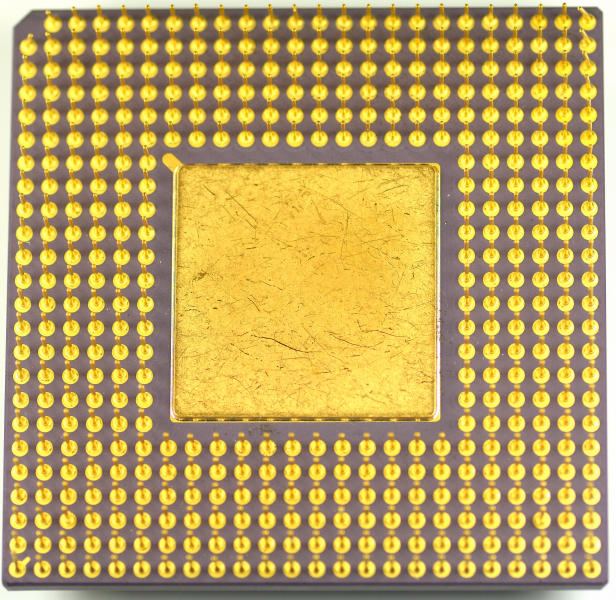
PGA 431 refers to a PGA (pin grid array) package or socket form factor with a total of 431 contacts/pins. It is not, by itself, “a CPU” nor a single, unambiguous standard like a modern consumer socket: it is a mechanical–electrical descriptor (pin count and geometry) that can appear in different contexts, for example as a microprocessor package or as a dedicated socket (including test/burn-in variants).
In practice, “PGA 431” is a useful label to identify dimensions, pitch, number of connections, and mounting constraints, while functional compatibility always depends on the specific device (pinout, voltages, signals, buses).
What “PGA” means in practical terms
A PGA package uses a matrix of pins arranged in multiple rows and columns. Typical advantages are:
Mechanical robustness and good long-term retention in industrial or instrumentation systems.
Possible use with ZIF (zero insertion force) sockets in some variants, reducing stress on pins and the PCB.
Easier replacement of the component, useful for maintenance and testing.
Main limitations are larger footprint and height compared to SMD packages (QFP, BGA), plus the extra care required for alignment and pin integrity.
Geometry and pitch: how to interpret “431 pins”
The number 431 indicates the total contacts, but it does not imply a “fully populated” matrix. In real implementations:
the grid may be, for example, a 24×24 matrix with missing positions (mechanical keying, unpinned areas, routing constraints).
the pitch is often around 2.54 mm (0.1") in traditional through-hole PGAs, consistent with historical sockets and footprints.
The result is a package/socket that occupies significant PCB area and requires careful layout for multiple rails, grounds, and high-switching signals.
Use cases and compatibility: what to expect
Because “PGA 431” is a package descriptor, you may encounter it in:
microprocessors and DSPs in workstation/industrial environments (often in the 1990s and non-consumer contexts).
dedicated PGA sockets for CPUs or custom devices, including test and qualification versions.
Compatibility is not interchangeable between different components: two devices in PGA 431 can have completely different pinouts and functions. Therefore, when dealing with PGA 431 in an operational context, you always need:
the device datasheet (pinout, logic levels, supplies).
the socket specification (ZIF/non-ZIF, materials, plating, current per pin, temperature).
board-level constraints (stack-up, thermal design, EMC constraints).
Assembly and reliability aspects
In practical use, the critical points are:
Alignment: PGA pins bend easily if insertion is not perfectly aligned.
Cleanliness and oxidation: contacts and pins must remain clean; plating (gold on contact, tin on tails) impacts long-term reliability.
Insertion cycles: sockets have cycle limits; for test applications, burn-in rated versions are preferable.
Thermal constraints: many historical PGAs are associated with ceramic packages or higher dissipation; heatsink retention and mechanical pressure must be managed correctly.
Table 1 – Identification data and specifications
Characteristic | Indicative value |
|---|
Designation | PGA 431 |
Category | PGA package / socket |
Contact count | 431 |
Geometry | Matrix with potentially missing positions (keying and unpinned areas) |
Mounting | Typically through-hole on PCB (socket) |
Typical pitch | ~2.54 mm (0.1") in many traditional implementations |
Variants | ZIF / non-ZIF, test/burn-in sockets, different materials and platings |
Table 2 – Operational and design aspects
Aspect | Practical meaning |
|---|
“PGA 431” is not a pinout | It primarily identifies mechanics and pin count, not electrical compatibility |
Matrix may be non-full | Missing positions are common for keying or routing constraints |
Insertion and bent-pin risk | Requires care in assembly and maintenance; ZIF sockets are preferable when available |
Contact reliability | Plating and cleanliness affect contact resistance and long-term stability |
Industrial/test usage | Common where serviceability and robustness matter more than compactness |