

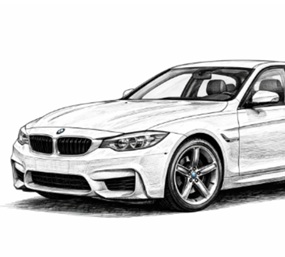
BMW is a German premium manufacturer active in the production of cars and motorcycles, with a long-standing positioning centered on engineering, perceived quality, and driving dynamics. At the corporate level it operates as the BMW Group and includes, in addition to the BMW brand, MINI, Rolls-Royce Motor Cars, and BMW Motorrad, alongside dedicated customer financial services (leasing, financing, insurance).
Its headquarters and decision-making center are in Munich, while its industrial footprint is global, with a production network distributed across multiple sites and a widespread sales presence in many markets. The business model combines “premium” volumes with a high degree of product personalization (trims, powertrains, packages) and a structured approach to residual-value management, a key driver of profitability and competitiveness in leasing and long-term rental.
On the strategic side, BMW is addressing the electric and digital transition with a multi-technology approach (battery-electric, hybrid, and combustion where market demand persists) and with a new generation of products and architectures under the Neue Klasse label, designed to integrate a dedicated EV platform, in-vehicle electronics, and new software-centric logic. In practice, the aim is to raise system efficiency (powertrain, aerodynamics, thermal management), software upgradability, and lineup coherence, while preserving premium positioning.

Governance is a relevant theme because it affects strategic continuity and the management of critical markets (notably EV competition and margin pressure). As of today, Oliver Zipse is CEO; the succession to Milan Nedeljković has been announced, with a handover planned for May 14, 2026, a signal of an intense execution phase for the industrial and product roadmap over the next cycles.
From an industrial and commercial perspective, the main challenge is balancing three levers: (1) margins on vehicles with high technological content, (2) adaptation to local preferences (infotainment, ADAS, perceived quality, pricing), and (3) speed of software updates and the broader digital ecosystem. This is especially true in markets under strong competitive pressure, where local EV makers push rapid iteration and richer standard equipment.
A distinctive trait of the brand remains its emphasis on dynamics and performance: the BMW M division and “sportiness across the range” reinforce image and differentiation, now extending toward electrification through projects that claim the intent to carry performance DNA into the new technological context. In parallel, the fleet channel and financial services remain fundamental to sustaining volumes and customer retention, especially on the business side.
In summary, BMW is a premium group that is shifting its competitive advantage from purely mechanical strengths toward a mix of platform, software, digital experience, and product coherence, while keeping perceived quality and drivability at the center. Success depends on the execution of the Neue Klasse roadmap, the management of key markets, and the ability to protect margins as electrification and digital content weigh more heavily.