

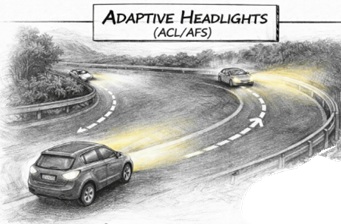
Active headlights ACL/AFS are automotive lighting systems that automatically adjust the beam direction, distribution, and, in some applications, intensity to improve night-time visibility and reduce glare depending on the driving scenario.

With ACL (Adaptive Cornering Light), one generally refers to the “cornering” function, i.e., additional illumination of the inside of a turn by switching on a dedicated projector (or a specific portion of the headlamp) when steering input is detected, the turn signal is activated, or a low-speed maneuver is recognized. This is typical in urban driving, roundabouts, and tight turns, where a standard low-beam pattern does not sufficiently illuminate the inner side.
With AFS (Adaptive Front-lighting System), one refers to a more comprehensive system, capable of steering the beam horizontally (and sometimes vertically) and selecting different lighting “maps”: for example highway, rural/extra-urban, urban, rain/fog modes, with changes in beam width and range.
From a hardware standpoint, AFS systems use projectors with movable modules (stepper motors or actuators) or LED matrix solutions that “shape” the beam through segments. In matrix-headlamp designs, adaptivity can include selective masking to avoid dazzling vehicles ahead or oncoming traffic.
Key inputs include steering angle, vehicle speed, yaw rate, and often data from a forward camera or rain/ambient-light sensors. The lighting control unit processes these signals and computes how far and in what way to shift/reconfigure the beam, keeping transitions smooth to avoid “jerky” visual effects.
A critical aspect is ride-height/leveling correction: acceleration, braking, and variable load change vehicle pitch and therefore the beam height. For this reason, AFS and automatic leveling often work together to limit glare and preserve effective range.
The main benefits are better road reading in bends (pedestrians, cyclists, obstacles at the roadside), improved visual comfort, and, in more advanced systems, reduced glare thanks to dynamic beam management. In practice, the goal is to increase the driver’s “perception time” of hazards, especially on curved trajectories.
Limitations depend on the technology: in heavy rain, fog, or highly reflective road markings, perception can degrade and automatic strategies must avoid excessive brightness. In addition, incorrect height aiming or faulty sensors/actuators can lead to a beam that is too high or too low, directly impacting safety and other road users’ comfort.
From a maintenance and diagnostic perspective, common issues involve actuators, leveling sensors, wiring, or LED modules; the vehicle often reports an AFS fault and may fall back to a fixed “safe” mode. After suspension or headlamp work, a calibration procedure may be required.
In summary, ACL is the function focused on illuminating the inside of a turn during maneuvers and cornering, whereas AFS is the broader set of functions that dynamically adapt the beam to the driving scenario. When properly designed and calibrated, these systems deliver a tangible improvement in night lighting quality without unnecessarily increasing visual disturbance for other road users.