

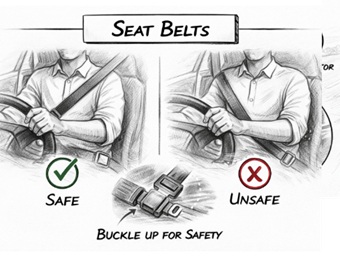
Seat belts are a passive-safety device designed to restrain the occupant in a crash or sudden deceleration, reducing the risk of impact with the steering wheel, dashboard, and windshield, and limiting ejection from the cabin.
The underlying physics is the management of momentum: the belt distributes forces over relatively strong areas of the body (mainly the pelvis and chest) and controls how the occupant decelerates together with the vehicle.

In modern cars, the standard solution is the three-point belt, consisting of webbing, a retractor, anchor points, and a buckle. Correct positioning is critical: the lap belt must sit on the iliac crests/hips, not on the abdomen, while the shoulder belt should run over the clavicle and sternum without contacting the neck.
The key element of the system is the inertial retractor, which allows freedom of movement under normal conditions but locks the webbing when it detects rapid belt payout or a significant vehicle deceleration. This locking can be achieved via mechanical sensors (mass/pendulum type) and, in more recent systems, also through logic integrated with the airbag control unit.
To improve effectiveness in the initial phase of the impact, many vehicles use a pretensioner, which in a fraction of a second removes belt slack by pulling the occupant back into the seat. Pretensioners can be pyrotechnic or electromechanical and operate in coordination with crash sensors.
Alongside pretensioning, a fundamental role is played by the load limiter, which allows a controlled release of webbing beyond a certain force threshold, reducing peak chest loads and therefore the risk of compression injuries. In practice, the belt should not be “maximally rigid” at all times: it must restrain, but also manage energy.
Seat belts and airbags are complementary systems: the airbag is designed to work correctly with an occupant who is already restrained by the belt, in the intended position. Without a belt, the occupant can move excessively and contact the airbag in an unfavorable way, increasing injury risk.
Real-world effectiveness also depends on usage factors: wearing the belt consistently, avoiding twists in the webbing, adjusting the shoulder height if available, and using dedicated child restraint systems correctly (child seats and boosters). Very bulky clothing can also introduce slack and reduce initial restraint.
In summary, seat belts are among the most effective elements for reducing injury severity in crashes: they restrain the occupant, distribute and modulate forces, and work together with the vehicle’s other systems to maximize protection during violent decelerations.