

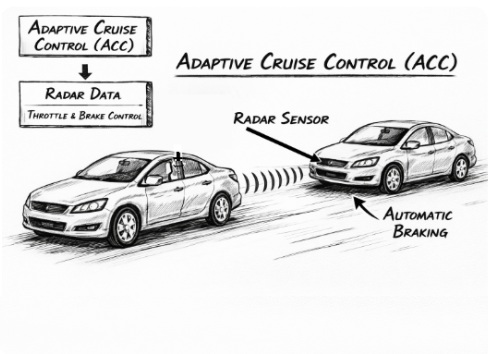
The Adaptive cruise control (ACC) is a driver-assistance system that maintains a set speed while automatically adjusting the vehicle’s pace to keep a safe following distance from the vehicle ahead.
Unlike conventional cruise control, ACC “reads” the forward scene using sensors—typically radar (often paired with a camera)—to estimate target range and relative speed.

When the lane ahead is clear, the system behaves like standard cruise control, managing engine torque and, when needed, transmission behavior to hold the selected speed.
When it detects a slower lead vehicle, ACC reduces speed by coordinating braking and powertrain control in a progressive way, aiming to preserve the driver-selected time gap (commonly set in steps or seconds).
More advanced stop&go implementations can bring the vehicle to a complete stop and resume automatically in traffic, within manufacturer-defined time and condition limits.
From a control standpoint, ACC is a closed-loop system: it compares actual distance to the target distance, computes the required acceleration/deceleration, and coordinates with ABS/ESC and the engine ECU to ensure stability and comfort.
Calibration matters: a well-tuned ACC avoids “jerky” braking, limits the accordion effect in traffic, and favors smooth transitions without sacrificing responsiveness when the lead vehicle slows down.
There are inherent limitations: severe weather, sensor contamination, tight curves, cut-ins, stationary objects, and complex scenarios can degrade perception and require continuous driver supervision.
In real use, ACC improves comfort on long trips and in congestion, reduces workload, and can promote smoother driving; however, it remains an assistance feature—not an autopilot—and the driver remains fully responsible for the vehicle.