

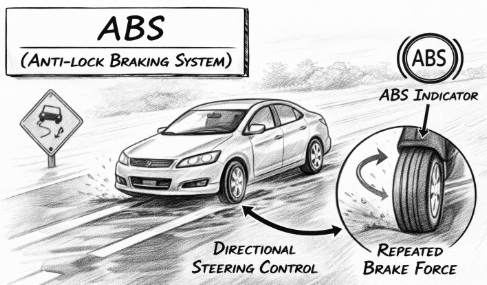
The ABS (anti-lock braking system) is an active-safety system that prevents the wheels from locking during heavy braking, preserving the ability to steer and improving overall vehicle stability.
In braking without ABS—especially on low-grip surfaces—one or more wheels can reach lock-up: at that point the tire transitions from “dynamic” friction to “static” friction and its ability to generate lateral force drops sharply, increasing the risk of losing directional control.
ABS instead works by keeping wheel slip within an optimal range: high enough to maximize deceleration, but not so high that lock-up occurs. This is why, with ABS active, you can still brake hard while steering to avoid an obstacle.

From a component standpoint, the system uses wheel-speed sensors (one per wheel in most architectures), an electronic control unit (ABS ECU), and a hydraulic modulator with solenoid valves and a recirculation pump.
When the ECU detects that a wheel is decelerating too quickly relative to the others (a sign of imminent lock-up), it commands the modulator to reduce pressure in that circuit; immediately after, it can hold or reapply pressure. This cycle occurs many times per second, producing the characteristic pedal pulsation.
The control logic can be axle-based or wheel-based and accounts for vehicle dynamics and grip conditions; in modern systems ABS is integrated with related functions such as EBD (electronic brakeforce distribution), traction control, and stability control, which share sensors and actuators.
ABS does not always guarantee shorter stopping distances on every surface: on gravel or fresh snow it can slightly increase stopping distance compared with “wedge” lock-up, but it preserves steerability and stability—often the most important factors for avoiding an impact.
In real use, it is essential to keep the pedal firmly pressed and let the system modulate pressure; “pumping” the brakes is counterproductive because it interferes with automatic regulation.
From a diagnostic standpoint, typical issues involve wheel sensors, wiring, tone rings, or the hydraulic unit; if a fault occurs the brakes still work, but without the anti-lock function and with a dedicated warning light.
In summary, ABS makes emergency braking more controllable and stable by reducing the risk of wheel lock-up and helping the driver maintain the intended path, especially on split-μ or variable-grip surfaces.