



Lotus Eletre
Country of production
The Lotus Eletre is produced in China, at the Wuhan plant (Hubei province), while remaining a Lotus-branded model with engineering and development also carried out in Europe.
Short description
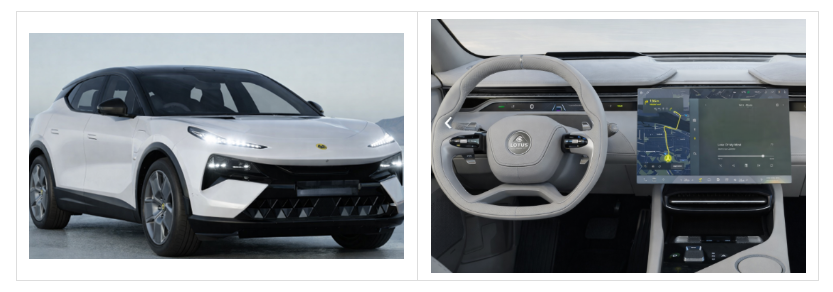
The Eletre is Lotus’s electric “hyper-SUV”: a high-end SUV (over 5.1 m) that aims to combine very high performance, flagship-level comfort, and dynamics that feel more “sporty” than its mass and dimensions would suggest. The project is built around an 800 V architecture and high-level fast charging, with a range currently structured around the 600 versions (more balanced) and 900 versions (more extreme), also differentiated by trims and equipment content.
Powertrain and performance
| Spec | Eletre 600 (600 range) | Eletre 900 (900 range) |
|---|---|---|
| Motors / layout | 2 motors, AWD | 2 motors, AWD |
| Max power | 450 kW (612 hp) | 675 kW (918 hp) |
| Max torque | 710 Nm | 985 Nm |
| 0–100 km/h | 4.5 s | 2.95 s |
| Top speed | 258 km/h | 265 km/h |
| Battery (max capacity) | 112 kWh | 112 kWh |
| Range (WLTP) | up to ~600 km (depending on version) | ~450 km (depending on version) |
| DC charging power (peak) | up to ~355 kW | up to ~355 kW |
| 10–80% (DC, optimal conditions) | ~20 min (ultra-fast chargers) | ~20 min (ultra-fast chargers) |
| AC charging | up to 22 kW | up to 22 kW |
Dimensions and capacity
| Specification | Value |
|---|---|
| Length | 5,103 mm |
| Width (without mirrors) | 2,019 mm |
| Height | 1,630–1,636 mm (depending on wheels/suspension) |
| Wheelbase | ~3,020 mm |
| Weight (indicative, depending on version) | from ~2,490 kg upwards |
| Rear trunk (min) | 610 L (4-seat config) / 688 L (5-seat config) |
| Rear trunk (max, seats folded) | 1,532 L (5-seat config) |
| Frunk | 46 L |
| Braked towing (indicative) | up to 2,250 kg |
| Roof load (indicative) | 90 kg |
Main trims and indicative pricing
| Version | From (€) |
|---|---|
| Eletre 600 | 103,990 |
| Eletre 600 GT | 112,190 |
| Eletre 600 GT SE | 121,390 |
| Eletre 600 Sport SE | 134,790 |
| Eletre 900 Sport | 151,190 |
| Eletre 900 Sport Carbon | 166,490 |
(Indicative prices; they may vary with options, model year, promotions, and on-the-road fees.)
Maintenance and early service (indicative costs)
(Estimates for a premium electric SUV: high variability depending on official network, tires, and usage style.)
| Intervention | Typical cost (€) |
|---|---|
| Periodic service / inspections | 350–750 |
| Brake fluid (periodic) | 120–250 |
| Cabin filter | 90–200 |
| Front brake pads | 500–1,000 |
| Front discs + pads | 1,300–2,500 |
| Tire (each, 20–23") | 280–650 |
| 12 V auxiliary battery (if needed) | 250–500 |
Pros
Very high performance (especially the 900 range) with AWD and benchmark-level figures.
800 V architecture and high-power DC charging: well-suited to long trips when ultra-fast infrastructure is available.
Cabin and equipment aligned with a modern premium SUV (comfort, technology, ADAS).
Strong cargo capacity for the category, with a rear trunk up to 688 L (5-seat configuration).
Cons
Significant size and mass: in cities and parking it requires space and attention.
Price and options: the “right” configuration can increase the total substantially.
The 900 range offers a shorter range than versions optimized for maximum WLTP distance.
Large tires and very high performance can raise running costs (tires/brakes).
In summary
The Lotus Eletre is a high-end electric SUV focused on performance, fast charging, and premium content, positioned closer to an “electric grand tourer on stilts” than a traditional family SUV. The 600 range is the more balanced choice for daily use and travel, while the 900 range targets those seeking maximum acceleration and sport-oriented content, accepting trade-offs in costs and range.
Verdict — Lotus Eletre (Model year 2025, 600/900 range)
Premium electric hyper-SUV · Trims: Eletre 600 (AWD), Eletre 900 (AWD) · 800 V architecture · Battery approx. 112 kWh nominal / 109 kWh usable · AC charging up to 22 kW · DC charging up to 350 kW (declared/recorded peaks around 367 kW) · 10–80% in about 20 min (ideal conditions) · WLTP range: up to 600 km (600 series) and roughly 410–500 km (900 series) · 0–100 km/h from 4.5 s (600) to 2.9–2.95 s (900) · Top speed up to ~265 km/h (900 series)
The Lotus Eletre is Lotus’s take on the high-performance electric SUV: it is not only about power, but about combining strong presence, advanced technology, and a more “sporting” driving character than the segment average. The 2025 lineup has been streamlined into two families, 600 and 900, making the choice clearer between a touring-oriented set-up (range and usability) and a more performance-driven one (power, response, chassis).
Inside, the approach is contemporary and heavily digital: the centerpiece is a large 15.1" OLED display, with a connected ecosystem based on Lotus Hyper OS and OTA updates, paired with a premium cabin focus on comfort, materials, and technology content. On the ADAS and sensing side, the Eletre can reach a very rich equipment level (depending on packs/markets), designed for advanced driver assistance on long journeys.
Key technical points:
Powertrain range and performance:
Eletre 600: total output 450 kW (612 PS), torque 710 Nm, AWD, 0–100 km/h 4.5 s, top speed 250 km/h.
Eletre 900: total output 675 kW (918 PS), torque 985 Nm, AWD, 0–100 km/h 2.9–2.95 s, top speed 260–265 km/h; two-speed transmission available (900 series).
Battery and range:
Battery 111.9 kWh nominal / 109.0 kWh usable.
WLTP range: up to 600 km for the 600 series; roughly 410–500 km for the 900 series (depending on version and configuration).
Charging and touring:
AC 22 kW (0–100% typically ~6 hours on a suitable wallbox).
DC HPC up to 350 kW (with indicated peaks around 367 kW); 10–80% ~19–20 minutes under ideal conditions.
Practicality and size (order of magnitude, useful for real-world use):
Length about 5.10 m; boot ~611–1,532 L and frunk ~46 L (depending on trim/market).
Towing capacity up to about 2,250 kg (for homologated versions).
Technology and ADAS:
Infotainment with 15.1" OLED, Hyper OS, connectivity and Over-the-Air updates.
Advanced sensor suite (depending on packs/markets), with radar and cameras and components described as “laser radar/LiDAR” for enhanced assistance functions.
| Category | Where it shines | Where it holds steady | Where it falls short |
|---|---|---|---|
| Design & image | Distinctive hyper-SUV shape; strong road presence | Modern reinterpretation of Lotus identity | Not minimalist: it is deliberately “tech-lux” |
| Performance | 900 series delivers supercar-like numbers; immediate response | 600 series is already very fast and usable | In sporty driving, mass and size remain decisive |
| Range & touring | 600 series: more touring-oriented (WLTP up to 600 km) | Planning is simplified with HPC | Real range is highly sensitive to speed, wheels, and climate |
| Charging | 800 V architecture and 10–80% ~20 min | AC 22 kW is useful in advanced home/office scenarios | To exploit it you need truly high-performance HPC infrastructure |
| Comfort & space | Premium angle, credible long-distance comfort | Good versatility (depending on trim/packs) | Large wheels/sport set-ups can be harsh on broken surfaces |
| Technology & ADAS | Big, updatable infotainment; advanced ADAS packs | Connectivity and functions can improve via OTA | Availability and functionality can vary widely by market/spec |
| Ownership costs | Strong image value; premium content | Warranties and services depend on buying channel | Tires, brakes, and insurance can be demanding, especially 900 |
Who it is for
Drivers who want a high-performance premium electric SUV with a very advanced tech approach, high-level charging capability, and a calibration that tries to preserve a more “Lotus-like” driving feel than mainstream competitors. In particular, the 600 series is more coherent for frequent long-distance use; the 900 series is for those chasing absolute performance and a more extreme dynamic package.
Who should consider alternatives
If your priority is maximizing real-world efficiency (consumption and true range), materially reducing purchase/running costs, or achieving the softest possible ride on any surface, some premium electric SUVs with a stronger comfort/efficiency focus may be better centered for your needs.
Recommended configuration
Eletre 600 if you want the best balance between performance and daily use: it is already very quick, more touring-oriented, and tends to be the most rational choice in the range.
Eletre 900 only if you explicitly want the top performance (0–100 and thrust), accepting compromises on range and costs; it makes sense if you often use fast roads and want a “harder” set-up.
In both cases, for real-world use it is advisable to prioritize: non-extreme wheels/tires, ADAS packs aligned with your touring needs, and a charging solution (home/office + HPC) that can leverage the charging curve.

