



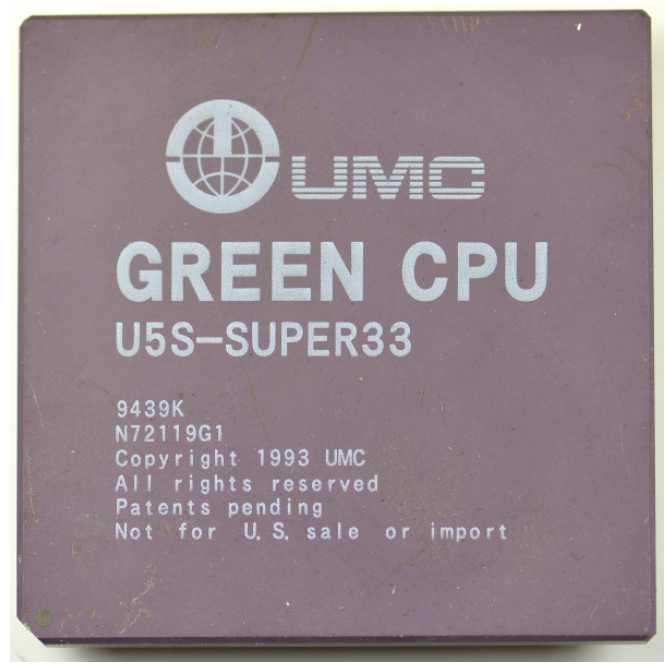
UMC U5S-SUPER33
The UMC U5S-SUPER33 is a 486-class CPU introduced in 1993 by United Microelectronics Corporation (UMC). It is described as a “fast” 486 with reduced power consumption compared to contemporary Intel CPUs, therefore aimed at delivering a strong performance/thermal balance on standard 486 platforms.
In practice, it is a processor intended for 486 motherboards where x86 compatibility matters, with period-typical specifications: 33 MHZ clock, 5 V supply, 0.6 micron process, and 8K L1 cache.
Context (1993): why an “alternative” 486 made sense
In 1993 the 486 market was highly competitive. For PC manufacturers and system builders, a 486-compatible CPU with good performance and a better power profile could mean:
lower costs on the same platform
more flexibility for cooling and board layout
the ability to build value systems without sacrificing too much responsiveness
Clock: 33 MHZ
Clock: 33 MHZ
A 33 MHZ speed grade is typical for entry/mid-range 486 platforms. In practice:
performance and responsiveness depend heavily on the chipset and RAM
systems with well-configured external cache often feel faster than the raw clock suggests
stability at 33 MHZ is generally easier to guarantee on 5 V boards than at higher frequencies
Supply: 5 V
Voltage: 5 V
A 5 V supply is consistent with many 486 motherboards of the era. Operationally:
it simplifies integration on “legacy” platforms (less complex regulation)
it requires attention to overall system thermals, especially in poorly ventilated cases
it makes comparison straightforward versus many contemporary 5 V Intel 486 CPUs
Process: 0.6 micron
Micron: 0.6
A 0.6 µm process is typical of early 486-generation manufacturing nodes. In practice:
it limits density and maximum achievable frequencies versus later nodes
it influences power and heat, which is why “low power” optimization is a meaningful positioning point
L1 cache: 8K
L1 cache: 8K
An 8K L1 cache is a key parameter on a 486-class CPU: it reduces main-memory accesses on small/medium working sets and improves responsiveness on frequently reused code and data. In practice:
it helps on “desktop” workloads of the era (DOS/Windows, utilities, light applications)
final results still depend on the rest of the platform: motherboard L2 cache, RAM timings, and chipset behavior
Practical impact: performance vs power
The “fast and lower power” description versus Intel CPUs should be read as market positioning where:
at the same clock (33 MHZ), the CPU aims to deliver strong perceived performance
lower power can translate into simpler cooling, better thermal stability, and the ability to use less aggressive cooling solutions
On 486 platforms this can be a real advantage, because cooling quality and electrical stability strongly affect long-term operation.
Sketch of the most important connections
                 486 chipset + RAM + I/O (motherboard)
        ┌──────────────────────────────────────────────────────────┐
        │  memory controller, BIOS/ROM, external cache (L2), I/O     │
        │  peripheral bus (ISA/VLB depending on system)              │
        └───────────────────────────────┬──────────────────────────┘
                                        │
                                        ▼
                           ┌─────────────────────────────┐
                           │      UMC U5S-SUPER33         │
                           │   486-class CPU @ 33 MHZ     │
                           │   5 V, 0.6 µm, 8K L1         │
                           └─────────────┬───────────────┘
                                         │
                                         ├────────► RAM/ROM (via chipset)
                                         └────────► I/O (peripheral bus)
Table 1 – Identification data and specifications
| Characteristic | Indicative value |
|---|---|
| Device | UMC U5S-SUPER33 |
| Manufacturer | UMC (United Microelectronics Corporation) |
| Introduction year | 1993 |
| Class | 486-class CPU |
| Clock | 33 MHZ |
| Voltage | 5 V |
| Process | 0.6 µm |
| L1 cache | 8K |
| Positioning | Fast 486, lower power than contemporary Intel CPUs |
Table 2 – Operational and design considerations
| Aspect | Practical meaning |
|---|---|
| 486 compatibility | Integration on 486 motherboards with period-standard chipsets and RAM |
| 33 MHZ | Common speed grade; real performance depends heavily on memory and external cache |
| 5 V | Easier use on legacy platforms, with attention to overall heat dissipation |
| 0.6 µm | Period-typical node; impacts power and frequency headroom |
| 8K L1 | Improves responsiveness by reducing RAM traffic on frequently accessed working sets |
| Lower power | Thermal advantage and potentially higher reliability in poorly ventilated chassis |
| Board dependency | L2 cache, RAM timings, and chipset can matter as much as the CPU itself |

