

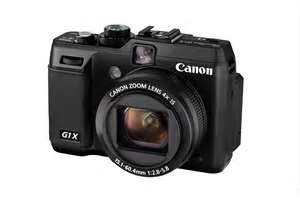
Canon PowerShot G1 X – Pros and cons
Model name: Canon PowerShot G1 X
Type: Advanced compact camera
Market launch year: 2012
Category: Premium compact
Target users: Advanced enthusiasts and professionals as a second camera body

Main technical specifications
| Characteristic | Value |
|---|
| Sensor | CMOS 1.5″ (18.7 × 14 mm) |
| Effective resolution | 14.3 megapixels |
| Processor | DIGIC 5 |
| Lens | 28–112 mm equiv. |
| Maximum aperture | f/2.8–5.8 |
| Stabilization | Optical (IS) |
| ISO | 100–12,800 |
| Display | 3.0″ articulating LCD, 920k dots |
| Viewfinder | None (optional EVF not supported) |
| Video | Full HD 1080p |
| File formats | JPEG / RAW |
| Weight | ~534 g (with battery) |
In-depth technical analysis
Sensor and image quality
Pros:
The 1.5″ sensor is significantly larger than those found in typical compact cameras, approaching APS-C dimensions.
Strong high-ISO performance, with controlled noise up to roughly ISO 1600–3200.
Good dynamic range, above average for compact cameras of its time.
RAW support, essential for advanced post-processing.
Cons:
14.3 MP resolution is lower than many APS-C cameras of the same era, although still adequate for most uses.
Lower performance than APS-C DSLRs or mirrorless cameras in extremely challenging low-light scenarios.
Built-in lens
Pros:
28–112 mm equivalent range, versatile for travel, street, and basic portrait work.
Effective optical stabilization for handheld shooting.
Overall optical quality is high for a fixed-lens compact.
Cons:
f/5.8 at the long end limits low-light capability and background separation.
No interchangeable lens option, which is an inherent limitation of the system.
Operational performance
Pros:
Accurate autofocus in static scenes.
Canon UI is well-structured and intuitive.
Generally reliable and predictable operation.
Cons:
Slow burst rate (~1.9 fps), not suitable for sports or action photography.
Autofocus is less responsive than modern mirrorless systems.
Startup time and card write speeds are not particularly fast.
Ergonomics and build
Pros:
Solid body with a premium feel.
Articulating display is very useful for low- and high-angle shooting.
Pronounced grip for a compact camera.
Cons:
Video
Pros:
Cons:
Continuous autofocus is slow and not very smooth for video.
Lacks modern advanced features (4K, log profiles, focus peaking).
Comparison with premium compacts of the same era
| Aspect | PowerShot G1 X | Typical 2011–2013 premium compacts |
|---|
| Sensor size | Very large | Small / medium |
| Image quality | High | Medium-high |
| Burst rate | Slow | Variable |
| Weight | High | Medium |
| Lens versatility | Medium | Medium |
| Video | Good | Variable |
Interpretation: The G1 X clearly prioritizes sensor-driven image quality, trading off speed and portability.
Pros and cons – Technical summary
Pros
Large sensor with above-average image quality for a compact camera.
RAW support and good dynamic range.
Strong travel camera when image quality is the priority.
Solid build and articulating display.
Cons
Slow autofocus and burst rate.
High weight and size for a compact.
Limited aperture at longer focal lengths.
No built-in viewfinder.
Video features are technically dated by current standards.
Conclusion
The Canon PowerShot G1 X is an unusual premium compact, designed to deliver DSLR-like image quality in a fixed-lens body. It is well-suited for travel, landscape, and general-purpose photography focused on image quality, but it is not ideal for sports/action or for users who prioritize minimal weight. Today, it can still be interesting on the used market for those who value sensor size over operational speed.