



SUV: pros, cons, problems
A SUV (Sport Utility Vehicle) is a vehicle category characterized by a raised driving position, a taller body, and an engineering focus on versatility and the ability to handle variable surfaces, with a predominantly road-oriented setup in today’s market. The modern SUV concept has evolved: many models share platforms with sedans or crossovers and prioritize comfort and interior space more than “hard-core” off-road capability.
From a technical standpoint, typical elements include increased ground clearance, often wider tracks, tires with taller sidewalls than a sports car, and—in many trims—availability of all-wheel drive or traction-management systems. However, true off-road capability depends on concrete parameters: approach/departure angles, ground clearance, underbody protection, transmission ratios, the presence of low range, and traction-control calibration.
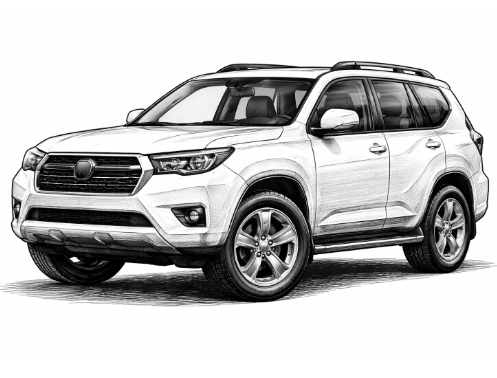
The architecture can be unibody (the most common) or body-on-frame (more typical of traditional off-roaders and pickups). Unibody construction improves comfort, perceived rigidity, and efficiency; body-on-frame favors robustness and payload/towing capability, but with penalties in mass and on-road dynamics.
The main user benefit is interior usability: a higher seating position, easier ingress/egress, greater interior volume, and often a more practical trunk. Forward visibility can also be better, but the tall body and thick pillars can create blind spots, making sensors and cameras particularly useful.
From a dynamics perspective, greater height and mass compared with an equivalent sedan affect roll, braking, and fuel consumption. Modern SUVs mitigate this with advanced suspensions, anti-roll bars, appropriate tires, and electronic controls (ESP, roll stability control), but physical constraints remain: a higher center of gravity and greater inertia require smoother inputs during sudden maneuvers.
In terms of efficiency, a SUV tends to have higher aerodynamic drag and weight, so fuel consumption and emissions can be higher for the same powertrain. Electrification (mild hybrid, full hybrid, plug-in, BEV) is often adopted to compensate, but mass remains a critical factor also for tire and brake wear.
From a usage standpoint, SUVs are chosen for cargo capacity, modularity, and long-distance comfort; they can also offer advantages on rough roads, ramps, and light snow, especially with AWD and suitable tires. Towing is often a strong point, but it depends on homologation limits, cooling capacity, and transmission calibration.
Trade-offs concern size and operating costs: larger dimensions make parking and city maneuvers harder, and higher mass increases running costs (tires, brakes, fuel). The safety of other road users (pedestrians/cyclists) is also a key engineering topic: higher front ends and greater mass require specific energy-absorption solutions and effective ADAS.
In summary, a SUV body style prioritizes space, comfort, and versatility, with variable low-grip capability depending on drivetrain and geometry. It delivers practical benefits and a commanding driving position, in exchange for compromises in efficiency, dynamics, and footprint—trade-offs that become more significant as vehicle size and mass increase.

