



Front-wheel drive (FWD): pros, cons, problems
Front-wheel drive (FWD) is a drivetrain layout in which driving torque and steering are handled by the front wheels. It is currently the most widespread configuration in compact and mid-size cars because it offers a strong balance of cost, space efficiency, and predictable on-road behavior.
From an architectural standpoint, the engine (often mounted transversely) is coupled to a gearbox and an integrated front differential in a single unit (a transaxle). Torque is then delivered to the wheels through two drive shafts with constant-velocity joints, which allow power transmission while the wheels are steered and the suspension is moving.
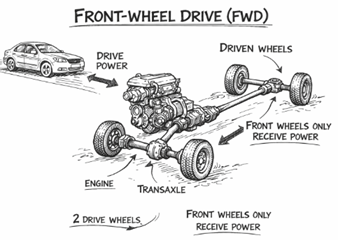
The main advantage is packaging efficiency: the absence of a propshaft to the rear axle and a rear differential frees up space for the cabin and luggage compartment, reduces mass and mechanical complexity, and—vehicle for vehicle—tends to improve fuel consumption and production/maintenance cost.
In low-grip conditions, front-wheel drive often behaves in a predictable way: with the engine’s mass over the front axle, the driven wheels carry higher vertical load, which supports traction during launch and at low speeds, especially on slippery surfaces.
From a dynamics perspective, FWD naturally tends toward understeer: when accelerating through a corner, the front tires must generate both lateral force (to turn) and longitudinal force (to drive). If the combined demand exceeds available grip, the front end “pushes” wide and the car follows a larger radius. This behavior is generally considered more stable and manageable for the average driver.
A typical side effect is torque steer: under acceleration—especially in higher-power cars—the steering may pull due to driveline asymmetries (unequal driveshaft lengths), suspension geometry, differential characteristics, and left-right grip differences. Manufacturers mitigate it with equal-length shafts, suspension tuning, and electronic controls.
Front-wheel drive integrates well with TCS and ESP, which limit wheelspin and help maintain the intended trajectory. On many modern cars, selective braking can also simulate a limited-slip effect, improving traction on corner exit.
Limitations become clearer in sporty driving or under heavy loads: because both steering and propulsion are concentrated at the front axle, the front tires can reach their grip limit sooner, with faster wear and a stronger tendency to understeer when driving aggressively. Moreover, during hard acceleration the rearward load transfer lightens the front axle, reducing available traction precisely when torque demand is highest.
In summary, front-wheel drive is a rational solution for efficiency, cost, and predictable handling. It provides good real-world traction in many everyday conditions and an inherent safety margin linked to understeer, in exchange for some compromises in outright sportiness, high-torque management, and front-tire workload.

