



Renault Twizy
Country of production
The Renault Twizy was produced in Spain, at Renault’s Valladolid plant, and distributed across Europe as an urban electric quadricycle.
Market launch date
May 2011: opening of reservations and communication of European commercial positioning.
Early 2012: start of first deliveries/availability in Europe.
Late March 2012: start of showroom availability (commercial launch phase).
September 2023: end of production and progressive exit from price lists, with the concept passing on to newer group quadricycles.
Facelifts and key updates
No mid-cycle facelift comparable to a passenger-car facelift (front-end/body panels/structure) was introduced in an official and unambiguous way across the whole range: Twizy kept the same technical layout and core architecture throughout its lifecycle.
The most relevant changes were mainly range and use-case updates: the introduction of trims, colour combinations and accessories, and above all the Twizy Cargo variant/solution (micro-transport setup with a dedicated load compartment in place of the rear seat).
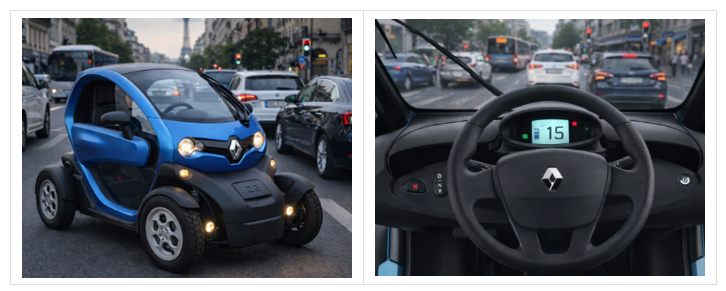
The Twizy is an electric quadricycle with two seats in tandem (one behind the other), positioned halfway between a scooter and a car: compact, very light, and designed for the city. The cabin is “open” (with doors and weather solutions offered as accessories/depending on model year and trims), the turning circle is very tight, and driving is straightforward thanks to a single-speed transmission. The historic range was mainly split between the Twizy 45 (light quadricycle, limited to 45 km/h) and the Twizy 80 (heavy quadricycle, up to 80 km/h), both using the same roughly 6.1 kWh battery and household-socket charging.
Powertrain and performance
| Caratteristica | Twizy 45 (L6e) | Twizy 80 (L7e) |
|---|---|---|
| Motor / layout | 1 electric motor, RWD | 1 electric motor, RWD |
| Power | 4 kW (5 hp) | 13 kW (17 hp) |
| Max torque | 33 Nm | 57 Nm |
| 0–45 km/h | 9.9 s | 6.1 s |
| Top speed | 45 km/h | 80 km/h |
| Battery (energy) | 6.1 kWh | 6.1 kWh |
| Homologated range (ECE-15 urban cycle) | 120 km | 100 km |
| Charging | 220 V household socket (integrated cable) | 220 V household socket (integrated cable) |
| Charging time (indicative) | up to 3 h 30 min | up to 3 h 30 min |
Note: real-world range varies significantly with driving style, route, and temperature; practical values can be lower than the urban homologation figures.
Dimensions and capacity
| Specifica | Misura |
|---|---|
| Length | 2,338 mm |
| Width | 1,237 mm (up to ~1,381–1,396 mm with doors/accessory overhangs, depending on specification) |
| Height | ~1,451–1,454 mm |
| Wheelbase | 1,686 mm |
| Turning circle (curb-to-curb) | 6.8 m |
| Kerb weight (indicative) | ~450–474 kg (depending on version/reference data) |
| Trunk / storage | 31–33 L (standard configuration) |
Main trims and prices
(Model no longer on sale: the prices below are historical launch references and/or indicative; today the market is mainly used, with wide variability depending on battery condition, year, and accessories.)
| Versione | Indicative price (historical) |
|---|---|
| Twizy 45 | from ~€6,990 (launch) |
| Twizy 80 Urban | from ~€7,690 (launch) |
| Twizy 80 Technic/Intens | from ~€8,490 (launch) |
| Battery | frequent monthly rental formula (historically ~€45–49/month, depending on version and period) |
(Practical note: on the used market, Twizy prices typically span a very wide range, often from around €4,000 upwards depending on year, condition, and equipment.)
Maintenance and early service (indicative costs)
(Estimates for electric quadricycles: strong variability by network, city, and tires.)
| Intervento | Typical cost (€) |
|---|---|
| Periodic check/service | 120–260 |
| Brake fluid (periodic) | 70–150 |
| Front brake pads | 120–240 |
| Front discs + pads | 320–650 |
| Tire (each, small sizes) | 70–150 |
| 12 V battery (if needed) | 120–240 |
| Roadworthiness inspection (legal deadlines) | 45–80 |
Pros
Minimal footprint and high agility: ideal for urban traffic and parking.
Two philosophies (45 and 80): L6e accessibility vs broader L7e usability.
Simple household charging and highly simplified mechanical layout.
Iconic product: a recognizable and functional “micro-vehicle” for short commuting.
Cargo variant: a concrete solution for city micro-logistics.
Cons
Comfort and weather protection are inevitably limited (open layout, even if accessory-equipped).
Performance is coherent with the category: the 45 is strictly urban; the 80 remains a quadricycle.
Limited standard cargo capacity (31–33 L trunk).
Road-use rules: it is not a car, and access to certain roads can be limited by category/top speed.
Out of production: availability and support depend on dealer network/parts and the local market.
In summary
The Renault Twizy was one of the most original interpretations of urban electric mobility: very light, compact, and designed to minimize city friction (space, parking, manoeuvres). The choice between 45 and 80 was the real usage fork: the first for purely city trips, the second for a more flexible role. It did not receive a classic mid-cycle facelift, but evolved through trims and practical solutions (especially Cargo). Today it is assessed mainly as a used purchase, with careful attention to vehicle condition and equipment.
Verdict — Renault Twizy
Urban electric quadricycle with 2 tandem seats · Historic versions: Twizy 45 (L6e) and Twizy 80 (L7e) + Cargo variant · Motors: 4 kW (5 hp) (45) / 13 kW (17 hp) (80) · Torque: 33 Nm / 57 Nm · 6.1 kWh battery · Type-approval range ECE-15: 120 km (45) / 100 km (80) · Top speed: 45 km/h or 80 km/h · 0–45 km/h: 9.9 s (45) / 6.1 s (80) · Claimed full charge: up to 3 h 30 min from a 220 V household socket · Turning diameter curb-to-curb: 6.8 m · Discontinued: it is available used only · Used-market pricing (late 2025): typically ~€2,300–€9,900 ·
In 2025, the Renault Twizy is no longer a “new product”: it is a four-wheel micromobility object best evaluated as a niche urban choice in the used market. It remains unique in concept (2 tandem seats, extremely small footprint, simple driving) and in practical effectiveness in city contexts: “impossible” parking becomes possible, agility is high, and energy costs are low. At the same time, its limits are structural: only partial weather protection (doors and upper closures were often optional), a lack of car-like comfort (heating/air-con are not comparable to a city car), and—above all—an operating perimeter constrained by quadricycle rules and speed limits.
If you consider it today, the decision is fairly binary: Twizy 45 if use is pure urban and accessibility (including very young drivers) is the priority; Twizy 80 if you need a bit more flowing-traffic capability (still staying off ring roads/motorways) and greater versatility.
Key technical points:
Homologation and driving eligibility (general context):
Twizy 45: L6e, top speed 45 km/h; drivable with AM licence (typically from age 14).
Twizy 80: L7e, top speed 80 km/h; typically requires B1 (from age 16) or B.
Road restrictions: not permitted on motorways and, in general, on major fast roads where quadricycles are prohibited (always check signage and local rules).
Powertrain and performance:
4 kW / 33 Nm (45) and 13 kW / 57 Nm (80).
0–45 km/h: 9.9 s (45) / 6.1 s (80).
Battery, range and charging:
Energy on board: 6.1 kWh.
Type-approval range ECE-15: 120 km (45) / 100 km (80) (real use can vary widely with driving style, route, and temperature).
Charging: plug into a 220 V socket; up to 3 h 30 min claimed for a full charge (in cold conditions, times can be longer and range lower).
Maneuverability and footprint:
Curb-to-curb turning diameter 6.8 m.
Typical “micro” dimensions: length about 2.34 m; very favorable for parking.
Practicality and variants:
2 tandem seats; historic options/accessories: wing doors, upper closures, “semi-enclosed” solutions.
Twizy Cargo: cargo box in place of the rear seat (for micro-logistics).
| Category | Where it shines | Where it holds steady | Where it falls short |
|---|---|---|---|
| Urban mobility | Minimal footprint and very easy parking | Agile in slow traffic | Operating perimeter constrained by quadricycle rules |
| Accessibility | 45 version suits very young drivers | Simple use (single-speed) | 80 version requires more “car-like” licence/age requirements |
| Running costs | Generally low energy and routine maintenance | Simple mechanicals | Insurance and used value depend heavily on city/local demand |
| Range | Coherent for short, repetitive trips | Adequate for urban commuting | Type-approval figure is not “motorway range”; climate has a big impact |
| Comfort and weather protection | More “protected” than a scooter in some configurations | Usable year-round with the right set-up | Limited protection in cold/heat; options are often decisive |
| Perceived safety | Dedicated frame and seatbelts (quadricycle set-up) | Disc brakes | Not an M1 car: city-car expectations are not appropriate |
| Practicality | Cargo is interesting for last-mile use | Strong as a second vehicle | 2 tandem seats and limited load space (if not Cargo) |
Who it is for
Urban residents with short, repetitive trips and absolute priority on parking, agility, and low running costs. It makes particular sense as a second urban vehicle or a dedicated last-mile solution (especially in Cargo form).
Who should consider alternatives
If you need a true car replacement (comfort, full weather protection, safety and versatility as an M1 passenger car), or if you often use faster-flow roads, a conventional city car or a small “full car” EV is more coherent.
Recommended configuration
Twizy 45 if your use is pure urban and you want maximum simplicity/compatibility (including younger drivers, where allowed).
Twizy 80 if you want a bit more light extra-urban capability, while keeping realistic expectations about comfort and circulation rules.
In both cases, when buying used:
prioritize examples with doors/closures and “winter” equipment if you use it daily;
carefully check battery/charging condition and equipment, because these impact real experience more than the “version name”.

