



Volvo EX30
Country of production
The Volvo EX30 was initially produced in Zhangjiakou (China) and, from 2025, it is also produced in Europe at the Ghent (Belgium) plant to better serve European demand and diversify manufacturing capacity.
Market launch date
7 June 2023: global debut and opening of orders/pre-orders in selected markets.
December 2023: first cars delivered to customers, with deliveries increasing throughout 2024.
From 2025: start of European production in Ghent, Belgium.
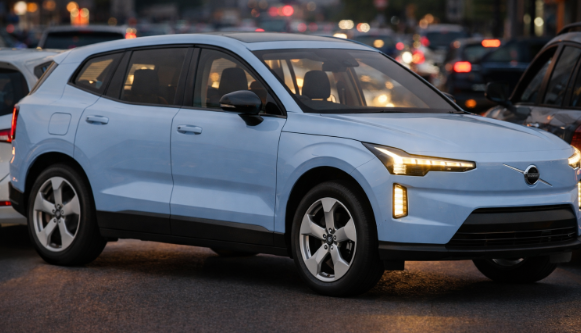
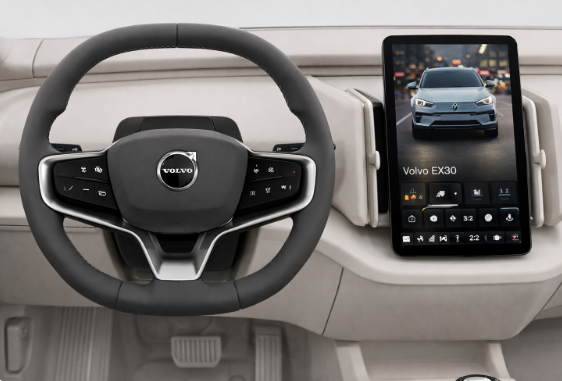
The EX30 is the most compact SUV in Volvo’s electric range: a fully electric 5-seat crossover designed for urban and suburban use, but with a “compact premium” approach (comfort, driver assistance, connectivity, and updates). Styling is clean and contemporary, while the cabin adopts a minimalist, strongly “software-first” layout with many functions centralized. On the road it prioritizes ease of driving, quietness, and the prompt response typical of EVs; the Twin motor performance version adds sports-car-like acceleration in a compact format.
 |  |
Powertrain and performance
| Spec | Single motor | Single motor extended range | Twin motor performance |
|---|---|---|---|
| Motor / layout | 1 motor, RWD | 1 motor, RWD | 2 motors, AWD |
| Max power | 200 kW / 272 hp | 200 kW / 272 hp | 315 kW / 428 hp |
| Max torque | 343 Nm | 343 Nm | 543 Nm |
| 0–100 km/h | 5.7 s | 5.3 s | 3.6 s |
| Top speed | 180 km/h | 180 km/h | 180 km/h |
| Consumption (WLTP weighted) | 17.2 kWh/100 km | 17.0 kWh/100 km | 17.5 kWh/100 km |
| Battery (nominal) | 51.0 kWh | 69.0 kWh | 69.0 kWh |
| Range (WLTP weighted) | up to 337 km | up to 476 km | up to 450 km |
| AC charging 0–100% (3-phase 16A) | 6 h | 8 h | 8 h |
| DC charging 10–80% | 150 kW / 26 min | 175 kW / 26 min | 175 kW / 26 min |
Dimensions and capacity
| Specification | Value |
|---|---|
| Length | 4,233 mm |
| Width (without mirrors) | 1,838 mm |
| Width (with mirrors) | 2,032 mm |
| Height (indicative) | 1,550 mm |
| Wheelbase | 2,650 mm |
| Turning circle | 11 m |
| Trunk (max, behind 2nd row) | 400 L |
| Trunk (rows folded) | 1,000 L |
| Front compartment (frunk) | 7 L |
Main trims and prices
(Indicative “on-the-road” prices; they may vary due to promotions, options, and dealer/on-the-road fees. Some items such as IPT and PFU contributions may not be included depending on the price list.)
Single motor (200 kW)
| Version | From (€) |
|---|---|
| Essential | 36,350 |
| Core | 37,700 |
| Plus | 40,300 |
| Plus black edition | 41,800 |
Single motor extended range (200 kW)
| Version | From (€) |
|---|---|
| Essential | 40,900 |
| Core | 42,700 |
| Plus | 43,370 |
| Ultra | 49,650 |
| Ultra black edition | 50,350 |
Twin motor performance (315 kW)
| Version | From (€) |
|---|---|
| Core | 48,900 |
| Plus | 49,950 |
| Ultra | 52,350 |
| Ultra black edition | 53,050 |
Maintenance and early service (indicative costs)
(Estimates for a compact premium electric SUV: they vary by official network, city, 19–20" tires, and service packages.)
| Intervention | Typical cost (€) |
|---|---|
| Annual check/service | 200–450 |
| Brake fluid (periodic) | 90–170 |
| Cabin filter | 70–150 |
| Front brake pads | 250–450 |
| Front discs + pads | 650–1,100 |
| Tire (each, 19–20") | 180–350 |
| 12 V battery (if needed) | 150–260 |
Pros
Compact size and a tight turning circle: very suitable for city driving.
Extended range version with WLTP range up to 476 km: the most sensible choice for frequent travel.
Claimed DC charging 10–80% in 26 min: good practicality on longer trips.
Twin motor performance: very high performance (0–100 in 3.6 s) for the category.
Cons
Trunk size is decent (up to 400 L), but not “large family car” level: worth evaluating if you often travel with 4–5 people.
A strongly screen-centered interface: those who prefer many physical controls may find it less immediate.
With larger wheels and higher-power versions, tire/alignment costs can rise more quickly.
In summary
The Volvo EX30 is a compact, modern premium proposition focused on safety, technology, and everyday usability. The Single motor is the most accessible choice for urban use; the single motor extended range is the best compromise for mixed driving and travel; the twin motor performance is for those who want an electric “hot crossover,” accepting higher pricing and more demanding tire management.
Verdict — Volvo EX30 (Model year 2025)
Compact premium electric SUV · Main trims: Single motor (RWD), Single motor extended range (RWD), Twin motor performance (AWD) · Output up to 315 kW (428 hp) · Torque up to 543 Nm · Batteries: 51 kWh (nominal) or 69 kWh (nominal) · Range up to 476 km WLTP (Single motor extended range) · DC charging 10–80% in ~26 min · Top speed 180 km/h · 0–100 km/h from 5.7 s (Single motor) to 3.6 s (Twin motor performance) · Italy price “from” €36,350 · Market launch: first customer deliveries in Europe December 2023 (announcement January 4, 2024)
The Volvo EX30 is the brand’s electric “entry point” into the SUV world, but with a premium product mindset: minimalist Scandinavian design, a simplified cabin (centralized digital interface), and a technical package aimed at maximizing everyday usability. In 2025 the lineup is particularly easy to read: a more accessible RWD base version, a RWD larger-battery version for higher mileage users, and an AWD Performance variant for those who want maximum acceleration and traction.
On the road, the EX30 prioritizes ease: the instant response typical of BEVs, compact-SUV maneuverability, and comfort aligned with urban and suburban use. The real decision factor—more than power—is battery choice versus your usage profile: the 51 kWh suits commuting and city driving, while the 69 kWh makes extra-urban use and trips noticeably more relaxed. The Twin motor performance adds higher-segment performance, but can also be more energy-hungry if you exploit it.
Key technical points:
Powertrains, drivetrain and performance (Italy range):
Single motor (RWD): 200 kW (272 hp), 343 Nm, 0–100 km/h 5.7 s, range up to 337 km WLTP.
Single motor extended range (RWD): 200 kW (272 hp), 343 Nm, 0–100 km/h 5.3 s, range up to 476 km WLTP.
Twin motor performance (AWD): 315 kW (428 hp), 543 Nm, 0–100 km/h 3.6 s, range up to 450 km WLTP.
Batteries and charging:
51 kWh (nominal) or 69 kWh (nominal).
DC 10–80% ~26 min (typical claimed value; depends on conditions and infrastructure).
AC 0–100% (three-phase 16A): about 6 h (51 kWh) / 8 h (69 kWh).
Project performance stance: top speed 180 km/h (limited).
Dimensions and maneuverability: length 4,233 mm, wheelbase 2,650 mm, turning circle 11 m (urban compact-SUV set-up).
| Category | Where it shines | Where it holds steady | Where it falls short |
|---|---|---|---|
| Design & image | Clean, modern look, Volvo “electric” identity | Compact premium SUV presence | Interior minimalism is not for everyone (few physical interfaces) |
| Ease of use | Intuitive driving, instant response, manageable footprint | Strong for city and ring roads | On motorways, efficiency depends heavily on speed and temperature |
| Range & battery choice | Extended range: 476 km WLTP improves real life | Base version suits urban use | Performance version tends to consume more if exploited |
| Charging | 10–80% ~26 min makes trips credible | Home AC aligns with daily routine | Real experience depends on charger quality/congestion |
| Performance | Twin motor performance is very quick (3.6 s) | Single motor is already more than sufficient | Not conceived as a “sport SUV” chassis-first: comfort and stability take priority |
| Practicality | Compact format, usable as a single city car | Small-SUV versatility | Rear space and cargo depend on family needs |
| Ownership costs | EV: potential benefits on energy and routine maintenance | Predictable with home charging | Tires/insurance can rise on higher trims and larger wheels |
Who it is for
Drivers who want a compact premium electric SUV that is modern and easy to use, with a clear lineup and a battery choice that lets you optimize the car around your profile: urban use (51 kWh) or long commuting and trips (69 kWh). It is especially coherent if you have a charging routine (home/work) and want to minimize the compromises typical of compact BEVs.
Who should consider alternatives
If you need maximum rear-seat space and family-grade cargo capacity, or if you often drive at sustained motorway speeds without reliable HPC along your routes, you may prefer a larger-segment electric SUV or a hybrid solution. Also, buyers who dislike a very software-led minimalist cabin may find it less “traditional” than they want.
Recommended configuration
Single motor extended range (RWD) as the “sweet spot”: higher WLTP range and already strong performance—often the best balance between daily use and travel.
Single motor (RWD) if your focus is city/short commuting and you want to optimize entry cost.
Twin motor performance (AWD) only if you explicitly want maximum acceleration and traction, accepting greater sensitivity to real-world consumption and wheel/tire choice.
In any case: if range and comfort are priorities, avoid extreme wheel sizes and invest first in a reliable home charging solution.

