



Lotus Emira
Country of production
The Lotus Emira is produced in the United Kingdom, at the Hethel plant (Norfolk), Lotus’s historic production base.
Short description
The Emira is Lotus’s most “modern” sports car with a notably analog feel, yet more mature for everyday usability: mid-engine, rear-wheel drive, two seats, and a setup that prioritizes precision and driver engagement. It retains purist solutions (such as hydraulic steering) while adding comfort and technology (infotainment and a digital instrument cluster) closer to current premium standards. The range combines a turbocharged 4-cylinder with a DCT gearbox and a supercharged V6 with a manual gearbox (or automatic, depending on market/trim), covering both those who want “easy” performance and those seeking a more traditional experience.
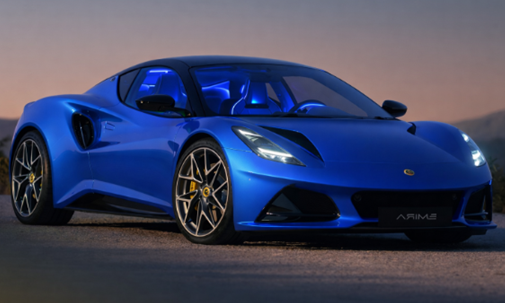 | 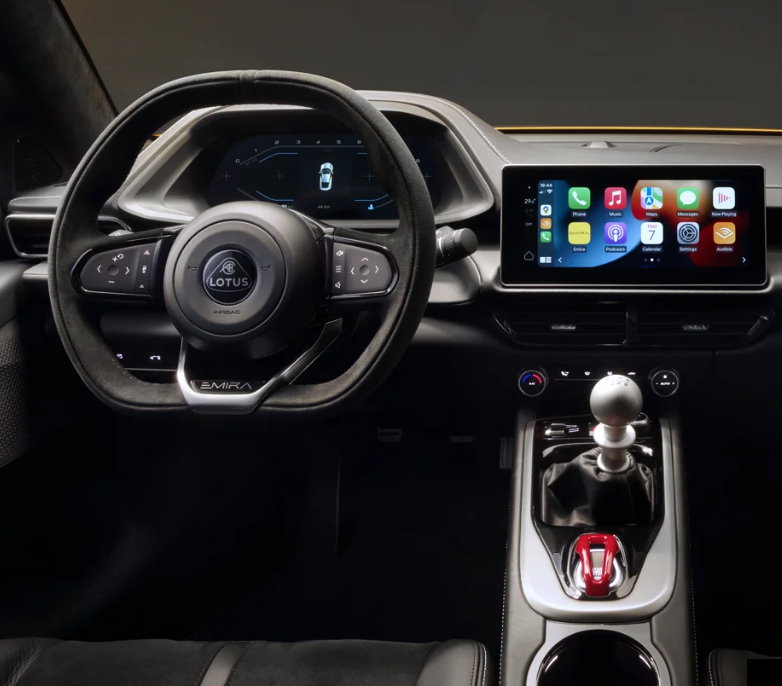 |
Powertrain and performance
| Spec | Emira Turbo | Emira Turbo SE | Emira V6 SE |
|---|---|---|---|
| Engine / layout | 2.0 turbo I4, RWD | 2.0 turbo I4, RWD | 3.5 supercharged V6, RWD |
| Gearbox | 8-speed DCT | 8-speed DCT | 6-speed manual (base) |
| Power | 269 kW (360 bhp) | 294 kW (400 bhp) | 298 kW (406 hp) |
| Max torque | ~430 Nm (indicative) | 480 Nm | 420 Nm |
| 0–100 km/h | 4.4 s | 4.0 s | 4.3 s |
| Top speed | 275 km/h | 291 km/h | 290 km/h |
| Combined consumption (indicative) | ~9.2–10.0 L/100 km | ~9.2 L/100 km | 11.3 L/100 km |
Note: figures can vary by homologation/model year and specification (tires, suspension, options).
Dimensions and capacity
| Specification | Value |
|---|---|
| Length | ~4,413 mm |
| Width (without mirrors) | ~1,895–1,900 mm |
| Height | ~1,230–1,235 mm |
| Wheelbase | ~2,575 mm |
| Weight (indicative) | ~1,405 kg (V6 SE, list figure) |
| Trunk (min–max) | 151–208 L |
| Frunk | 0 L (not provided) |
Main trims and indicative pricing
| Version | From (€) |
|---|---|
| Turbo | 101,500 |
| Turbo SE | 113,800 |
| Turbo SE Racing Line | 117,900 |
| V6 SE | 122,000 |
| V6 SE Racing Line | 126,100 |
(Indicative pricing; it may vary with promotions, options, and on-the-road fees.)
Maintenance and early service (indicative costs)
(Estimates for a premium sports car: strong variability depending on official network, city, driving style, and tires.)
| Intervention | Typical cost (€) |
|---|---|
| Annual service / 15–20,000 km | 500–900 |
| Brake fluid (periodic) | 120–250 |
| Cabin filter | 80–160 |
| Front brake pads | 450–900 |
| Front discs + pads | 1,200–2,400 |
| Tire (each, performance) | 250–450 |
| Alignment / geometry (if needed) | 120–250 |
Pros
True sports-car layout (mid-engine, RWD) with a highly engaging drive.
Hydraulic steering: feel and feedback that are rare today.
Rational range: Turbo is more “plug-and-play”, V6 for those who want a more classic setup.
Relatively compact dimensions by today’s standards, with credible “weekend car” usability.
Cons
Inevitably limited practicality: small trunk and only two seats.
Running costs consistent with the segment (tires and brakes can be significant).
In urban use it requires attention due to ride height and sports-coupé visibility.
Equipment/options: reaching the ideal configuration can increase the price quickly.
In summary
The Lotus Emira is one of the few recent sports cars that still puts feel and engagement at the center, without fully sacrificing comfort and technology. The Turbo is the most modern and accessible entry point, the Turbo SE adds a layer of “easy” performance, while the V6 SE remains the most purist choice for those who want a manual gearbox and a strongly mechanical character.
Verdict — Lotus Emira (Model year 2025, Turbo / Turbo SE / V6 SE range)
Mid-engine two-seat sports coupé · Trims: Emira Turbo (2.0 turbo 4-cylinder, 8-speed DCT), Emira Turbo SE (uprated 2.0 turbo 4-cylinder, 8-speed DCT), Emira V6 SE (3.5 supercharged V6, 6-speed manual or automatic) · Rear-wheel drive · Lightweight aluminium chassis structure · Double wishbone suspension · Electro-hydraulic steering · 0–100 km/h from 4.4 s (Turbo) to 4.0 s (Turbo SE) and 4.3 s (V6 SE) · Top speed up to 291 km/h (Turbo SE)
The Lotus Emira is Hethel’s last major internal-combustion sports car: a mid-engine coupé that aims to preserve the brand’s historic DNA (relative lightness, mechanical feedback, precision), but with a more modern level of finish and daily usability than the Elise/Exige era. In 2025 the range is clearly structured: Turbo as the entry point, Turbo SE as the performance flagship of the four-cylinder lineup, and V6 SE for those who want the more “analog” experience (manual gearbox and the character of the supercharged V6).
On the road, the Emira plays on two main axes: on the one hand a highly communicative dynamic set-up (steering feel, turn-in, and load control), on the other hand notably higher real-world usability than past Lotuses (more credible infotainment, available ADAS, improved comfort). It makes sense both as a weekend car and for fast touring, provided you accept the two-seat layout and the low, compact driving position.
Key technical points:
Engines and performance (2025 lineup data):
Emira Turbo: AMG 2.0 turbo 4-cylinder, 360 bhp / 269 kW, 8-speed DCT, 0–100 km/h 4.4 s, top speed 275 km/h.
Emira Turbo SE: uprated AMG 2.0 turbo 4-cylinder, 400 bhp / 294 kW (about 406 CV), 8-speed DCT, 0–100 km/h 4.0 s, top speed 291 km/h.
Emira V6 SE: 3.5 supercharged V6 (3,456 cc), 400 bhp / 298 kW (about 406 CV), 6-speed manual (with LSD as standard) or automatic, 0–100 km/h 4.3 s, top speed 290 km/h.
Chassis architecture & driving: front/rear double wishbone suspension, electro-hydraulic steering (focus on feedback), two main calibrations (set-ups oriented to comfort/road use and to more focused dynamics).
Brakes and “performance” hardware: large-diameter discs with AP Racing calipers (depending on version/equipment), consistent with a mid-engine sports-car brief.
ADAS and daily use: safety and driver-assistance features available/expandable via packs (availability can vary by market and transmission).
| Category | Where it shines | Where it holds steady | Where it falls short |
|---|---|---|---|
| Design & image | Compact supercar proportions, mid-engine stance, strong presence | Modern lines consistent with Lotus tradition | Low posture and visibility require adaptation in city use |
| Driving dynamics | Very communicative steering and chassis; precise turn-in | Balanced set-up between road use and spirited driving | Not a soft GT: it remains a proper sports car |
| Performance | Turbo SE and V6 SE are genuinely quick; strong response | Turbo is already convincing and easier to exploit | On public roads you will rarely use the full potential |
| Daily usability | Interior and equipment are more “livable” than historic Lotuses | ADAS and connectivity make trips easier | Still a two-seater: practicality is inherently limited |
| Ownership costs | Strong “iconic” value as a modern ICE sports car | Manageable maintenance if well looked after | Tires/brakes and insurance can be demanding |
| Trim choice | Clear range: Turbo / Turbo SE / V6 SE | Broad personalization packs | Gearbox/comfort choice depends heavily on real usage |
Who it is for
Drivers seeking a mid-engine sports car with a very “mechanical,” driver-centered experience, without giving up modern comfort and technology entirely. It is especially well suited to those who want genuine driving pleasure (twisty roads, mountain passes, fast touring), more than a purely image-led object.
Who should consider alternatives
If your priority is maximum practicality (rear seats, large boot, easy urban use) or consistently soft comfort on broken surfaces, a two-seat mid-engine coupé is not the most efficient choice. Likewise, those who want a fully relaxed “automatic-first” experience in every scenario may prefer more GT-oriented alternatives.
Recommended configuration
Emira Turbo SE if you want the best mix of performance and ease of use: fast DCT, very strong headline numbers (0–100 and top speed), and high usability for a mid-engine sports car.
Emira V6 SE (manual) if you want the most analog experience: involvement, supercharged V6 character, and a more direct driver-machine relationship (accepting a bit more rawness).
Emira Turbo if you want to enter the Emira range with a more daily-oriented calibration while still retaining strong performance.

