



Lotus Emeya
Country of production
The Lotus Emeya is produced in China, in the Wuhan area (the group’s industrial hub), while retaining a strong Lotus brand setup and a technical development approach with a clear Lotus imprint.
Short description
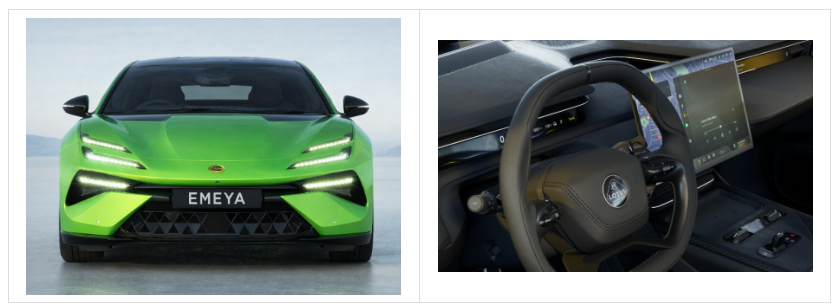
The Emeya is an electric hyper-gt 5-door liftback that brings Lotus into the realm of large battery-powered grand tourers: strong thrust, flagship-level comfort, and carefully tuned dynamics (advanced suspension and, depending on the trim, active aerodynamics content). The project is built around an 800 V platform and benchmark ultra-fast charging, intended to make long-distance touring credible beyond pure performance. The range is structured clearly: 600 variants (more balanced) and 900 variants (more extreme), with differences in performance, equipment, and positioning.
Powertrain and performance
| Spec | Emeya 600 (600 GT / 600 GT SE / 600 Sport SE) | Emeya 900 (900 Sport / 900 Sport Carbon) |
|---|---|---|
| Motors / layout | 2 motors, AWD | 2 motors, AWD |
| Max power | 450 kW (612 hp) | 675 kW (918 hp) |
| Max torque | 710 Nm | 985 Nm |
| 0–100 km/h | ~4.1 s | 2.8 s |
| Top speed | 250 km/h | 256 km/h |
| Battery (nominal) | ~102 kWh (net value varies by homologation/market) | ~102 kWh (net value varies) |
| Range (WLTP, indicative) | up to ~610 km (most efficient versions) | ~485 km (indicative) |
| DC charging (peak) | up to ~420 kW | up to ~420 kW |
| 10–80% (DC, optimal conditions) | up to ~14–15 min | up to ~14–15 min |
| AC charging | up to 22 kW | up to 22 kW |
Note: claimed charging times depend on charger capability, battery temperature, and real-world conditions.
Dimensions and capacity
| Specification | Value |
|---|---|
| Length | ~5,139–5,140 mm |
| Width (without mirrors) | ~2,005–2,070 mm (depending on the stated measurement) |
| Width (with mirrors) | ~2,241 mm (indicative) |
| Height | ~1,459–1,464 mm |
| Wheelbase | 3,069 mm |
| Kerb weight | ~2,555–2,650 kg (depending on version) |
| Trunk (min–max) | 509–1,388 L |
| Frunk | 34 L |
| Braked towing (indicative) | up to 2,250 kg |
Main trims and indicative pricing
| Version | From (€) |
|---|---|
| 600 GT | 112,190 |
| 600 GT SE | 121,390 |
| 600 Sport SE | 134,790 |
| 900 Sport | 151,190 |
| 900 Sport Carbon | 166,490 |
(Indicative “from” prices; they may vary with options, model year updates, promotions, and on-the-road fees.)
Maintenance and early service (indicative costs)
(Estimates for a premium electric sedan/GT: tires, mass, and output have a meaningful impact.)
| Intervention | Typical cost (€) |
|---|---|
| Periodic service / inspections | 350–800 |
| Brake fluid (periodic) | 120–250 |
| Cabin filter | 90–200 |
| Front brake pads | 450–1,000 |
| Front discs + pads | 1,200–2,500 |
| Tire (each, larger sizes) | 300–700 |
| 12 V auxiliary battery (if needed) | 250–500 |
Pros
800 V platform and ultra-fast charging: among the strongest points for long-distance travel.
Clear range logic: balanced 600; 900 for those seeking near-supercar performance levels.
Good everyday usability: 5 doors, a real trunk (509–1,388 L), plus a frunk for cables/small items.
Premium positioning: strong technology content and comfort aligned with a modern GT flagship.
Cons
Significant size and mass: in urban use and parking it requires space and attention.
Price and options: the “right” configuration can increase the total quickly.
The higher-performance 900 range tends to deliver a shorter WLTP range than the most efficient variants.
Large tires and high performance can increase running costs (tires/brakes).
In summary
The Lotus Emeya is an electric grand tourer focused on charging, performance, and premium comfort, with a character closer to a “fast long-distance cruiser” than a traditional sedan. The 600 GT/GT SE is typically the most sensible choice for daily use and travel, while the 900 is designed for those who want maximum acceleration and sport-oriented content, accepting trade-offs in cost and range.
Verdict — Lotus Emeya (Model year 2025, 600/900 range)
Four-door electric Hyper-GT · Trims: Emeya 600 (AWD), Emeya 900 (AWD) · 800 V architecture · Battery approx. 102 kWh nominal / ~98.9 kWh usable · AC charging up to 22 kW · DC charging up to 350 kW (with Lotus communications referencing “Hyper Charging” up to 420 kW under compatible conditions/infrastructure) · 10–80% in about 18 min (ideal conditions) · WLTP range: up to ~580 km (600) and around ~435 km (900) · 0–100 km/h from 4.2 s (600) to 2.8 s (900) · Top speed up to 256 km/h (900)
The Lotus Emeya is Lotus’s answer to the modern “electric GT” concept: not a sedan built only for straight-line numbers, but a car that tries to combine high performance, high-speed stability, and genuine long-distance usability. The 2025 streamlining into two families (600 and 900) makes the choice clearer: the 600 is the more balanced daily/touring option, while the 900 pushes harder on power, response, and a more aggressive content set (including availability of a two-speed transmission).
Inside, the approach is highly technological and driver-oriented: a large projected HUD, full connectivity, digital services, and OTA software updates. On the dynamics side, the Emeya also leverages active aerodynamics (front and rear) to combine stability/control with improved efficiency at higher speeds.
Key technical points:
Powertrain range and performance:
Emeya 600: total output 450 kW (612 PS), torque 710 Nm, AWD, 0–100 km/h 4.2 s, top speed 250 km/h.
Emeya 900: total output 675 kW (918 PS), torque 985 Nm, AWD, 0–100 km/h 2.8 s, top speed 256 km/h; two-speed transmission available.
Battery and range:
Battery approx. 102 kWh nominal / ~98.9 kWh usable.
WLTP range: up to ~580 km (600) and around ~435 km (900), with strong sensitivity to wheels, temperature, and usage profile.
Charging and touring:
AC 22 kW (useful for advanced business/home charging scenarios).
DC HPC up to 350 kW; Lotus communications cite “Hyper Charging” up to 420 kW in specific scenarios; 10–80% ~18 minutes under ideal conditions.
Aerodynamics and control:
Active aerodynamics elements (grille/air dam/diffuser/spoiler) to optimize airflow and stability across drive modes.
In-cabin technology:
Hyper OS, Apple CarPlay/Android Auto compatibility, Over-the-Air updates; large projected HUD to reduce visual load on the central display.
| Category | Where it shines | Where it holds steady | Where it falls short |
|---|---|---|---|
| Design & image | Distinctive Hyper-GT profile | Modern Lotus identity | Not minimalist: deliberately tech-lux |
| Performance | 900 delivers supercar-like figures; immediate response | 600 is already very fast and usable | EV GT mass and footprint are felt in tighter driving |
| Range & touring | 600 is more coherent for touring (higher WLTP) | Strong motorway logic with the right chassis set-up | Real range is highly sensitive to speed, wheels, and climate |
| Charging | 800 V architecture and 10–80% ~18 min | AC 22 kW is useful for frequent charging | To exploit it you need truly high-performance HPC infrastructure |
| Driving dynamics | Active aero and tuning aimed at stability/control | Coherence as a fast, drivable GT | In cities, size and visibility require adaptation |
| Technology & ADAS | Digital ecosystem and OTA evolution | Well-integrated connectivity | Features and availability can vary by market/spec |
| Ownership costs | Premium content and positioning | Warranties/services depend on buying channel | Tires and brakes can be demanding, especially 900 |
Who it is for
Drivers who want a premium electric GT with very high performance and high-level fast charging, but with a more “fast touring” mindset than “sprint only.” The 600 is the more rational real-world choice; the 900 is for those who want maximum performance and accept compromises on range and costs.
Who should consider alternatives
If your priority is maximum real-world efficiency, maximum family-style space, or ultra-soft comfort on any surface, some premium alternatives with a stronger comfort/space-first focus may be more coherent.
Recommended configuration
Emeya 600 for the best balance: already very high performance, stronger touring coherence, and (typically) better range/manageability.
Emeya 900 only if you explicitly want the top performance (0–100, response, and a more aggressive set-up), accepting compromises on range and costs.
For real-world use: avoid extreme wheel/tire set-ups unless needed, and invest in charging (home/office + HPC access) to truly leverage the 800 V architecture.

