



Porsche Taycan
Country of production
The Porsche Taycan is produced in Germany, at the Zuffenhausen plant (Stuttgart).
Short description
The Taycan is Porsche’s electric sports sedan: a low-slung stance, four-door coupé proportions, and a distinctly “Porsche” engineering approach built around an 800 V electrical architecture, a low center of gravity, and dynamics that prioritize precision over simple straight-line theatrics. The cabin is modern and tech-forward (digital instrumentation, advanced infotainment), yet the car remains fundamentally driver-focused: direct steering, refined torque management, and the ability to sustain a fast pace without losing composure. Following the 2024–2025 range update, the key gains are improved efficiency, faster charging, and even higher performance in the top variants.
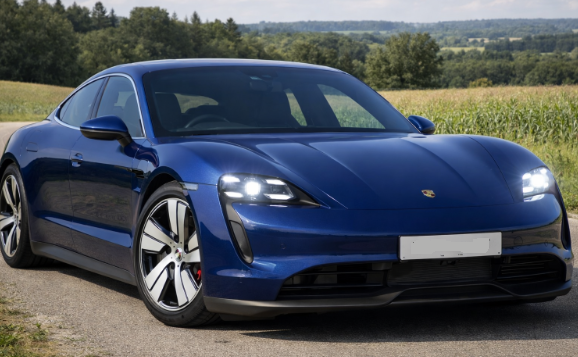 | 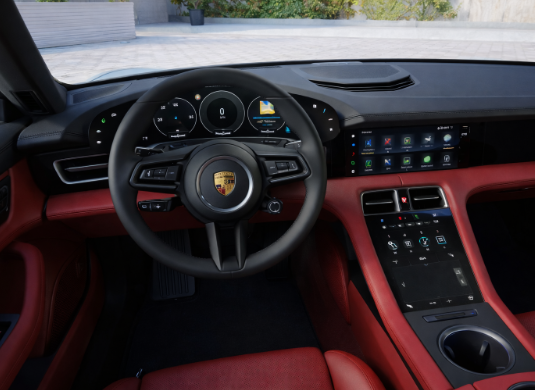 |
Powertrain and performance
| Spec | Taycan (RWD) | Taycan 4 (AWD) | Taycan 4S (AWD) | Taycan Turbo (AWD) | Taycan Turbo S (AWD) | Taycan Turbo GT (AWD) | Taycan Turbo GT Weissach (AWD) |
|---|---|---|---|---|---|---|---|
| Motors / layout | 1 rear motor | 2 motors (one per axle) | 2 motors (one per axle) | 2 motors (one per axle) | 2 motors (one per axle) | 2 motors (one per axle) | 2 motors (one per axle) |
| Output (Launch Control/overboost) | up to 300 kW (408 hp) | up to 320 kW (435 hp) | up to 400 kW (544 hp) | up to 650 kW (884 hp) | up to 700 kW (952 hp) | up to 760 kW (1,034 hp) | up to 760 kW (1,034 hp) |
| Max torque (Launch Control) | 420 Nm | 585 Nm | 695 Nm | 890 Nm | 1,110 Nm | 1,240 Nm | 1,240 Nm |
| 0–100 km/h | 4.8 s | 4.6 s | 3.7 s | 2.7 s | 2.4 s | ~2.3 s | ~2.2 s |
| Top speed | 230 km/h | 230 km/h | 250 km/h | 260 km/h | 260 km/h | ~290 km/h | ~305 km/h |
| Combined consumption (WLTP) | 19.1–16.7 kWh/100 km | ~18.5 kWh/100 km | 20.1–17.6 kWh/100 km | 20.5–18.0 kWh/100 km | 20.5–17.9 kWh/100 km | 21.2–20.6 kWh/100 km | 21.2–20.5 kWh/100 km |
| Battery / range | 89 kWh / 598–680 km (WLTP) | 89–105 kWh / 559–643 km (WLTP) | 89–105 kWh / 566–645 km (WLTP) | 105 kWh (97 net) / 557–630 km (WLTP) | 105 kWh (97 net) / 558–630 km (WLTP) | 105 kWh (97 net) / 550–555 km (WLTP) | 105 kWh (97 net) / 550–555 km (WLTP) |
| DC charging | up to 320 kW | up to 320 kW | up to 320 kW | up to 320 kW | up to 320 kW | up to 320 kW | up to 320 kW |
| 10–80% (DC, optimal conditions) | ~18 min | ~18 min | ~18 min | ~18 min | ~18 min | ~18 min | ~18 min |
| AC charging | up to 11 kW | up to 11 kW | up to 11 kW | up to 11 kW | up to 11 kW | up to 11 kW | up to 11 kW |
Dimensions and capacity
| Specification | Value |
|---|---|
| Length | ~4,962 mm |
| Width (incl. mirrors) | ~1,966 mm (mirrors ~2,144 mm) |
| Height | ~1,378–1,381 mm |
| Wheelbase | ~2,900 mm |
| Kerb weight | ~2,100–2,300+ kg (depending on version) |
| Rear trunk (min) | ~366–407 L (depending on version) |
| Frunk | ~84 L |
Main trims and prices
| Version | “On-the-road” price (excluding IPT) from (€) |
|---|---|
| Taycan | 110,111 |
| Taycan 4 | 115,233 |
| Taycan 4S | 129,784 |
| Taycan Turbo | 186,460 |
| Taycan Turbo S | 222,048 |
| Taycan Turbo GT | 253,654 |
| Taycan Turbo GT with Weissach package | 253,769 |
(Indicative “on-the-road” prices as per online lists; they can vary with promotions, options, and dealer fees.)
Maintenance and early service (indicative costs)
(Estimates for a premium electric sedan in Italy: variability depends heavily on the official network, city, tires, and service packages.)
| Intervention | Typical cost (€) |
|---|---|
| Scheduled service | 350–700 |
| Brake fluid (periodic) | 120–250 |
| Cabin filter | 80–180 |
| Front brake pads | 450–900 |
| Front discs + pads | 1,200–2,200 |
| Tire (each, 19–21") | 280–550 |
| 12 V auxiliary battery (if needed) | 250–450 |
Pros
Class-leading driving dynamics among EVs: steering, chassis, and traction feel unmistakably Porsche.
800 V architecture with DC fast charging up to 320 kW: very competitive for long-distance travel.
Wide range: from the balanced base Taycan to extreme variants (Turbo S / Turbo GT).
Strong build quality and premium positioning, with a well-executed, tech-forward cabin.
Cons
Price and options: reaching the “right” configuration can raise the total quickly.
High mass: inevitable for a high-performance EV sedan, and noticeable when driving hard.
Rear-seat comfort and practicality are not “pure family car” level (also influenced by wheels and suspension choices).
Consumption and tires: with large wheels and brisk driving, running costs (tires/brakes) increase.
In summary
The Porsche Taycan is one of the few electric cars that truly puts driving at the center: it is not only fast in a straight line, but also coherent, precise, and rewarding when the road becomes interesting. Entry versions already deliver more than enough performance and strong balance; the 4S is often the sweet spot for those wanting full sportiness without extremes; Turbo S and especially Turbo GT are enthusiast choices aimed at maximum performance, with the corresponding costs and compromises.
Verdict — Porsche Taycan (Model year 2025)
Premium electric sports sedan · Body styles: Sport Saloon, Sport Turismo, Cross Turismo · Main trims: Taycan (RWD), Taycan 4 / 4S, GTS, Turbo, Turbo S, Turbo GT (and “Black Edition” variants where available) · 800 V architecture · DC charging up to 320 kW (with Performance Battery Plus) · 10–80% in about 18 min (ideal conditions) · Claimed range up to 678 km WLTP (specific configurations) · 0–100 km/h from 4.8 s (Taycan) to 2.2 s (Turbo GT with Weissach) · Up to 1,034 PS (Turbo GT)
In its updated 2025 cycle, the Porsche Taycan is one of the most convincing real-world interpretations of the “electric sports car” concept: low seating position, Porsche-grade steering and chassis, and a technical maturity that shows most clearly in range, charging, and energy management at speed. It is not an EV built only to chase acceleration headlines: the goal is dynamic consistency and repeatability—from daily driving to fast long-distance travel.
Inside, the approach is modern and rational: driver-centered ergonomics, a fully digital instrument cluster, and system integration that prioritizes clarity and speed of use. The key strength remains balance: the Taycan is comfortable when needed and precise when the pace rises, with the brand’s typical sense of solidity and control.
Key technical points:
Range and performance (main models as reference):
Taycan (RWD): 408 PS, 0–100 km/h 4.8 s (Launch Control).
Taycan 4: 408 PS, 0–100 km/h 4.6 s.
Taycan 4S: 544 PS, 0–100 km/h 3.7 s.
Taycan GTS: 700 PS, 0–100 km/h 3.3 s.
Taycan Turbo: 884 PS, 0–100 km/h 2.7 s.
Taycan Turbo S: 952 PS, 0–100 km/h 2.4 s.
Taycan Turbo GT: 1,034 PS, 0–100 km/h 2.3 s (Turbo GT with Weissach: 2.2 s).
Range: up to 678 km WLTP (depending on body style, trim, and configuration).
Battery and architecture: 800 V platform; Performance Battery Plus with 105 kWh gross / 97 kWh net capacity (technical figure for specific versions).
Charging: DC peak up to 320 kW (with Performance Battery Plus); 10–80% in ~18 minutes under ideal conditions.
Dynamics and transmission: strong focus on traction and torque management; many versions use a two-speed rear transmission to support both acceleration and top-end efficiency/speed.
| Category | Where it shines | Where it holds steady | Where it falls short |
|---|---|---|---|
| Performance | Extremely broad spread: from “very fast” to “supercar-quick” | Full, immediate thrust across the lineup | On public roads it is hard to exploit everything, especially Turbo GT |
| Range & touring | 2025 is far more credible on long journeys | Planning is simplified with fast charging | Real range depends heavily on wheels, speed, and temperature |
| Charging & tech | 800 V architecture and peaks up to 320 kW | Competitive charge curve for the segment | You need suitable HPC sites to truly leverage 320 kW |
| Driving dynamics | Benchmark steering precision and control in the class | High comfort with the right chassis set-up | EV premium mass and footprint remain, especially on upper trims |
| Practicality | Sport Turismo/Cross Turismo add versatility | Strong day-to-day usability | Low seating and a “sports-first” feel are not for everyone |
| Ownership costs | High perceived quality and value | Strong model image retention | Purchase price, tires, and brakes (especially on high-output trims) can be demanding |
Who it is for
Drivers who want a premium electric sports car they can genuinely use: commuting, weekends, and fast long-distance travel, with a chassis that communicates and charging technology that supports extended routes. It is particularly well suited to those who want performance without giving up Porsche’s characteristic driving coherence.
Who should consider alternatives
If your priority is maximum cabin space and family-style cargo capacity, or minimizing purchase and running costs, it is more coherent to look at premium EVs focused on comfort and interior volume. If you want the softest possible ride/character, some alternatives prioritize isolation and comfort-first calibration.
Recommended configuration
Taycan 4S (Sport Saloon or Sport Turismo): often the best compromise between performance, usability, and traction, without stepping into the hyper-specialized Turbo territory.
Taycan (RWD) if you want efficiency and a “cleaner” feel (less complexity/weight than AWD), while keeping performance at a very high level.
Turbo / Turbo S / Turbo GT only if you have a clear reason (absolute performance): they make sense for those who want the top end and accept the cost and real-world “overkill.”
In all cases, battery and wheels/tires have a decisive impact on real range and comfort: for real-world use and touring, it is advisable to avoid overly extreme set-ups unless necessary.

