



The automatic transmission: pros, cons, problems
The automatic transmission is a drivetrain system that selects and engages gears autonomously, with the aim of optimizing comfort, efficiency, and performance while reducing the driver’s workload. Unlike a manual gearbox, clutch actuation and gear selection are handled by a combination of mechanical, hydraulic, and electronic systems.
There are four main technology families: AT with a torque converter, DCT (dual-clutch transmission), CVT (continuously variable transmission), and automated/robotized manual transmissions (AMT). Each solution has its own control logic and trade-offs in terms of responsiveness, smoothness, and durability.
The classic AT uses a torque converter to connect the engine to the transmission, enabling very smooth launches and damping vibrations; under steady cruising, a lock-up clutch often engages to eliminate converter slip and improve efficiency. Gear selection is achieved through planetary gearsets and multi-plate clutches/brakes controlled hydraulically.
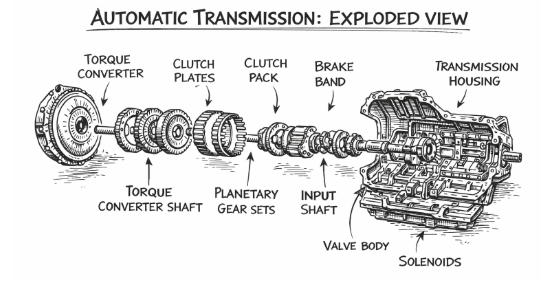
A DCT (dual-clutch transmission) uses two clutches (one for even gears, one for odd gears) and two concentric input shafts, enabling rapid shifts because the next gear can be “preselected.” The downside is higher sensitivity during low-speed maneuvers and clutch heat management, especially in urban driving or towing, depending on the design (dry vs wet clutches).
A CVT varies its ratio continuously (typically via variable-diameter pulleys and a belt/chain), keeping the engine in its most efficient or most powerful operating range. It delivers very smooth acceleration, but it can produce a “rubber-band” feel (engine speed rises without a proportional increase in road speed) and requires careful torque management for long-term reliability.
AMTs are manual gearboxes with actuators that automate clutch and shift operations: they can be efficient and lightweight, but often feel less smooth than ATs or DCTs during transitions—especially at launch and low-speed shifts—if calibration is not highly refined.
Control is managed by a dedicated unit (TCU) that processes inputs such as accelerator position, vehicle speed, engine load, estimated road grade, oil temperature, drive mode selection, and—on more modern systems—predictive data (navigation and radar) to choose the optimal gear. Perceived quality depends heavily on calibration: shift points, engagement speed, lock-up strategy, and anti-jerk control.
In driving terms, an automatic transmission improves comfort in traffic and can reduce fuel consumption if well engineered (especially with many ratios and extensive lock-up use). Under acceleration, DCTs and some modern ATs deliver very short shift times; on slippery surfaces, integration with TCS/ESP is important to modulate torque and limit wheelspin during shifts.
Key critical aspects are temperature and lubrication: the fluid (ATF or application-specific oils) is essential for clutches, valves, and actuators. Service intervals, fluid quality, and thermal management (heat exchangers, oil coolers) directly influence durability and reliability, particularly under heavy-duty use.
In summary, the automatic transmission is a complex system that combines hardware and electronic control to automate gear selection. The choice between AT, DCT, CVT, and AMT depends on usage priorities (comfort, sportiness, efficiency, towing) and on engineering quality, with maintenance and thermal control as key factors for consistent long-term performance.

