



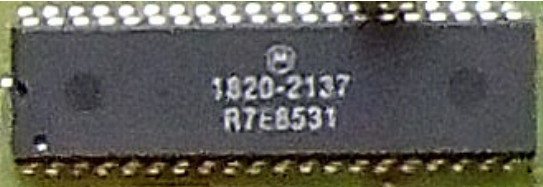
Motorola MC68A00P – 8-bit microprocessor of the 6800 family, with a 16-bit address bus and an embedded-oriented architecture
The Motorola MC6800 is an 8-bit microprocessor from the first generation of “general-purpose” CPUs intended to be integrated into systems with external RAM/ROM and bus-connected peripherals. It is one of the foundational parts of the 6800 family, designed for industrial, control, and embedded computing, with a relatively linear programming model and a typical hardware platform based on address decoding, memory mapping, and bus I/O.
Practically, the MC6800 favors “discrete-component” system designs: ROM for firmware, RAM for data, peripherals on the bus (timers, parallel/serial ports, interrupt logic), plus glue logic and clear control signals for board-level integration.
Base architecture: 8-bit core with 16-bit addressing
8-bit core
The CPU operates natively on 8-bit (byte) data and provides the fundamental instructions for logic, arithmetic, and control flow typical of microprocessors of its era.
16-bit address bus
The MC6800 uses 16-bit addressing, so it can directly access up to 64 KB of memory space. Operationally, this implies a memory map where ROM, RAM, and peripherals are placed into windows within the 0x0000–0xFFFF range via address decoding.
Registers and programming model
The register set is essential and oriented toward compact code:
Accumulator A and accumulator B (8-bit)
Two separate accumulators are useful for arithmetic/logic operations and for reducing RAM accesses during repetitive routines.
Index register (16-bit)
A 16-bit index register facilitates access to tables, buffers, and data structures, making loops and indexed addressing more efficient.
Stack pointer (16-bit)
The stack pointer enables subroutine and interrupt handling with a cleaner stack discipline than more minimal CPUs.
Program counter and condition codes
The program counter controls instruction flow, and condition flags (condition codes) enable conditional branching and state checks (zero, carry, negative, overflow depending on operations).
Instructions and addressing modes: practical impact
The MC6800 provides an instruction set oriented to:
Byte operations (add/sub/and/or/xor, shift/rotate)
Branches and calls (branch, jump, subroutine)
Stack and interrupt management (push/pull, return)
Typical addressing modes include immediate, direct, extended, and indexed. Practically, the “direct + indexed” combination is often the basis for efficient embedded firmware: direct for “near” variables and indexed for buffers and tables.
System bus and integration with memory and peripherals
The MC6800 is designed for a classic bus with:
Address lines (16-bit)
Data lines (8-bit)
Control signals for read/write and synchronization
Practically, system quality depends on three elements: the memory map, address decoding, and timing (wait states, compatibility with RAM/ROM and peripherals). This makes the MC6800 well suited to industrial systems where timing and bus peripherals are tightly controlled.
Interrupts and operational robustness
Interrupt support enables handling asynchronous events (timers, I/O, faults, communications). Operationally, having a stack and return/state-handling instructions supports more robust firmware: deterministic main loops can be combined with external-event handling through ISRs (interrupt service routines).
Typical deployments and historical context
The MC6800 was widely used in:
Industrial control and automation
Instrumentation and measurement systems
Terminals, embedded systems, and control boards with memory-mapped peripherals
In its historical competitive context, it is often viewed conceptually in contrast to platforms derived from the Intel 8080, with differences in ecosystem and integration choices.
Sketch of the most important connections
                 16-bit address bus + 8-bit data bus + control
        ┌──────────────────────────────────────────────────────────┐
        │              system logic / decoding                      │
        │  ROM (firmware), RAM (data), I/O (peripherals), interrupts │
        └───────────────────────────────┬──────────────────────────┘
                                        │
                                        ▼
                           ┌─────────────────────────────┐
                           │        Motorola MC6800       │
                           │    8-bit CPU, 16-bit addr     │
                           │  A/B accumulators, 16-bit index│
                           │   stack + interrupt support    │
                           └─────────────┬───────────────┘
                                         │
                                         ├────────► ROM (program)
                                         ├────────► RAM (variables/stack/buffers)
                                         └────────► I/O (timers, ports, interfaces)
Table 1 – Identification data and specifications
| Characteristic | Indicative value |
|---|---|
| Device | Motorola MC6800 |
| Manufacturer | Motorola |
| Class | 8-bit CPU |
| Address bus | 16-bit |
| Addressable space | 64 KB |
| Data bus | 8-bit |
| Key registers | A/B accumulators (8-bit), index (16-bit), stack pointer (16-bit) |
| Typical integration | ROM + RAM + bus peripherals with address decoding |
| Usage domain | Embedded/industrial, parallel-bus systems |
Table 2 – Operational and design considerations
| Aspect | Practical meaning |
|---|---|
| 16-bit addressing | Up to 64 KB memory map: ROM/RAM/I-O decoding is central |
| A/B + index registers | Good balance for loops and buffer routines, with fewer RAM accesses |
| 16-bit stack pointer | Cleaner subroutines and interrupts, more maintainable firmware |
| Addressing modes | Direct/extended/indexed: straightforward embedded code optimizations |
| Classic external bus | Design depends on timing, memory components, and glue logic |
| Interrupts | Handling asynchronous events and peripherals without constant polling |

