



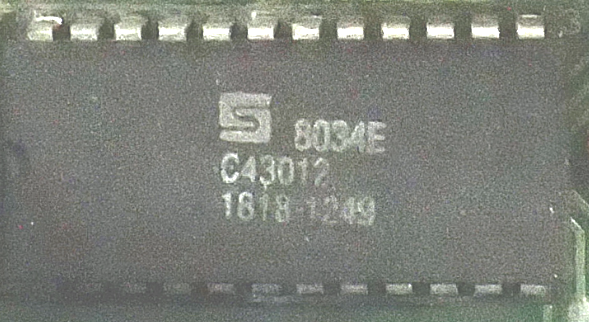
Synertec C43012 (HP 1818-1249) – ROM paired with C43013
Definition
The Synertec C43012 is a ROM (read-only memory) used as a firmware component in HP systems, designed to operate as a pair with the Synertec C43013. In practical terms, the C43012/C43013 pair forms a non-volatile memory set that the system reads at startup and during operation to obtain microcode, tables, service routines, and resident operating logic.
For the C43012, the associated HP part number is 1818-1249.
Functional relationship with the C43013: why two ROMs exist
The fact that the C43012 works together with the C43013 indicates an architecture in which the firmware is split across two ROM devices. In instruments and digital systems of the same era, this choice was typically adopted to:
Separate content into blocks (for example “main program” and “support/diagnostics”), or to implement parallel/interleaved reading (for example even/odd bytes) to match the bus width and timing requirements of the system.
In this specific case, the available information confirms that the C43012 is a ROM and that it operates jointly with the C43013, but it does not publicly disclose (in the retrieved sources) the memory map, detailed pinout, or internal organization of the contents.
HP part number and BOM identification
Within HP documentation and spare parts logistics, 1818-1249 identifies the C43012 component. This type of coding is typical for “custom” (or selected) components used on proprietary boards and instruments, where the HP part number is often the most useful reference for searching, replacement, and compatibility checking.
Application context: HP instrumentation
The C43012 is listed as a ROM associated with HP instruments (for example, it is indicated as present on the HP 5335A Universal Counter).
In a service/maintenance context, the designation C43012 also appears in period HP technical documentation (indexed as a part/IC).
Package and practical replacement constraints
The C43012 is reported in a DIP 24 package in the available information. This is consistent with the use of ROMs in sockets or on through-hole PCBs in benchtop instruments and legacy HP logic boards.
From an operational standpoint, replacement requires attention to:
Compatibility of the pair C43012/C43013 (consistent versions/steps).
Presence of HP coding (part number) and possible firmware revisions.
Socket integrity (if fitted) and absence of oxidation/weak contacts, common in older equipment.
Sketch of the most important connections
                 address bus (A0..An) + control signals
        ┌──────────────────────────────────────────────────────┐
        │                     CPU / Controller                 │
        │                                                      │
        │  address ───────────────┬───────────────┐           │
        │  control (/CE,/OE, etc.) ├─────┐         │           │
        └──────────────────────────┘     │         │           │
                                          ▼         ▼
                               ┌────────────────┐  ┌────────────────┐
                               │  :contentReference[oaicite:1]{index=1}      │  │  Synertec      │
                               │  C43012        │  │  C43013        │
                               │  ROM (HP       │  │  ROM (HP       │
                               │  1818-1249)    │  │  1818-1250)    │
                               └───────┬────────┘  └───────┬────────┘
                                       │                   │
                                       └────── data bus ───┘
                                              (D0..D7)
Table 1 – Identification data and specifications
| Characteristic | Indicative value |
|---|---|
| Device | Synertec C43012 |
| Class | ROM (read-only memory) |
| Role | Firmware ROM paired with Synertec C43013 |
| HP part number | 1818-1249 |
| Paired component | Synertec C43013 (HP part number 1818-1250) |
| Package | DIP 24 |
| Indicated application context | HP instrumentation (e.g., HP 5335A Universal Counter) |
Table 2 – Operational and design considerations
| Aspect | Practical meaning |
|---|---|
| ROM pair (C43012 + C43013) | Firmware split across two ICs; version consistency between the two is required |
| HP part number as primary reference | For spares and compatibility, the HP code is often more useful than the manufacturer marking alone |
| DIP 24 package | Favors servicing on legacy instruments (sockets, easier rework than SMD) |
| Failure diagnostics | Startup errors, failing self-tests, or anomalous behavior can be consistent with degraded ROMs or oxidized socket contacts |
| Replacement | Requires attention to firmware revisions and to the complete ROM pair, not a single device in isolation |

