



IIT 3C87-20
Definition
The IIT 3C87-20 is an X87-compatible math coprocessor designed as a plug-in alternative to the 80387DX for systems based on the 80386DX. The “-20” suffix indicates the nominal 20 MHZ version. Its purpose is to accelerate floating-point operations (and a subset of advanced math functions) versus software execution, while maintaining instruction-level compatibility with the X87 ecosystem expected on 386 platforms.
In practical use, it was selected as a market “second source” (i.e., an alternative supplier to INTEL) to improve availability, pricing, or power/performance, while remaining compatible with the expected socket and with software written for the platform.
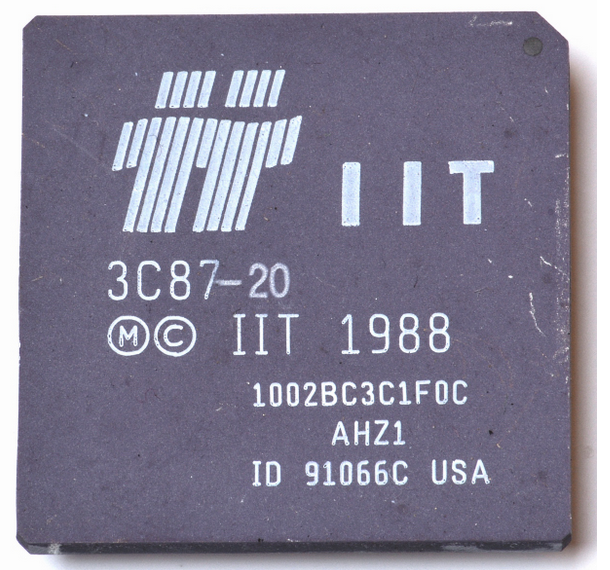
Key point requested: lower power thanks to CMOS technology
Compared with several earlier solutions (or variants built on less efficient processes), the 3C87-20 was manufactured using CMOS technology, with the goal of reducing dissipation and improving energy efficiency. For a coprocessor in this class, the practical benefits of CMOS typically translate into:
Lower power dissipation at the same frequency and numeric workload.
Reduced thermal stress on the board, improving stability and reliability.
Easier integration in systems with limited cooling constraints.
Compatibility and positioning (what “80387-compatible” means)
Saying the 3C87-20 is compatible with the 80387DX means, at system level:
Electrical/mechanical compatibility: typically the same package and pinout expected by the coprocessor socket on 386DX motherboards.
Software compatibility: support for the X87 instruction model required by applications that use a coprocessor (CAD, technical computing, scientific software, advanced spreadsheets).
Transparent integration: software that “sees” an external FPU works without being rewritten, because floating-point instructions are executed by the dedicated unit.
Technical note: some third-party compatible implementations may include extensions or minor differences compared with the INTEL reference; however, the general goal remains operational compatibility for real-world use in DOS/UNIX environments and typical applications of the era.
Board-level integration (system architecture)
On an 80386DX motherboard, the coprocessor:
Is installed into the dedicated socket (when present).
“Works alongside” the CPU: floating-point instructions are handled by the FPU, while the CPU continues to manage overall program flow and integer operations.
Accesses operands and stores results through system memory according to the X87 architecture model.
Sketch of the most important connections
                 ┌──────────────────────────────┐
                 │            CPU 80386DX        │
                 │  fetch/execute integer + ctrl │
                 │  bus + system signals         │
                 └──────────────┬───────────────┘
                                │ coprocessor interface (387DX socket)
                                ▼
                       ┌──────────────────┐
                       │    IIT 3C87-20   │
                       │      X87 FPU     │
                       │  floating-point  │
                       │  dedicated unit  │
                       └─────────┬────────┘
                                 │ operands/results in memory
                                 ▼
                 ┌────────────────────────────────┐
                 │ System RAM / ROM / I/O          │
                 │ (data, code, results)           │
                 └────────────────────────────────┘
Table 1 – Identification data and specifications (English)
| Characteristic | Typical value |
|---|---|
| Device | IIT 3C87-20 |
| Class | X87 math coprocessor ( 80387DX compatible) |
| Typical platform | Systems with CPU 80386DX and a coprocessor socket |
| Nominal frequency | 20 MHZ |
| Technology | CMOS (goal: lower power/dissipation) |
| Typical package | Ceramic PGA (“387DX socket” class) |
| Purpose | Floating-point acceleration vs. software emulation |
Table 2 – Operational and usage aspects (English)
| Aspect | Practical meaning |
|---|---|
| Software compatibility | Executes code using X87 instructions expected on 386/387 platforms |
| Performance benefit | Very high on floating-point workloads; marginal on integer-only software |
| Thermal impact | More manageable thanks to CMOS implementation (typically lower dissipation) |
| Integration | Installed in a dedicated socket; transparent to software that detects an FPU |
| Typical use | CAD, technical/scientific computing, period 3D graphics, spreadsheet-heavy workloads |
| “Second source” rationale | Availability/price/power/performance as an alternative to INTEL parts |

