



Sun UltraSPARC III
The Sun UltraSPARC III is a server/workstation CPU from Sun Microsystems based on the 64-bit SPARC V9 architecture, designed for highly scalable multiprocessor systems. It implements the VIS instruction set to accelerate vector/multimedia-style operations and integrates advanced RAS capabilities typical of enterprise platforms.
Architecturally, UltraSPARC III combines 4-way superscalar execution with a 14-stage “non-stalling” pipeline, an integrated L1 cache subsystem (instruction + data), and an 8 MB external L2 cache, plus a system bus based on the Sun Fireplane Interconnect to support very large CPU-count configurations.
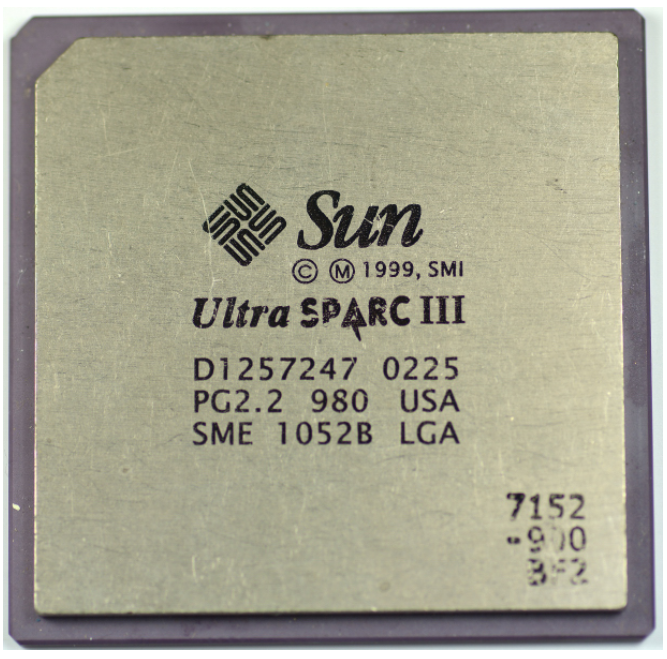
64-bit SPARC V9 architecture and VIS instruction set
64-bit open standards-based SPARC V9 with VIS Instruction Set
The 64-bit SPARC V9 architecture enables large addressing and 64-bit register operations while remaining consistent with an “open standards-based” ecosystem. The VIS set is designed to accelerate operations typical of vector data processing (for example transforms, block operations, and repetitive patterns), with practical impact on selected workloads.
4-way superscalar execution and 14-stage pipeline
4-way superscalar
The CPU can issue up to four operations per cycle (under ideal conditions), improving throughput on code with sufficient instruction-level parallelism.
14-stage non-stalling pipeline
A 14-stage pipeline aims to increase clock frequencies and internal parallelism. The “non-stalling” concept indicates a design approach intended to reduce internal blocking and keep execution flow more continuous, with practical benefits on server workloads where sustained throughput matters as much as peak speed.
RAS capabilities and enterprise robustness
Advanced RAS features
RAS (reliability, availability, serviceability) features are central in mission-critical environments: in practice they include diagnostic mechanisms, error handling, and predictable behavior under fault conditions, aiming to reduce downtime and simplify maintenance.
MP scalability and the Fireplane interconnect
MP scalability: architecturally designed for >1000 CPUs/system
The platform is conceived to scale to extremely large multiprocessor configurations (on the order of >1000 CPU per system as an architectural target). In practice, this requires coherent protocols, high-bandwidth interconnect, and a design that minimizes shared bottlenecks.
System bus: Sun Fireplane Interconnect
The Fireplane bus/interconnect is the system element that enables communication and scaling between processors and memory/I/O resources, with focus on bandwidth and latency in multi-socket configurations.
Processor memory bandwidth scales with number of processors
Memory bandwidth increases with the number of processors: in practice the architecture aims to avoid saturating a single shared memory channel as CPU count grows, improving real scalability in parallel workloads.
Integrated memory controller
The integrated memory controller reduces dependence on external components for memory management and can improve access latency and predictability, especially when coordinated with the multiprocessor topology.
Cache hierarchy: integrated L1 and 8 MB external L2
L1 caches: integrated instruction (32 KB) & data (64 KB)
The L1 caches are integrated and split between instruction (32 KB) and data (64 KB), reducing contention between code fetch and data access. In practice, this improves responsiveness and stabilizes throughput on mixed workloads.
L2 cache: 8 MB external (2 way, set-associative)
The L2 cache is external, with 8 MB capacity, organized as 2-way set-associative. In practice, a large L2 reduces traffic to main memory on medium/large datasets, benefiting server workloads (for example databases and services with significant working sets).
Available clock frequencies
Clock frequencies: 900 MHZ, 1050 MHZ and 1.2 GHZ
The series is specified with 900 MHZ, 1050 MHZ, and 1.2 GHZ variants. In practice, the speed grade defines the trade-off between performance and thermal/platform constraints while keeping the same architectural baseline.
Sketch of the most important connections
                 system interconnect (Sun Fireplane) + memory/I-O
        ┌──────────────────────────────────────────────────────────┐
        │      Fireplane fabric / backplane + system resources       │
        │      memory, I/O, coherence and multiprocessor routing     │
        └───────────────────────────────┬──────────────────────────┘
                                        │
                                        ▼
                           ┌─────────────────────────────┐
                           │        Sun UltraSPARC III     │
                           │  64-bit SPARC V9 + VIS        │
                           │  4-way superscalar            │
                           │  14-stage pipeline            │
                           │  L1 32 KB I + 64 KB D          │
                           │  external L2 8 MB (2-way)      │
                           │  integrated memory controller  │
                           └─────────────┬───────────────┘
                                         │
                                         ├────────► memory (bandwidth scales with CPU count)
                                         └────────► other sockets via Fireplane (MP)
Table 1 – Identification data and specifications
| Characteristic | Indicative value |
|---|---|
| Device | Sun UltraSPARC III |
| Architecture | 64-bit SPARC V9 |
| Extended instruction set | VIS |
| Execution | 4-way superscalar |
| Pipeline | 14 stages (non-stalling) |
| Reliability features | Advanced RAS |
| MP scalability | Architecturally designed for >1000 CPU/system |
| Bus / interconnect | Sun Fireplane Interconnect |
| Memory controller | Integrated |
| L1 cache | 32 KB instruction + 64 KB data |
| L2 cache | 8 MB external, 2-way set-associative |
| Frequencies | 900 MHZ, 1050 MHZ, 1.2 GHZ |
Table 2 – Operational and design considerations
| Aspect | Practical meaning |
|---|---|
| 64-bit SPARC V9 | Large addressing and 64-bit compute for server/workstation workloads |
| VIS | Acceleration for selected vector-style operations on compatible workloads |
| 4-way superscalar | Higher throughput when code exposes instruction-level parallelism |
| 14-stage pipeline | Higher clocks and internal parallelism, focused on steady execution flow |
| Advanced RAS | Robustness, diagnostics, and error handling to reduce downtime |
| Fireplane + MP | System interconnect designed to scale across many sockets |
| Scalable memory bandwidth | Reduces risk of saturating a single bottleneck as CPU count grows |
| Integrated memory controller | More predictable latency and tighter memory-subsystem integration |
| Split L1 32K/64K | Reduces I/D contention and stabilizes performance on mixed workloads |
| External 8 MB L2 | Reduces RAM accesses and improves performance on medium/large working sets |

