



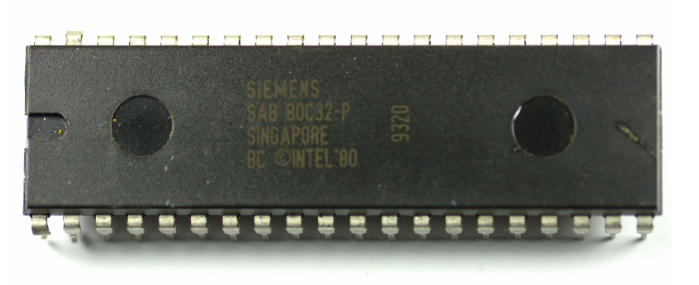
Siemens SAB 80C32-P
Definition
The Siemens SAB 80C32-P is an 8-BIT MICROCONTROLLER compatible with MCS-51 ( 8052-class core), typically in a ROMLESS version: the program memory is not integrated on-chip and is provided by an external memory (EPROM/FLASH) mapped into the code space. The “-P” suffix is commonly associated with the package (often a 40-PIN DIP class, or equivalent depending on the commercial variant).
It is intended for embedded and control systems where parallel ports, timers, and an integrated serial port are needed, with typical clock classes of 12 MHZ, 16 MHZ, and 20 MHZ (depending on version and rating).
Clock: 12, 16, 20 MHZ (what it implies in practice)
Clock frequency directly affects:
Instruction execution time (many classic MCS-51 instructions scale with the clock period).
TIMER/COUNTER resolution and serial baud rates (derived from clock and prescalers).
Timing margins when external memory is used (setup/hold and strobe timing on the external bus).
In practice, moving from 12→16→20 MHZ increases throughput and enables tighter time-bases, but requires more attention to layout and to the access times of external memories.
Memories: ROM only on the 80C52 model, RAM 256 × 8
ROM 8K × 8: this is not a feature of the SAB 80C32-P; it is typical of the 80C52 model (same family, but with on-chip program ROM). Therefore:
SAB 80C32-P → no on-chip ROM (external firmware).
SAB 80C52 → on-chip ROM 8K × 8 (internal firmware).
RAM 256 × 8: the SAB 80C32-P integrates 256 BYTE of internal data RAM. In real use this RAM is used for:
Stack and low-latency “hot” variables.
Small buffers for serial and I/O handling.
Internal data areas and special-function register working typical of the 8052-class devices.
If an application needs more RAM, external RAM is used in the external data space ( XDATA ).
4 × 8-bit ports: 32 I/O lines (practical use)
The 4 ports of 8 bits each (total 32 I/O lines) are a primary adoption driver:
Direct connection to sensors, keys, LEDs, relays (via drivers), latches, and expansion buses.
Possible multiplexing with alternate functions (depending on mode and configuration).
In external-memory configurations, some ports also serve as the address/data bus and control signals (typical MCS-51 extended mode behavior).
Typical peripherals of the 80C32 class (expected functional profile)
While details vary by stepping and vendor, an 80C32 “8052-class” device normally includes:
An integrated serial port (typically a full-duplex UART) for communication and diagnostics.
16-BIT TIMER/COUNTER blocks (at least two, often with a third timer in the 8052-class).
A multi-source interrupt system (timers, serial, external inputs).
An on-chip oscillator/clock interface (crystal or external clock), with reset support.
This profile makes it well suited to deterministic control and I/O-dense interfaces with structured firmware.
Sketch of the most important connections
                 ┌──────────────────────────────┐
                 │         EPROM / FLASH         │
                 │ (external program, up to 64K) │
                 └──────────────┬───────────────┘
                                │ code bus (addr/data + control)
                                ▼
                       ┌──────────────────┐
                       │ SIEMENS SAB 80C32│
                       │ ROMLESS 8-BIT MCU│
                       │ 256 B RAM        │
                       │ 4×8 I/O PORTS    │
                       │ UART + TIMERS    │
                       │ on-chip OSC/CLK  │
                       └───────┬──────────┘
                               │
                               ├────────► I/O → sensors / drivers / latches / LEDs / relays
                               │
                               ├────────► UART → communication / debug
                               │
                               └────────► (opt.) XDATA → external RAM/peripherals
Table 1 – Identification data and specifications (English)
| Characteristic | Typical value |
|---|---|
| Device | Siemens SAB 80C32-P |
| Class | 8-BIT MICROCONTROLLER ( MCS-51 family, 8052-class core) |
| Clock | 12 / 16 / 20 MHZ (version-dependent) |
| On-chip program ROM | Not present ( ROMLESS model) |
| ROM 8K × 8 | Present only on the 80C52 model (not on 80C32) |
| Internal RAM | 256 × 8 (256 BYTE) |
| I/O ports | 4 × 8-BIT (32 lines) |
| Typical package | 40-PIN DIP class / equivalent variants |
Table 2 – Operational and design aspects (English)
| Aspect | Practical meaning |
|---|---|
| External firmware | Updatable via EPROM/FLASH, suitable for development and maintenance |
| 256 B internal RAM | Stack and critical variables; external RAM is often added for large buffers |
| 4 parallel ports | High I/O density for control, interfaces, and programmable glue logic |
| Frequency (12–20 MHZ) | Higher performance and faster timers, but tighter constraints on external memory and layout |
| Integrated peripherals | UART, timers, and interrupts reduce BOM and improve deterministic control |

