



Motorola XSP56001RC27
The Motorola XSP56001RC27 is a general-purpose DSP (digital signal processor) from the 56K family, based on the DSP56001 core, designed for real-time numerical and signal processing (digital filters, repeated MAC operations, FFT, control, audio, and communications). Compared to a contemporary general-purpose CPU, the goal is to maximize efficiency and determinism on data streams and repetitive loops.
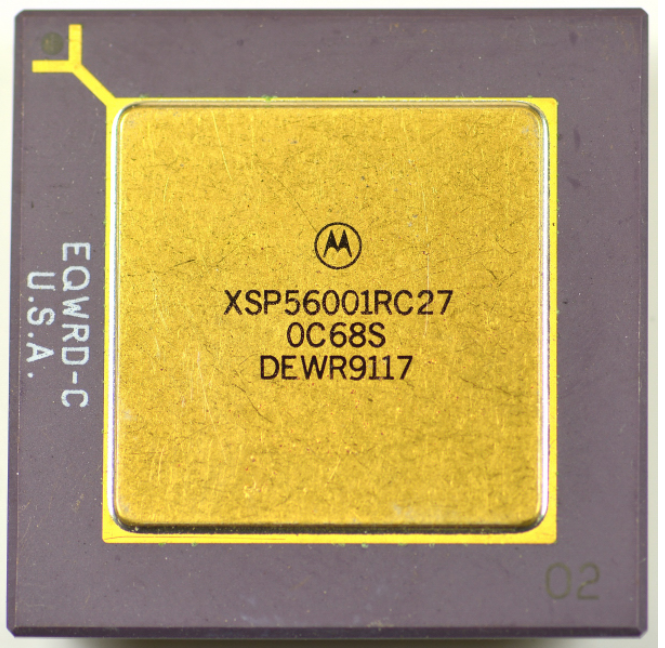
The device suffix highlights two key elements:
56001: membership in the DSP56001 line (24-bit datapath, 56-bit accumulation, Harvard-type architecture).
RC27: RC package and speed grade 27 (maximum nominal frequency typically associated with about 27 MHz; an indicative value tied to manufacturing specification and electrical/thermal conditions).
The XSP prefix (as shown in the marking) often indicates a special variant compared to the “standard” commercial part number (for example pre-production samples, special lots, or internal qualification codes). Practically, it is advisable to treat it as a device with characteristics very similar to the DSP56001 but with potentially different traceability and ordering details compared to more common versions.
Computing architecture: 24-bit and 56-bit accumulation
The DSP56001 operates with 24-bit data paths, well suited to audio and telecom signals, and uses 56-bit accumulators to preserve precision in intermediate sum-of-products results. This reduces quantization error and unwanted saturation in DSP chains such as:
FIR and IIR filters
audio equalization and dynamics
correlations and transforms (FFT)
scaling and normalization in numerical control
The Harvard approach (program space separated from data space) and multiple internal buses sustain high rates on repetitive loops, with a relatively deterministic timing model.
Internal parallelism: data ALU, AGU, and program controller
The core is structured to execute in parallel:
data ALU operations (arithmetic/logic, multiplication, accumulation),
address calculation via the AGU (address generation unit), useful for circular buffers and indexed access,
flow control and prefetch by the program controller.
In practice, code optimization is not only about clock frequency, but also about efficient addressing, correct use of parallel moves, and compact loop structures.
On-chip memories and bootstrap
A distinctive feature of the DSP56001 is the use of internal program RAM (PRAM), typically loaded at boot. The device can start via a small bootstrap mechanism and then:
load code into PRAM from external memory, or
be initialized and controlled by a host through the host interface.
This is typical of “host + DSP” systems, where a general CPU coordinates and the DSP executes signal-processing routines.
Interfaces and system integration
The DSP56001 integrates interfaces that allow it to be used as a complete subsystem:
SCI for service serial communications (UART-like).
SSI for synchronous streams (connection to codecs and digital streams).
Host interface for data/control exchange with an external CPU.
Memory expansion port for external memory and I/O when more space or dedicated logic integration is required.
Clock and speed grade RC27: performance implications
The speed grade 27 indicates a higher frequency target than the RC20 variant. In a real design, the effective frequency is constrained by:
clock and layout quality (noise, jitter, EMC constraints),
thermal budget and dissipation,
timing of interfacing to external memory and host,
stability margins required (industrial, instrumentation, low-noise audio).
Operationally, a higher clock improves the number of operations per unit time, but the final result also depends on the balance between compute and I/O (streaming, external accesses, subsystem latencies).
RC package: ceramic PGA
The RC package is a ceramic PGA (pin grid array), therefore:
through-hole mounting,
high mechanical and thermal robustness,
a larger footprint than plastic SMD packages (e.g., QFP).
It is typical of industrial boards, prototyping, instrumentation, and systems where robustness is a priority.
Markings and codes (practical reading)
From the visible marking on the device:
XSP56001RC27: model identification.
0C68S: lot/line code or internal production identifier (exact meaning depends on Motorola conventions of the period).
DEWR9117: internal traceability code (often includes elements of plant/lot/date; precise decoding requires the manufacturer’s table).
Side markings such as U.S.A.: typically refer to the manufacturing site or supply chain of the package.
These codes are mainly useful for traceability and revision consistency across production lots or repair scenarios.
Table 1 – Identification data and specifications
| Characteristic | Indicative value |
|---|---|
| Model | XSP56001RC27 |
| Family | Motorola 56K (DSP56001) |
| Type | General-purpose DSP |
| Data width | 24 bit (datapath) |
| Accumulators | 56 bit |
| Architecture | Harvard, multiple internal buses |
| On-chip memories | PRAM and on-chip data RAM (typical of the 56001 family) |
| Interfaces | SCI, SSI, host interface |
| Expansion | memory expansion port |
| Speed grade | “27” ≈ 27 MHz (indicative) |
| Package | “RC” = ceramic PGA (through-hole) |
Table 2 – Operational and design aspects
| Aspect | Practical meaning |
|---|---|
| 24 bit + 56 bit | Good compromise between dynamic range, precision, and numerical stability in sum-of-products |
| Harvard + parallelism | High efficiency on MAC loops and streaming, with more deterministic timing |
| Internal PRAM | Boot-loadable firmware, suitable for “host + DSP” systems |
| SCI / SSI | Serial links for control and synchronous streams (codecs, digital streams) |
| Host interface | Low-latency data/control exchange with an external CPU |
| RC (ceramic PGA) | Robustness and through-hole mounting, typical of industrial/instrumentation systems |
| RC27 | Higher performance profile than RC20, constrained by layout, external I/O, and thermals |
| XSP prefix | Possible special or lot variant; ordering and revision verification recommended |

