



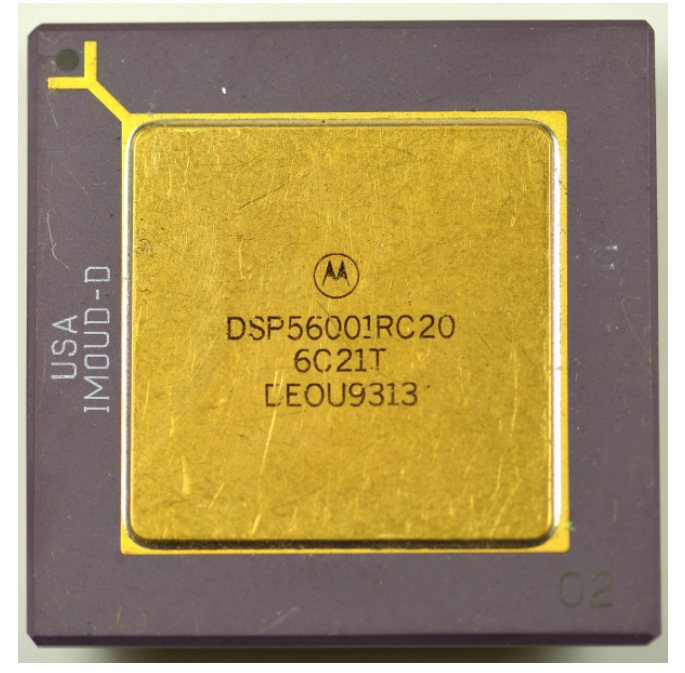
Motorola DSP56001RC20
The DSP56001RC20 is a general-purpose 24-bit DSP (digital signal processor) of the Motorola 56K family, designed to execute with high efficiency typical numerical and signal-processing operations (digital filters, FFT, feedback control, modulators/demodulators, audio and communications).
The RC20 suffix identifies two key aspects of the device in practical terms:
RC: PGA (pin grid array) ceramic package type, for through-hole mounting.
20: nominal speed grade corresponding to a maximum frequency of about 20.5 MHz (indicative).
Computing architecture: 24-bit datapath and 56-bit accumulation
The DSP56001 operates with 24-bit data paths (well suited to audio/telecom signals) and uses 56-bit accumulators to preserve precision in intermediate results (sum-of-products, IIR/FIR filters, scaling), reducing saturation and quantization effects in DSP chains.
The architecture is Harvard-type (logical separation between program space and data space), with multiple internal buses and units operating in parallel. Operationally, this results in:
high throughput on repetitive loops (MAC and data moves),
better determinism than contemporary general-purpose CPUs,
code and energy efficiency for classic DSP algorithms.
Internal parallelism and “low-visibility” pipeline
The core integrates three blocks that can operate in parallel:
data ALU (data arithmetic/logic, multiplications),
address generation unit (address calculation and pointer updates, useful for circular buffers),
program controller (prefetch/flow control).
The pipeline is designed to be relatively transparent to the programmer: optimization mainly relies on correct addressing usage, parallel moves, and dedicated loop structures.
On-chip memories and bootstrap
A distinctive feature of the DSP56001 is the use of internal program RAM (instead of the program ROM typical of the DSP56000), with bootstrap mechanisms to quickly load code at startup. In practice, the DSP can start from a small boot ROM and then:
load program RAM from an external byte-wide memory via the expansion port, or
be initialized by a host through the host interface.
This approach is typical of systems where firmware is loaded/updated, or where an external CPU supervises the DSP.
Integrated peripherals and interfacing
The DSP56001 includes “MCU-style” peripherals that allow it to be used as a relatively autonomous subsystem:
SCI (serial communication interface) for UART-like asynchronous/synchronous communications.
SSI (synchronous serial interface) for synchronous digital streams (serial audio, codec links, point-to-point connections).
Host interface for connection to an external CPU (coordination, data/control exchange).
Memory expansion port to expand external memory and I/O when more space or integration with dedicated logic is required.
Clock, speed grade, and performance implications
The RC20 suffix indicates a device intended to operate up to about 20.5 MHz. In a real design, the effective frequency depends on:
available clock source (oscillator/crystal and layout quality),
EMC/noise constraints (especially in audio),
thermal and power budget,
interfacing timing (host, external memory, serial ports).
RC package: ceramic PGA
The RC package is a PGA (pin grid array), therefore:
through-hole mounting (suited to boards with mechanical constraints or prototypes/instrumentation),
good mechanical and thermal robustness of the ceramic package,
footprint and height typically larger than QFP solutions.
Typical uses
The DSP56001RC20 fits applications such as:
digital audio (effects, equalization, synthesis, real-time processing),
telecommunications (filters, modems, compression/companding and numerical routines),
high-speed control (servo systems, motor control with numerical processing),
numerical processing (FFT, correlations, calculations on 24-bit streams).
Table 1 – Identification data and specifications
| Characteristic | Indicative value |
|---|---|
| Model | DSP56001RC20 |
| Family | Motorola 56K (DSP56000/56001) |
| Type | General-purpose DSP |
| Data width | 24 bit (datapath) |
| Accumulators | 56 bit |
| On-chip program memory | 512 words PRAM (24 bit) |
| On-chip data memory | two 256-word data RAM blocks |
| On-chip ROM | boot ROM + preprogrammed data ROM (tables) |
| Interfaces | SCI, SSI, host interface |
| Expansion | memory expansion port |
| Speed grade | “20” ≈ 20.5 MHz |
| Package | “RC” = ceramic PGA (through-hole) |
Table 2 – Operational and design aspects
| Aspect | Practical meaning |
|---|---|
| 24 bit + 56 bit | Good compromise between dynamic range, precision, and performance for DSP algorithms |
| Harvard + multiple buses | High efficiency for MAC, streaming, and concurrent program/data accesses |
| Internal PRAM | Boot-loadable firmware, system flexibility, and support for host-driven DSP operation |
| SCI / SSI | Serial links for control and streaming (codecs, digital peripherals, diagnostics) |
| Host interface | “Coprocessor” integration with an external CPU, low-latency data exchange |
| RC (ceramic PGA) | Robust mounting, suitable for industrial/instrumentation and through-hole boards |
| 20.5 MHz (RC20) | Performance profile typical for audio/telecom and real-time control in the 56K generation |

