



What is a DSP (Digital Signal Processor) chip
A DSP chip (Digital signal processor) is a special-purpose processor engineered to run signal-processing math fast and with predictable timing, especially on real-time streams of samples (audio, RF, sensors, imaging). Compared with a general-purpose CPU, a DSP is optimized to execute tight numeric loops—such as MAC (multiply–accumulate), digital filters, FFT, correlations, and convolutions—at high rates while keeping latency low and behavior deterministic.
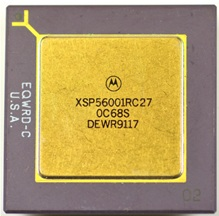
Typical architectural traits (vary by vendor/family):
Dedicated MAC units: accelerate FIR/IIR filters, EQ, echo cancellation, beamforming.
Harvard-style memory/bus organization: separate instruction/data paths to increase internal bandwidth.
Pipelining and parallelism: deep pipelines; often SIMD or VLIW to do more work per cycle.
Circular buffers and specialized addressing modes: efficient handling of sliding windows/ring buffers.
Saturation + fixed-point support: many DSPs target fixed-point with saturation/rounding controls; others are floating-point for easier development and wider dynamic range.
DMA engines: move sample blocks between peripherals and memory without burning core cycles.
Low-latency interrupts and precise timers: critical for audio, motor control, telecom stacks.
What a DSP does in a system:
Ingests samples from an ADC or from digital links (e.g., I²S/TDM audio, SPI sensors, high-speed RF front-ends).
Runs algorithm chains: filtering, compression, feature extraction, demodulation, estimation, cancellation.
Outputs to a DAC, an audio codec, an RF chain, or sends results to a host CPU/MCU.
Common application domains:
Audio: EQ, crossovers, noise reduction, echo cancellation, dynamics (compressor/limiter), wake-word.
Communications: modem baseband, OFDM, demodulation, synchronization, channel estimation.
Industrial/automotive: motor control, power conversion, vibration monitoring, sensor fusion.
Sensors/vision pre-processing: filtering and correlation; often alongside GPU/NPU for heavier vision/ML.
DSP vs CPU/MCU/GPU (quick intuition):
DSP: best for streaming numerical workloads with hard latency and deterministic timing.
CPU: best for OS, control, networking, UI; often less efficient on pure DSP kernels per watt.
MCU: strong on low-power control and I/O; some MCUs include DSP-like instructions, but not always DSP-grade throughput/bandwidth.
GPU/NPU: excellent throughput for massively parallel tasks; may be less ideal for tight real-time interrupt-driven pipelines in some embedded setups.
Practical selection checks:
Numeric format: fixed vs float, precision, dynamic range, saturation behavior.
Real performance: kernel throughput (MAC/FFT) plus memory bandwidth and DMA capability.
Latency/determinism: interrupt response, cache behavior, pipeline predictability.
Interfaces: I²S/TDM, external ADC/DAC, SPI/UART, CAN/Ethernet/USB/PCIe.
Tooling/libraries: optimized FFT/filter libraries, debugging/trace, RT frameworks.
Sketch of the most important connections (typical embedded topology)
                 Clock/oscillator
                       │
Power rails ──► PMIC ──┼──────────────► Reset supervisor
 (core/I/O)            │                      │
                       ▼                      ▼
                    ┌─────────────────────────────┐
JTAG/SWD ◄──────────┤           DSP chip           │◄────────► Host CPU/MCU
Debug/trace          │  Core + MAC/SIMD + IRQ       │   (SPI/UART/PCIe/Ethernet)
                    │  DMA + Timers                │
                    │  Internal RAM/Cache (L1/L2)  │
                    └───────┬───────────┬──────────┘
                            │           │
                     External memory    │
                     (QSPI/DDR/SDRAM)   │
                            │           │
                            ▼           ▼
                      ┌─────────┐   ┌─────────┐
                      │ Flash   │   │  DDR    │
                      └─────────┘   └─────────┘

          Audio / signal I/O path (example)
Mic/line ─► ADC/Codec ─► I²S/TDM ─► DSP ─► I²S/TDM ─► DAC/Codec ─► Amp/Speaker

          Sensor / comms (examples)
Sensors ─► SPI/I²C ───────────────► DSP
Network ─► Ethernet/CAN/USB ───────► DSP (or via host)
Pin-level sketch
                         ┌──────────────────────────────────────────┐
                         │                DSP chip                  │
                         │                                          │
Power rails (core)        │  VDD_CORE ──┐                           │
                          │             ├─► Decoupling (caps at pins)
                          │  GND     ───┘                           │
                         │                                          │
Power rails (I/O)         │  VDD_IO  ──┐                            │
                          │            ├─► Decoupling + ferrite (opt)
                          │  GND    ───┘                            │
                         │                                          │
Clock & reset             │  XTAL_IN ◄── Crystal/oscillator ──► XTAL_OUT
                          │  CLK_IN  ◄── External clock (opt.)
                          │  RESET_N ◄── Reset supervisor / PMIC
                          │  BOOT[ ] ◄── Strap resistors (boot mode)
                         │                                          │
Debug                     │  JTAG_TCK/TMS/TDI/TDO ───► JTAG header
                          │  TRST_N (opt.)                           │
                         │                                          │
External memory (QSPI)    │  QSPI_CS_N ───► Flash CS
Firmware/boot             │  QSPI_CLK  ───► Flash CLK
                          │  QSPI_IO0..3 ◄► Flash IO0..3
                         │                                          │
External memory (DDR)     │  DDR_CK±    ───► DDR differential clock
Buffers / large blocks    │  DDR_A[ ]   ───► DDR address
                          │  DDR_DQ[ ]  ◄► DDR data
                          │  DDR_DQS±   ◄► DDR strobe
                          │  DDR_CS/WE/RAS/CAS/CKE/ODT ─► DDR control
                         │                                          │
Digital audio             │  I2S_BCLK  ◄──► Codec BCLK
(typical chain)           │  I2S_LRCLK ◄──► Codec LRCLK/FS
                          │  I2S_DIN   ◄──  Codec DOUT (to DSP)
                          │  I2S_DOUT  ───► Codec DIN (from DSP)
                          │  MCLK (opt.)◄──► Master clock
                         │                                          │
Analog audio (if on-chip) │  ADC_INx   ◄── Mic/line (antialias + bias)
(optional)                │  DAC_OUTx  ───► Amp (reconstruction filter)
                         │                                          │
Sensors                   │  I2C_SCL/SDA ───► Sensors (pull-ups)
                          │  SPI_SCK/MOSI/MISO/CS ─► Sensor/AFE
                         │                                          │
Host / network             │ UART_TX/RX ───► Host / BT module
(if available)            │ CAN_H/L (via transceiver) ─► CAN bus
                          │ ETH_TX/RX (via PHY) ─────► Ethernet
                         │                                          │
GPIO                      │ GPIOx ──► LEDs / amp enable / mute / ext IRQ
                         └──────────────────────────────────────────┘


Practical “critical nets”
- Decoupling: many small caps (e.g., 100 nF) at each VDD + some bulk caps.
- Clock domain: short traces, continuous ground return, avoid crossing split planes.
- Reset/boot straps: well-defined pull-ups/downs, stable before reset release.
- DDR: controlled impedance routing, length matching, minimize via stubs.
- I²S/TDM: confirm master/slave (who drives BCLK/LRCLK) and codec MCLK needs.
- ADC/DAC analog: separate analog/digital, filtering, clean references.

