



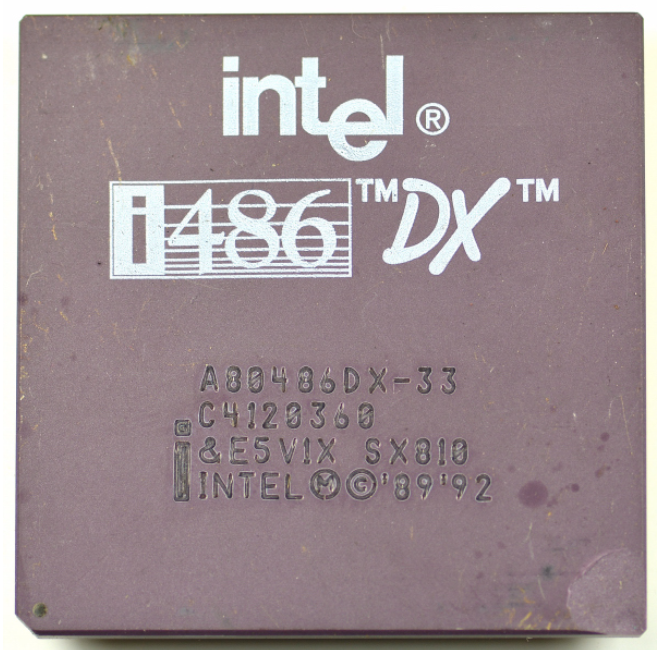
Intel 486 DX 33
The Intel 486 DX is an x86-family microprocessor introduced by Intel after the 386, in multiple frequency and stepping variants. The DX designation identifies the version with an integrated FPU (floating point unit), meaning floating-point hardware is inside the CPU and does not require an external coprocessor.
In the stated context, the 486 is a platform designed to preserve strong software continuity with the PC and workstation ecosystem of its era, while delivering a more efficient microarchitecture than the 386 (pipeline and “RISC-like” internal techniques), yet remaining compatible with the x86 ISA.
Software compatibility and execution environments
The 486 family is associated with software compatibility across widely used environments and operating systems, including:
MS-DOS, OS/2, Windows, UNIX, V36, iRMX, the iRMK kernel, and the Intel ecosystem.
Practically, this means the CPU is designed to run existing x86 software, improving performance and hardware integration without breaking the installed base.
8-bit code and byte-oriented operations
The “8-bit code” item is best read operationally as natural support for byte (8-bit) operations in memory and for instructions/data that work on byte/word/dword quantities typical of the x86 architecture.
Practically, the CPU handles code and data streams with byte granularity while maintaining consistency with the memory model and software compatibility.
Integrated FPU (DX): practical impact
The integrated FPU in the DX version enables floating-point computations directly in hardware:
It reduces the need for software emulation of floating point.
It improves performance for technical applications, CAD, graphics, and scientific computing compared to variants without an FPU or platforms requiring external coprocessors.
IEEE 1149.1 (JTAG) and version constraint
In the stated context, compatibility with IEEE 1149.1 (boundary-scan test interface) is indicated as present only in the 50 MHZ variant.
Operationally, this detail affects production test, diagnostics, and hardware validation—especially on complex boards where boundary scan can reduce test time and cost.
Upgradability: Intel OverDrive
The 486 is described as upgradable via Intel OverDrive, i.e., a processor/module upgrade intended to raise performance without replacing the entire platform.
Practically, OverDrive is a “drop-in” path to extend the life of existing motherboards and systems, within the constraints of socket, VRM, BIOS, and chipset support.
“RISC-like” microarchitecture and x86 compatibility
The “designed for RISC” note can be interpreted at the microarchitectural level: the 486 adopts more efficient internal techniques (pipeline, internal parallelism, optimizations) that echo RISC concepts, while still implementing the historically CISC x86 ISA.
Practically, binary compatibility remains the primary goal, while internal implementation aims to increase throughput and reduce average cycles per instruction.
Frequencies and bus bandwidth: indicative performance profile
Stated clocks: 25 MHz, 33 MHz, 50 MHz, 75 MHz, 100 MHz
Stated bus bandwidth: 80 / 106 / 160 Mbyte/s.
Practically, real performance depends on the memory subsystem (DRAM, external cache, wait states), chipset, and board design; “theoretical” and “real” bandwidth can differ substantially.
Process technology: CHMOS IV and CHMOS V
The 486 family is described as being built in CHMOS IV and CHMOS V process technologies—high-performance CMOS process generations for the era.
Practically, process stepping impacts power, heat dissipation, reliability, and clock margins, as well as compatibility with supply and packaging requirements.
Dynamic bus sizing: 8/16/32-bit support
Dynamic bus sizing allows the processor to interface efficiently with memories and devices of different widths: 8-bit, 16-bit, and 32-bit.
Practical implication: a platform can combine legacy narrow peripherals with wider memory and subsystems without forcing everything to the same width, provided decoding, wait states, and transceivers are designed correctly.
Sketch of the most important connections
                 system bus + memory/I-O controller
        ┌──────────────────────────────────────────────────────────┐
        │             chipset / system controller                   │
        │   RAM, ROM/BIOS, I/O, DMA/interrupt, timing, wait states  │
        └───────────────────────────────┬──────────────────────────┘
                                        │
                                        ▼
                           ┌─────────────────────────────┐
                           │          Intel 486 DX        │
                           │   integrated FPU, x86 compat │
                           │   dynamic bus sizing 8/16/32 │
                           │   25/33/50/75/100 MHZ clocks        │
                           └─────────────┬───────────────┘
                                         │
                                         ├────────► memory (performance tied to cache/DRAM)
                                         └────────► I/O (8/16/32-bit peripherals)
                      (possible upgrade: Intel OverDrive, if supported)
Table 1 – Identification data and specifications
| Characteristic | Indicative value |
|---|---|
| Device | Intel 486 DX 33 MHz |
| Positioning | After the 386; multiple commercial versions |
| Class | x86 CPU (fourth generation) |
| FPU | Integrated (DX) |
| Software compatibility | MS-DOS, OS/2, Windows, UNIX, V36, iRMX, iRMK kernel (stated context) |
| Frequencies | 25 MHZ, 33 MHZ, 50 MHZ |
| Bus throughput | 80 / 106 / 160 Mbyte/s (stated values) |
| Technology | CHMOS IV, CHMOS V |
| Boundary-scan test | IEEE 1149.1 only on the 50 MHZ version (stated context) |
| Upgrade | Intel OverDrive support (if platform-compatible) |
| Dynamic bus sizing | 8 / 16 / 32-bit |
Table 2 – Operational and design considerations
| Aspect | Practical meaning |
|---|---|
| Integrated FPU (DX) | Hardware floating point, useful for technical and scientific applications |
| x86 software continuity | Simplified adoption on existing platforms, strong binary compatibility |
| Internal “RISC-like” design | Microarchitectural optimizations to increase throughput while remaining x86 |
| 25/33/50 MHZ clocks | Performance scaling, but real results depend on memory and chipset |
| Stated bus bandwidth | Values affected by wait states and board design, not only by clock |
| Dynamic bus sizing | More flexible integration with 8/16/32-bit memories and peripherals |
| IEEE 1149.1 (50 MHZ) | Advantages in manufacturing test and diagnostics on complex hardware |
| OverDrive | “Drop-in” upgrade path if socket/BIOS/chipset support it |

