



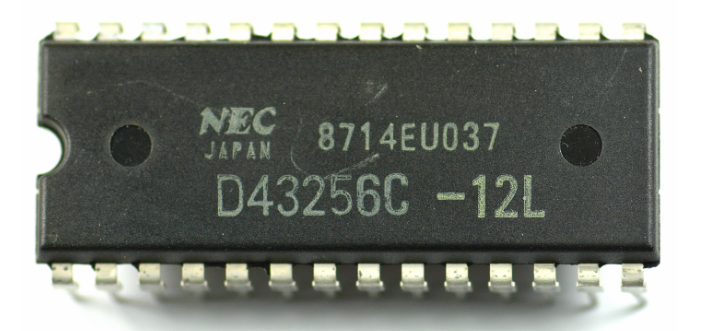
NEC D43256C – High-speed, low-power 32K × 8 (262,144-bit) CMOS static RAM
Definition
The NEC D43256C is a CMOS static SRAM featuring high speed and low power, organized as 32,768 words × 8 bits (total 262,144 bits). It is a typical component in microprocessor/microcontroller systems where a simple external parallel-bus RAM is needed for buffers, extended stack, data frames, tables, and general-purpose work areas with low access latency.
The family includes variants with battery backup (versions L, LL, A, B) and multiple speed grades (nominal access time on the order of 70–150 ns, depending on the suffix). It has been offered in 28-pin plastic DIP, 28-pin plastic SOP, and 28-pin plastic TSOP (I) packages, making it suitable for both through-hole designs and SMD assemblies.
32K × 8 organization: what it means in practice
The 32K × 8 organization implies:
15 address lines (A0–A14) to select one of 32,768 locations.
8 data lines (I/O1–I/O8 or DQ0–DQ7 depending on naming) to read/write one byte per access.
This is a classic size for 8/16-bit CPU systems with external RAM, for legacy embedded designs, or for retrofit/spare parts on older boards.
Bus interface: A0–A14, I/O0–I/O7 and three control signals
The SRAM is controlled through three active-low signals, typical of most 62256-compatible devices:
/CS (chip select): enables the device; when high, the chip is deselected and outputs go high-impedance.
/OE (output enable): enables outputs during read; it simplifies shared-bus interfacing and reduces contention.
/WE (write enable): when active, it writes the byte present on the data bus into the addressed location.
This supports direct connection to logic with a bidirectional data bus and tri-state bus management.
Tri-state and bus sharing: why it matters
The data lines go high-impedance when:
the chip is not selected (/CS = 1), or
during read, outputs are not enabled (/OE = 1).
In practice, you can place multiple memories/peripherals on the same data bus, delegating selection to address decoding (or to a dedicated /CS).
Low power and standby mode: reducing real consumption
A key feature of this SRAM class is that when deselected (/CS high) it enters standby with very low current (varying by version). The LL variant is typically the most aggressive in standby current reduction.
In real designs this translates to:
lower thermal dissipation,
longer battery life,
the ability to keep RAM “alive” without continuously powering the main supply.
Battery backup and data retention: how contents are preserved
Battery-backup-capable versions can preserve data by lowering VCC down to the data retention threshold (typically ≥ 2.0 V), provided the chip remains deselected (/CS high, or /CS ≥ VCC − 0.2 V per spec) and other pins are not forced into invalid levels (they can remain high-impedance).
Practical points:
you need a supply OR-ing network (diode OR or ideal diode / power mux) between the main supply and the battery;
when returning from data retention to normal operation, a recovery time on the order of milliseconds is expected (indicatively ~5 ms).
Supply voltage range: L/LL vs A/B versions
The family has been distributed with different voltage profiles:
L / LL: typically intended for “classic” VCC 4.5–5.5 V.
A: operation 3.0–5.5 V.
B: operation 2.7–5.5 V (better suited to nominal 3 V logic).
This directly affects compatibility with 5 V, 3.3 V, and mixed-supply systems.
Packages: DIP, SOP, TSOP (I)
DIP-28 (plastic): prototyping, sockets, repairs on legacy boards.
SOP-28 (plastic): “traditional” SMD, wider pitch than TSOP, easier rework.
TSOP (I)-28: reduced footprint, higher density; requires more care in PCB layout and soldering.
Sketch of the most important connections
             address bus A0..A14
        ┌─────────────────────────────────┐
        │  CPU / MCU / bus controller      │
        │                                 │
        │  A0..A14  ────────────────┐     │
        │  D0..D7   ◄──────────────►│─────┼──────── data bus
        │  /RD,/WR  ──► logic → /OE │     │
        │  /WR      ─────────► /WE │     │
        │  decode   ─────────► /CS │     │
        └──────────────────────┬───┘     │
                               │         │
                               ▼         │
                      ┌───────────────────┴──────────────┐
                      │           NEC D43256C             │
                      │   CMOS static SRAM 32K × 8        │
                      │   (262,144-bit)                   │
                      │   A0..A14   I/O0..I/O7  /CS /OE /WE│
                      └───────────────┬───────────────────┘
                                      │
                    power supply      │
               ┌──────────────────────┴─────────────────────┐
               │   Supply OR-ing (main + battery)             │
               │   VMAIN ─►|──┐                               │
               │            ├──► VCC (SRAM)  → data retention  │
               │   VBATT ─►|──┘                               │
               └──────────────────────────────────────────────┘
Table 1 – Identification data and specifications (English)
| Characteristic | Indicative value |
|---|---|
| Device | NEC D43256C |
| Class | Static SRAM with parallel bus |
| Technology | CMOS |
| Organization | 32,768 × 8 bits |
| Total capacity | 262,144 bits (≈ 32 KiB) |
| Address lines | A0–A14 (15 lines) |
| Data lines | I/O0–I/O7 (8-bit bidirectional, tri-state) |
| Control signals | /CS, /OE, /WE (active-low) |
| Speed (access time) | Typical grades ~70–150 ns (suffix-dependent) |
| Supply (by version) | L/LL: ~4.5–5.5 V; A: 3.0–5.5 V; B: 2.7–5.5 V |
| Data retention (battery backup) | VCCDR typical ≥ 2.0 V; recovery typical ~5 ms |
| Packaging | DIP-28, SOP-28, TSOP (I)-28 |
Table 2 – Operational and design considerations (English)
| Aspect | Practical meaning |
|---|---|
| /CS high → standby | Reduces consumption and sets outputs to high-impedance; useful for shared buses |
| Dedicated /OE | Cleaner reads on shared buses; simplifies interfacing with /RD signals |
| /WE controls write | Write occurs only during overlap of /CS low and /WE low |
| Tri-state on I/O | Enables multiple devices on the same data bus without contention (if decoding is correct) |
| Data retention | Preserves data with reduced VCC, if the chip remains deselected and pins are not forced |
| OR-ing with battery | Requires reliable supply switching/OR-ing (diode OR or power mux) |
| A/B variants | Support lower-voltage designs without strict “pure 5 V” regulation |
| Package choice | DIP for prototypes/retrofit; SOP/TSOP for density and SMD production |

