



Intel Pentium Pro – P6 x86 microprocessor for servers and workstations
Definition
The Pentium Pro is a 32-bit x86 microprocessor based on the P6 architecture, designed primarily for servers and workstations. Compared to earlier Pentium processors, it targets high performance on 32-bit software (operating systems and professional applications), introducing a more advanced microarchitecture with superscalar, out-of-order, and speculative execution.
From an integration standpoint, it is known for using a multi-chip module (MCM) package: in addition to the CPU die, it integrates one or more L2 cache dies within the same module, with L2 typically running at full core speed, a decisive factor in real-world performance on server workloads.
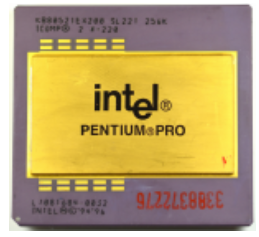
P6 architecture: why it was different
The P6 approach is built to maximize IPC (instructions per cycle), with several key concepts:
Decoding and translating x86 instructions into internal micro-operations (a more efficient approach for scheduling).
Out-of-order execution: instructions can be internally reordered to reduce stalls caused by memory latency or dependencies.
Speculative execution with branch prediction: the pipeline runs ahead along the “likely” path, improving continuity.
The practical result is a strong advantage on 32-bit workloads with many dependencies and memory accesses, typical of databases, services, and technical computing.
Cache: split L1 and L2 inside the module
The cache subsystem is one of the distinguishing traits:
L1 cache: split between instructions and data, relatively small but very fast.
L2 cache: integrated in the MCM, available in typical sizes 256 KB, 512 KB, and 1 MB; in classic configurations it runs at core frequency (a clear advantage over L2 running on a slower external bus).
In system design, this means the platform can achieve high performance even with a relatively low FSB, because L2 latency is significantly reduced.
System bus and operating frequencies
The most common versions fall, indicatively, within this range:
Typical core frequencies: 150–200 MHZ (depending on stepping and L2 configuration).
Front-side bus: 60 MHZ or 66 MHZ.
The FSB is not high by modern standards, but the MCM with full-speed L2 compensates significantly in the target applications.
Multiprocessing and APIC: a “server” focus
The Pentium Pro was designed with multiprocessing in mind:
Support for SMP configurations (multiple-CPU systems) with platform-oriented features.
Presence of a local APIC and support for APIC-based interrupt handling to coordinate efficiently in multiprocessor systems.
Practically, this is one reason it was valued in servers of its era: scalability and more structured interrupt management than many desktop-oriented solutions.
Package and socket: Socket 8 and MCM
From a physical and thermal standpoint:
Typical socket: Socket 8 (387 pins).
Packaging: often a ceramic MCM (commonly up to 512 KB L2) and plastic MCM variants for larger L2 configurations (typically 1 MB), with internal construction differences (number of cache dies, layout, thermal behavior).
This format imposes practical constraints on cooling and mechanics (proper heatsink, retention, airflow), more “server-grade” than consumer desktop solutions of the same period.
Sketch of the most important connections
                 FSB (address/data/control) + interrupt/APIC
        ┌──────────────────────────────────────────────────────────┐
        │                 Chipset / memory controller               │
        │                                                          │
        │  FSB 60/66 MHZ ────────────────┬─────────────────────┐   │
        │  RAM (EDO/FPM) ◄──────────────►│                     │   │
        │  I/O bridge / PCI ◄───────────►│                     │   │
        └───────────────────────────────┬┴─────────────────────┘   │
                                        │
                                        ▼
                           ┌─────────────────────────────┐
                           │        Pentium Pro          │
                           │  P6 core + L2 in MCM         │
                           │  Socket 8 (387 pins)         │
                           └─────────────┬───────────────┘
                                         │
                                         ├────────► L2 cache inside the module (256K/512K/1MB)
                                         └────────► local APIC / SMP signals (platform)
Table 1 – Identification data and specifications
| Characteristic | Indicative value |
|---|---|
| Device | Intel Pentium Pro |
| Class | 32-bit x86 microprocessor (i686 family) |
| Microarchitecture | P6 |
| Introduction period | 1995 (first commercial availability) |
| Typical core frequencies | 150–200 MHZ (depending on version) |
| Front-side bus | 60/66 MHZ |
| L1 cache | 8 KB instruction + 8 KB data |
| L2 cache | 256 KB / 512 KB / 1 MB, in-module (typically full speed) |
| Socket | Socket 8 (387 pins) |
| Packaging | MCM (CPU die + cache dies in the same module) |
| Process technology | BiCMOS with typical variants 0.50 µm and 0.35 µm (version/stepping-dependent) |
| Target market | Servers and workstations |
Table 2 – Operational and design considerations
| Aspect | Practical meaning |
|---|---|
| Out-of-order execution | Improves efficiency on workloads with memory latency and complex dependencies |
| Speculative execution | Reduces branch penalties, useful on server-like workloads |
| In-module L2 (MCM) | High performance thanks to reduced latency and typically full-speed cache |
| 60/66 MHZ FSB | Requires a compatible chipset; the platform leans on cache more than bus speed |
| SMP orientation | Designed for multiprocessor systems, with more advanced interrupt handling |
| Thermal/mechanical constraints | MCM and Socket 8 require more robust cooling and mechanics than contemporary desktop CPUs |
| 32-bit optimization | Best results with 32-bit OS and applications; less attractive in 16-bit-dominated environments |

