



NEC D7810G
(8-bit NMOS microcontroller with built-in A/D converter)
The NEC D7810G is an 8-bit microcontroller implemented in NMOS technology, belonging to the µPD7810/µPD7811 family, designed to integrate on a single chip not only the CPU but also typical control-oriented peripherals (timers, serial interface, analog inputs). In particular, this family includes a built-in A/D converter and an internal RAM block, with the option to expand to external memory via an external bus.
In many real-world applications, the D7810G is used as the central controller of electromechanical systems (printers, office equipment, dedicated control logic), where integration of peripherals and I/O management matters more than raw computing performance.
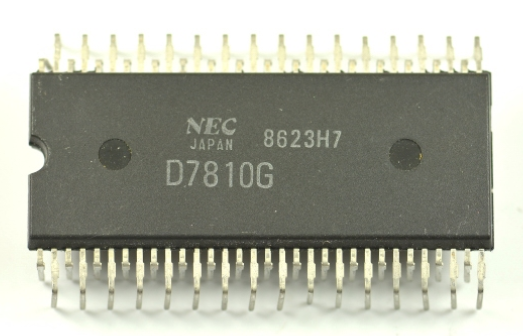
Architecture and integrated resources
At a functional level, the µPD7810/11 family integrates:
8-bit CPU with an enhanced internal datapath (an internal 16-bit ALU for certain operations and wider internal data paths than simpler 8-bit microcontrollers).
256 bytes of internal RAM (consistent with your specification).
Built-in A/D converter, useful to acquire analog signals (sensors, feedback voltages, references).
Timers and event-counting logic, typical of control systems.
Serial interface (USART) for synchronous or asynchronous links.
Wide availability of I/O lines (configurable depending on the expansion mode).
Standby and clock-management functions to reduce power during idle cycles.
Built-in A/D converter: practical meaning
Having the A/D on-chip makes it possible to:
reduce external components (fewer dedicated ICs, less analog routing on the PCB),
implement closed-loop control (for example regulation or self-diagnostics based on analog levels),
read low-cost sensors (temperature, light, potentiometers, threshold measurements).
Operationally, the A/D is intended for slow or medium-dynamics signals (service acquisitions, calibration, periodic measurements), rather than audio or high-speed sampling.
Clock: 12 MHz nominal and “design frequencies” in products
The family supports operation up to 12 MHz, a value often quoted as a nameplate reference. In a finished product, however, the frequency may be set to specific values depending on:
availability of “standard” crystals,
timing needs (serial baud rates, keyboard scanning, mechanical timing),
compatibility with external clock chains and logic.
Concrete example: in the Commodore MPS-1230, a clock of about 11.06 MHz is documented, close to the rated limit but chosen for practical system constraints.
“Z81 compatibility”: how to interpret it correctly
The wording “Z81 compatible” is plausibly a collector-style simplification or a “class reference” (8-bit controllers contemporary to Z80/Z8-type solutions). From a technical standpoint, for the µPD7810/11 the documentation highlights mainly:
8085A bus compatibility (useful to interface with external logic and memory following well-known schemes),
memory expansion modes over an external bus.
In other words: it is more accurate to talk about bus/expansion-level compatibility, not direct binary compatibility with a Z80/Z81 instruction set.
Memory: 256 bytes RAM and (possible) external ROM
A key point is the family distinction:
some µPD7811 variants include on-chip ROM,
the µPD7810 is described as a ROM-less version (intended to use external ROM/EPROM).
In typical implementations (e.g., printers), this translates into an architecture with:
microcontroller (D7810G) + external EPROM for firmware,
optional external SRAM for buffers or tables.
Presence in products: printers and calculators
Printers: in the technical documentation for the Commodore MPS-1230, the D7810G is indicated as the main microcontroller, with firmware in EPROM and a clock around 11.06 MHz.
Olivetti calculators: the presence of microcontrollers from the D7810/µPD7810 family is reported in various office and calculating devices; for the statement “numerous calculators” public traceability varies widely by model and service manual availability, but the use is consistent with the component’s profile (I/O, keyboard scanning, display/print handling, service-level analog acquisition).
Simplified functional diagram
           Clock (up to ~12 MHz) + standby management
┌─────────────────────────────────────────────────────────┐
│                    NEC D7810G (µPD7810/11)              │
│                                                         │
│  8-bit CPU  ── internal bus ── internal RAM (256 bytes)  │
│                                                         │
│  Timers / counters ──► event and timing control          │
│  USART ──────────────► synchronous/asynchronous serial   │
│  On-chip A/D ────────► analog inputs + Vref              │
│  I/O ports ──────────► digital lines / external bus      │
└───────────────┬─────────────────────────────────────────┘
                │ (expansion mode)
                ▼
      External memory / peripherals (ROM, RAM, latch, I/O)
Table 1 – Identification data and specifications
| Characteristic | Indicative value |
|---|---|
| Model | NEC D7810G |
| Family | µPD7810/µPD7811 |
| Architecture | 8-bit microcontroller |
| Technology | NMOS |
| Clock | Up to 12 MHz (typical) |
| Internal RAM | 256 bytes |
| A/D converter | Integrated (multi-channel) |
| Serial interface | Integrated USART |
| Timers | Integrated timers and event counters |
| Memory expansion | Supported (external bus) |
Table 2 – Operational and application aspects
| Aspect | Practical meaning |
|---|---|
| On-chip A/D | Sensor and service-level analog acquisition without external ICs |
| 12 MHz | Good compromise for light real-time control and I/O/timing handling |
| 256-byte RAM | Adequate for control/state; often paired with external RAM in complex systems |
| ROM-less (typical scenario) | Firmware in external EPROM, a common solution in printers and office equipment |
| Bus compatibility | “Microprocessor-like” approach for memory and peripheral expansion |
| Printer use | Motors, sensors, host protocols, and timing logic management |

