



Math coprocessor
Definition
A math coprocessor (an FPU, floating-point unit) is a specialized processor that works alongside the CPU to execute floating-point arithmetic and advanced math functions—often faster and with more convenient numeric behavior than pure software routines. In the classic Intel 8087 design, the coprocessor pairs with 8086/8088 CPUs: the CPU runs the program’s control flow, while the 8087 performs heavy numeric operations.
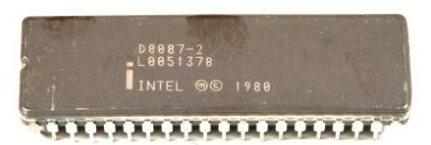
Why it existed
Early 8086/8088 systems could handle integer math reasonably, but software floating-point was slow and instruction-heavy. Adding an 8087 significantly improved performance for workloads such as CAD, scientific computing, engineering graphics, simulation, and other numeric-intensive code.
How the 8087 cooperates with 8086/8088
The 8087 does not replace the CPU; it co-executes selected instructions:
The CPU fetches/decodes instructions and issues escape (ESC) opcodes that represent FPU operations.
The 8087 monitors the bus, recognizes those opcodes, and executes the operation internally.
When memory operands are needed, the 8087 coordinates bus access to read/write data.
The CPU may continue executing, but must synchronize when it needs results immediately.
This is an early, explicit form of hardware acceleration and limited parallel execution.
Connection and data-flow sketch
                 ┌───────────────┐
Program/control  │     8086/8088  │
 flow ─────────► │  CPU (control) │
                 └──────┬────────┘
                        │ System bus + ESC opcodes observed
                        ▼
                 ┌───────────────┐
Floating-point   │      8087     │
 math execution  │ coprocessor   │
                 └──────┬────────┘
                        │
                        ▼
                 Memory / results
Architecture and programming model
The 8087 uses a register stack model (commonly described as 8 levels, ST(0)…ST(7)). Many instructions implicitly operate on the top of stack (ST(0)), combining it with another stack element or a memory operand.
Common traits in an 8087-style FPU model:
Register stack: implicit push/pop behavior in many instructions.
Extended internal precision: intermediate calculations may use higher precision than stored formats.
Numeric control: rounding modes, overflow/underflow behavior, and exception masking via FPU control/status.
What it accelerates
A math coprocessor like the 8087 primarily speeds up:
Floating-point add/subtract/multiply/divide.
Integer↔floating conversions.
Square root and related ops.
Selected transcendental functions (depending on the instruction set support).
Real-world gains depend on how much floating-point work the application performs and how often the CPU must wait for FPU results.
Synchronization and bottlenecks
Typical constraints of a discrete coprocessor design include:
Result dependencies: CPU must wait when it immediately needs the FPU result.
Memory transfers: shared bus access introduces latency.
Floating-point exceptions: special numeric conditions may require careful control/status handling.
Table 1 – Key characteristics
| Characteristic | Description |
|---|---|
| Role | Accelerator for floating-point math and advanced functions |
| Integration | External coprocessor paired with 8086/8088 CPUs |
| Register model | FPU stack model; many ops center on ST(0) |
| Data handling | Floating formats, often with extended internal precision |
| Typical benefit | Much faster and more consistent than software emulation |
| Typical limits | CPU/FPU synchronization and bus latency |
Table 2 – System and programming concepts
| Concept | Practical impact |
|---|---|
| FPU ESC opcodes | CPU emits opcodes the FPU observes and executes |
| Waiting/sync | Needed when results are required immediately |
| Floating-point exceptions | Managed through FPU control/status and masking |
| Net speedup | Increases with floating-point intensity of the workload |

