



The 5-speed manual transmission: pros, cons, problems
The 5-speed manual transmission is a drivetrain in which the driver directly selects gears via a gear lever and clutch, with five forward gears plus reverse. It is a very common layout in small and compact cars because it combines simplicity, low cost, and good mechanical efficiency.
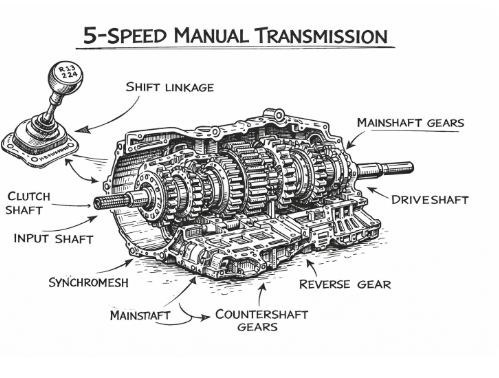
From a design standpoint, the gearbox consists of shafts (input and output), constant-mesh gears, and an engagement mechanism that, through synchronizers, connects the selected gear to the shaft while reducing harshness and noise. The clutch (typically a single dry plate) disconnects the engine from the gearbox during the shift, allowing rotational speeds to be matched.
Having five ratios implies spacing that must balance acceleration and fuel economy: the lower gears are shorter to support launch and response, while fifth gear is often taller (sometimes an “overdrive”-type) to reduce engine speed during cruising. Compared with a 6-speed, a 5-speed usually has wider ratio steps, which can slightly reduce acceleration continuity and rpm optimization.
Gear ratio selection is defined by the manufacturer based on engine torque characteristics, vehicle mass, and fuel/emissions targets. On less flexible engines, a 5-speed may require more frequent shifts on grades or under load; on torquier engines, the lower gear count can be less of a drawback.
In use, a manual transmission offers direct control: the driver can upshift earlier or later, exploit engine braking, and choose the most suitable gear for conditions such as snow, descents, or spirited driving. This control, however, requires competence and can increase fatigue in traffic, especially with a heavy clutch.
From a maintenance standpoint, key items are the clutch (wear of the disc, pressure plate, and release bearing), gearbox oil, and the condition of linkages/cables. Symptoms such as slip under acceleration, difficult engagement, or abnormal noise can indicate wear or the need for adjustment/repair.
Reliability of a 5-speed manual is generally good due to lower complexity than automatics or more sophisticated manuals, but it depends strongly on usage: clutch-heavy launches, frequent towing, and aggressive shifting increase thermal and mechanical loads on the clutch and synchronizers.
In terms of efficiency, a manual gearbox tends to have relatively low internal losses and good drivetrain efficiency; however, real-world fuel consumption depends on driving style and gearing. A too-short fifth gear can raise highway consumption, while a very tall fifth gear may require more downshifts on hills or during overtakes.
In summary, the 5-speed manual transmission is a robust and rational solution: it offers good efficiency, low cost, and direct control, with the trade-off of less finely spaced ratios than higher-gear-count transmissions and greater driver involvement, especially in urban use.

